

A single early position in Artificial Inu (AI) has delivered one of the standout gains on Robinhood Chain this cycle.
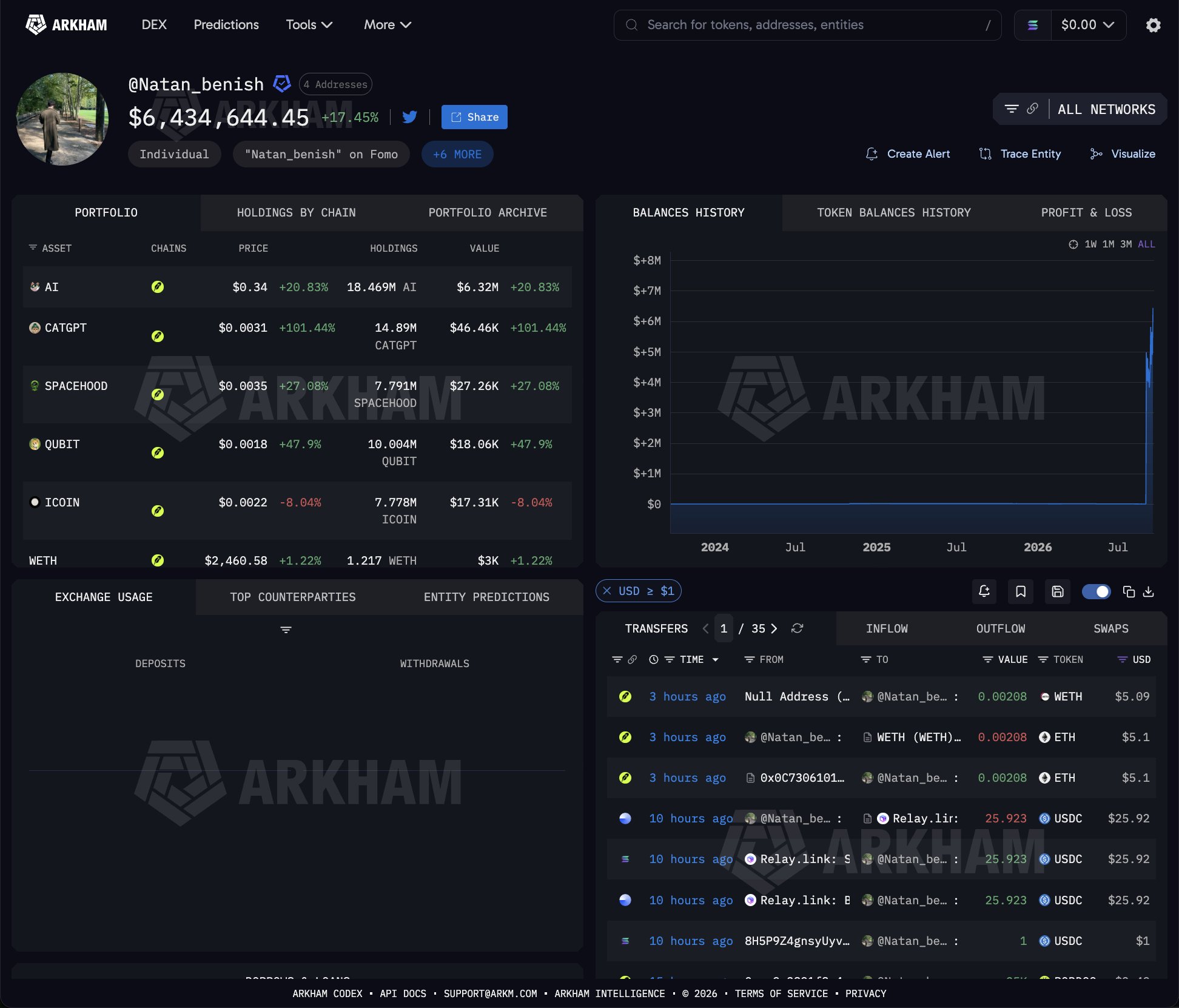
On-chain data tracked by Arkham shows that trader @Natan_benish spent just $3.8K on the token roughly two months ago, when its market capitalisation sat near $219.8K. He has never sold those tokens.
As of this writing, that original stake alone is valued at approximately $2.92 million, a roughly 758-fold return.
Beyond the initial purchase, his total Artificial Inu (AI) holdings now stand at $6.38 million.
The story stands out because it combines classic early-entry timing with the unusual design of Artificial Inu (AI) itself.
Unlike typical memecoins that pair against ETH or a stablecoin, this token trades primarily against tokenised NVIDIA stock on Robinhood Chain.
That pairing, plus a built-in fee routing system, has helped fuel both the narrative and the price action that rewarded patient holders.
How the Trade Unfolded
@Natan_benish entered when Artificial Inu (AI) was still a tiny market. He bought at a stage when the token’s fully diluted value hovered just above $200K.
In the weeks that followed, he added more through transfers, including a sizeable 6 million token block that arrived from another wallet linked to @heyhawx.
Roughly 54% of his current stack arrived via such transfers rather than open-market buys. He has kept every token.
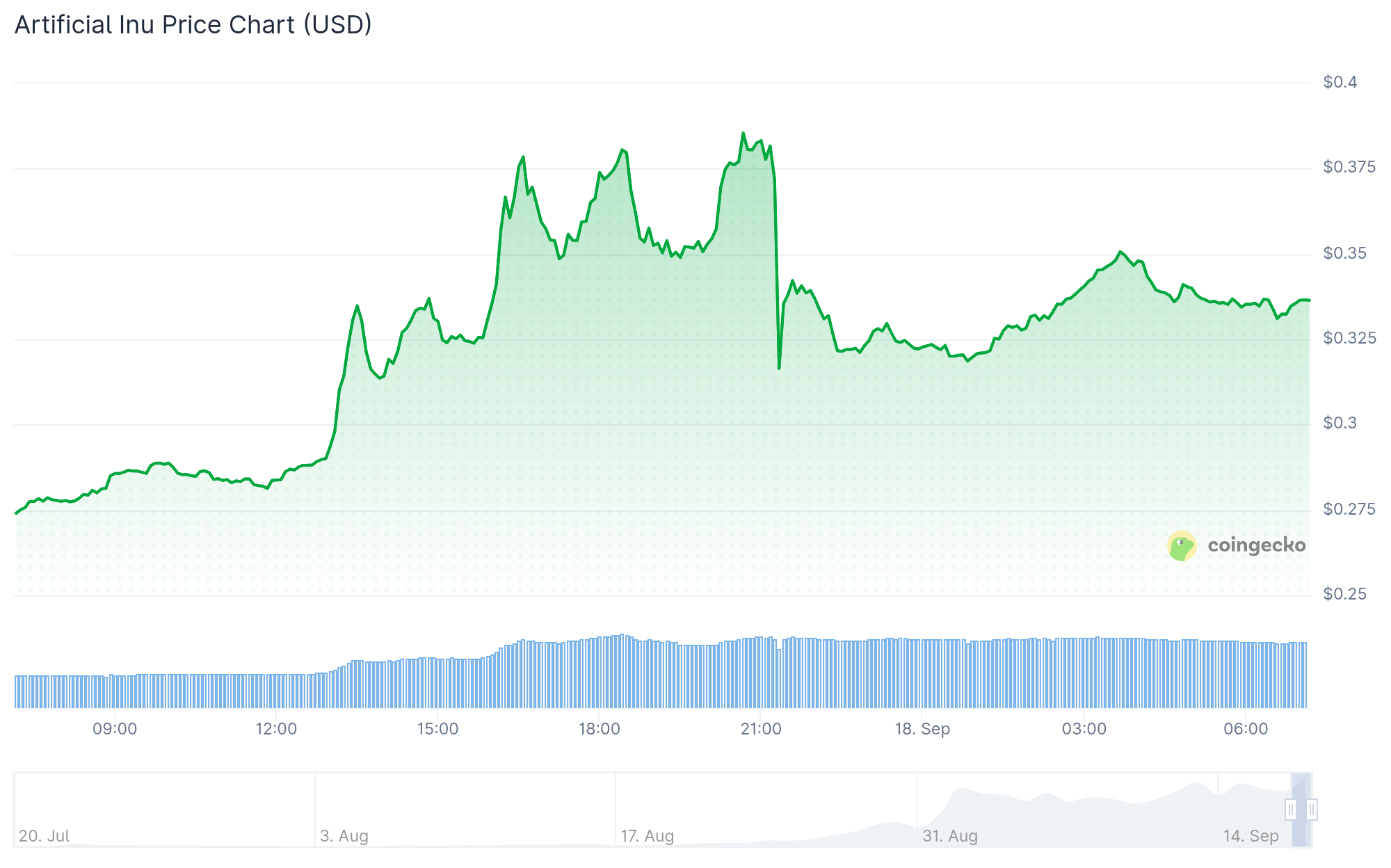
Meanwhile, the token’s market capitalisation climbed into the hundreds of millions. Price discovery on the AI/NVDA Uniswap v4 pool, combined with rising trading volume, turned the small early position into a multi-million-dollar holding.
Arkham’s entity page for the trader confirms the numbers and the holding pattern in real time.
What Makes Artificial Inu (AI) Different
Artificial Inu (AI) launched on Robinhood Chain through the LONG launchpad.
Its deepest liquidity sits against Robinhood’s tokenised NVDA stock token rather than a conventional quote asset.
Every trade generates creator fees that flow differently depending on direction.
On buys, the fees arrive in NVDA. About 80% of those fees move into a permanent community vault that holds real stock tokens and never releases them.
The remaining 20% goes to the original fee receiver. On sells, the fees arrive in AI itself.
Half of those tokens are burned forever, shrinking supply, while the other half locks inside the same vault.
In parallel, the mechanism creates a one-way pressure: the vault only grows and the circulating supply of Artificial Inu (AI) only shrinks as volume rises.
Volume itself becomes the engine that both accumulates real NVIDIA exposure and reduces token supply.

The Role of Robinhood Chain
Robinhood Chain is the permissionless Ethereum Layer-2 network that Robinhood launched in July 2026.
Built on Arbitrum technology, it focuses on tokenised real-world assets (RWA), especially Stock Tokens that track equities such as NVIDIA, Apple and others.
Gas is paid in ETH, block times are measured in tens of milliseconds, and the chain inherits Ethereum security while offering lower costs.
Artificial Inu (AI) sits at the intersection of that infrastructure and meme culture.
It turns tokenised NVIDIA into the quote asset for a dog-themed community token and routes trading activity back into permanent stock holdings.
That design has attracted both speculative volume and holders who like the idea of a memecoin that accumulates real equity exposure over time.
Why Early Holders Captured Such Large Multiples
While having time in the crypto market is more important than trying to time the market, for some tokens, timing matters.
Buying at a sub-$250K market capitalisation left enormous room for expansion once volume arrived.
The fee mechanism further amplified the effect by continuously removing tokens from circulation and building a vault of NVDA.
Beyond pure price appreciation, the trader’s decision to never sell locked in the full upside.
Many early wallets rotate quickly; this one did not. The additional tokens transferred in after the initial purchase simply increased the size of the winning position without diluting the original cost basis.

What Is Artificial Inu (AI) Exactly?
Artificial Inu (AI) is an Ethereum Request for Comments (ERC)-20 community token on Robinhood Chain.
It pairs against tokenised NVDA through Uniswap v4 and uses a directional fee system that sends buy-side fees (paid in NVDA) into a permanent vault while burning and locking sell-side fees (paid in AI).
It does not represent ownership of NVIDIA stock, grant voting rights, or allow holders to redeem assets from the vault.
It remains a speculative memecoin with an unusual collateral and burn design.
How Did the Trader Turn $3.8K into Millions?
He bought early at a $219.8K market capitalisation, held every token without selling, and later received additional tokens through transfers.
Price appreciation of roughly 758 times on the original stake, plus the extra holdings, produced the current multi-million-dollar position.

Is Artificial Inu (AI) Linked to NVIDIA?
No, NVIDIA has no involvement with this crypto project. The token simply uses Robinhood’s tokenised NVDA stock token as its primary trading pair. The company neither endorses the project nor has any claim on the community vault.
Can the Trader Easily Sell Without Moving the Market?
Large holders always face liquidity constraints. Selling a multi-million-dollar position in a still-young token can create significant slippage.
The same fee mechanism that helped drive the price higher also means sell pressure itself burns and locks tokens. Yet, the immediate market impact of a large exit remains a real risk.
Liquidity data on the main AI/NVDA pool shows depth that is meaningful but not unlimited.

What Risks Remain for Artificial Inu (AI) Holders?
As a new token without any real trading longevity, volatility is extreme.
Market capitalisation can expand and contract rapidly. The token carries no claim on the vault assets.
Smart-contract risk, liquidity risk, and the possibility that trading volume dries up all remain present.
Anyone evaluating the token should treat it as a high-risk speculative asset rather than a claim on real equity.
For stakeholders, the combination of early positioning, a distinctive fee design, and the growing activity on Robinhood Chain produced an outsized outcome for this particular wallet.
The numbers are public, the mechanism is documented, and the holding pattern is verifiable on-chain.
Whether similar early entries appear again depends on the next wave of launches and the continued growth of tokenised equity trading on the network.
