

Stablecoin continue to anchor the cryptocurrency market as digital dollars that bridge traditional finance (TradFi) and on-chain activity.
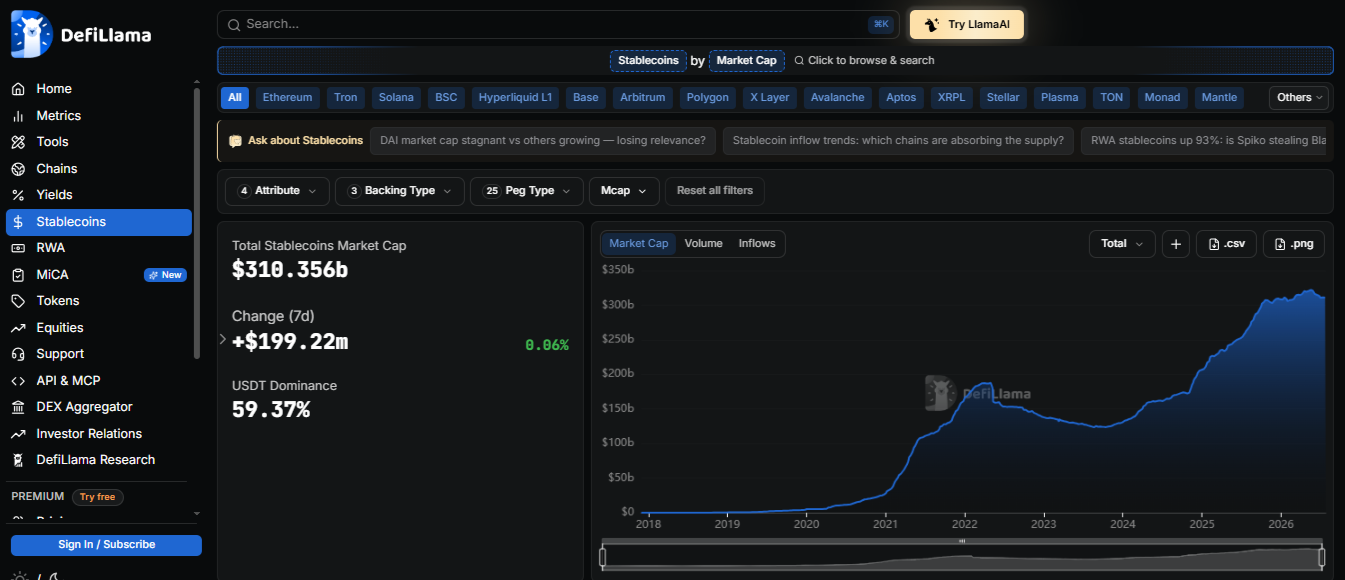
As of late July 2026, DefiLlama data shows the total stablecoin market cap hovering near $310–312 billion after peaking around $322 billion in May.
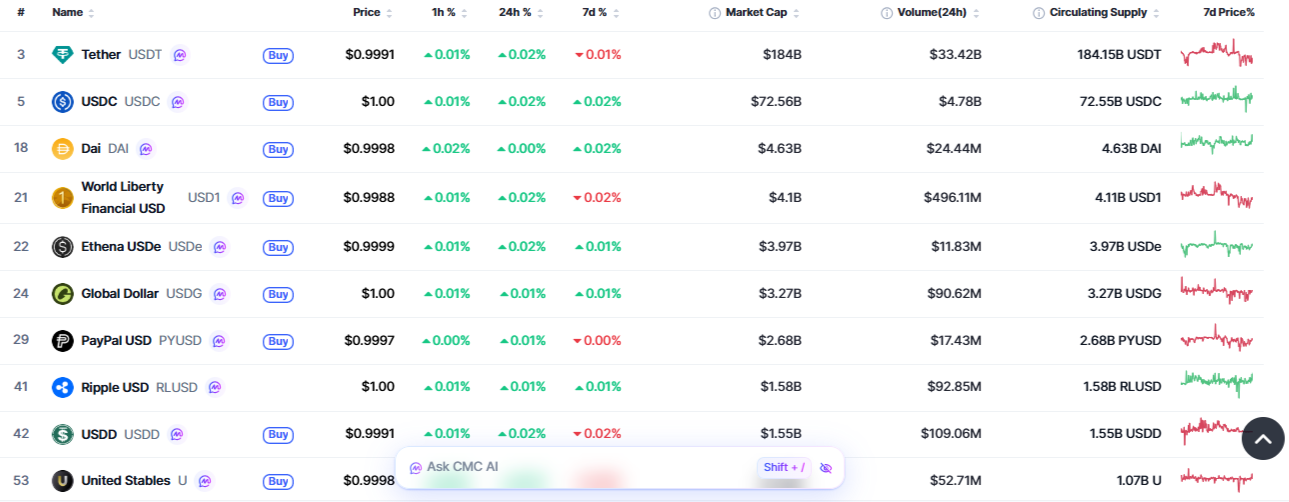
Tether (USDT) still commands roughly 59 percent dominance at about $184 billion, while USDC holds around $73–74 billion.
Meanwhile, a growing mid-tier of tokens including USDS, USD1, USDe, USDG, BUIDL, and RLUSD adds meaningful diversification.
This landscape raises a clear question: can stablecoins push past their recent high and set fresh records in the second half of 2026?
Current Landscape of the Stablecoin Market
Observers note that stablecoins have matured far beyond simple trading collateral. They now power payments, remittances, decentralised finance (DeFi) lending, and tokenised real-world assets.
Thus, monthly adjusted transaction volumes reached a record $1.79 trillion in June 2026, exceeding combined Visa and Mastercard daily transfer values in some metrics.
Furthermore, chains such as Solana recently hit all-time highs in stablecoin supply near $16 billion, driven largely by USDC inflows.
Tron simultaneously expanded its share of USDT to nearly half of global supply, underscoring retail and peer-to-peer strength. These shifts demonstrate active capital rotation rather than pure stagnation.
Drivers Propelling Stablecoin Expansion
Several forces actively fuel growth. First and foremost, regulatory clarity, including the GENIUS Act implementation and Markets-In Crypto Assets (MiCA) adjustments, encourages institutional participation.
Banks and asset managers increasingly issue or integrate yield-bearing and RWA-backed stablecoins such as BlackRock’s BUIDL, which has posted sharp gains.
Secondly, yield compression in some synthetic tokens has redirected capital toward more transparent, fiat-backed options, yet overall supply diversification continues.
Mid-tier stablecoins collectively expanded from under $5 billion to more than $30 billion over 18 months.
Third, cross-chain migration and payment rails expand utility: Solana captures institutional flows while Tron dominates smaller retail transfers.
As a result, stablecoins increasingly function as financial infrastructure rather than speculative tools alone.
Recent Pullbacks and Structural Resilience
Nevertheless, the market experienced its first quarterly contraction since 2023, slipping about 1.6 percent in Q2 to roughly $305 billion before stabilising near current levels.
USDT and USDC accounted for most of the $10 billion decline from the May peak. Analysts correctly view this as modest—only around 3 percent—compared with the 26 percent drop during the 2022 bear market.
Yield-bearing tokens such as USDe and USDS faced outflows when returns fell below risk-free rates, yet broader adoption metrics remain robust.
Stablecoin supply now represents about 1.35 percent of U.S. M2 money supply, illustrating steady penetration into the wider economy.
Outlook for New Highs in H2 2026
Looking ahead, several catalysts support renewed expansion. Institutional products, zero-fee minting initiatives, and further bank partnerships could inject fresh supply.
Forecasts from major institutions range widely—from $500–600 billion by 2028 (JPMorgan) to multi-trillion projections by 2030—yet near-term momentum depends on sustained real-world usage rather than speculation alone.
If payment volumes continue rising and RWA tokenisation accelerates, the market can reclaim and exceed the $322 billion high.
Conversely, prolonged yield compression or regulatory friction might prolong consolidation. Overall, the structural demand for reliable on-chain dollars remains intact.
In summary, stablecoins have evolved into a critical liquidity layer for crypto and traditional finance.
While a modest pullback followed the May peak, the combination of regulatory progress, chain-level adoption, and institutional entry positions the sector for potential new highs in H2 2026.
Market participants who track supply dynamics, dominance shifts, and genuine usage metrics will gain the clearest view of whether stablecoins break higher.
