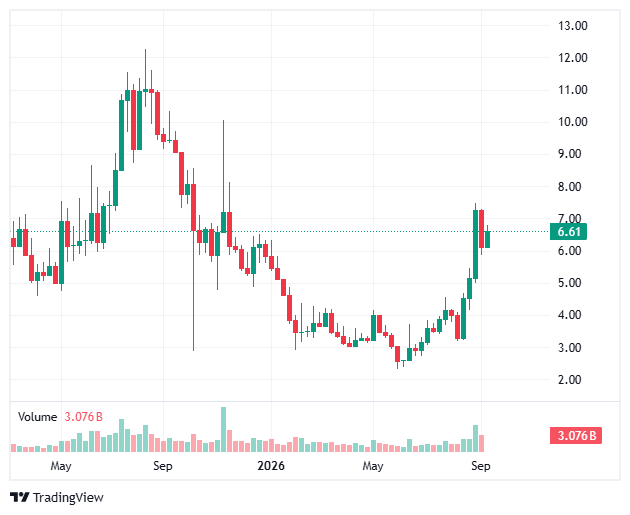


Uniswap Hooks have suddenly taken centre stage in the decentralised finance (DeFi).
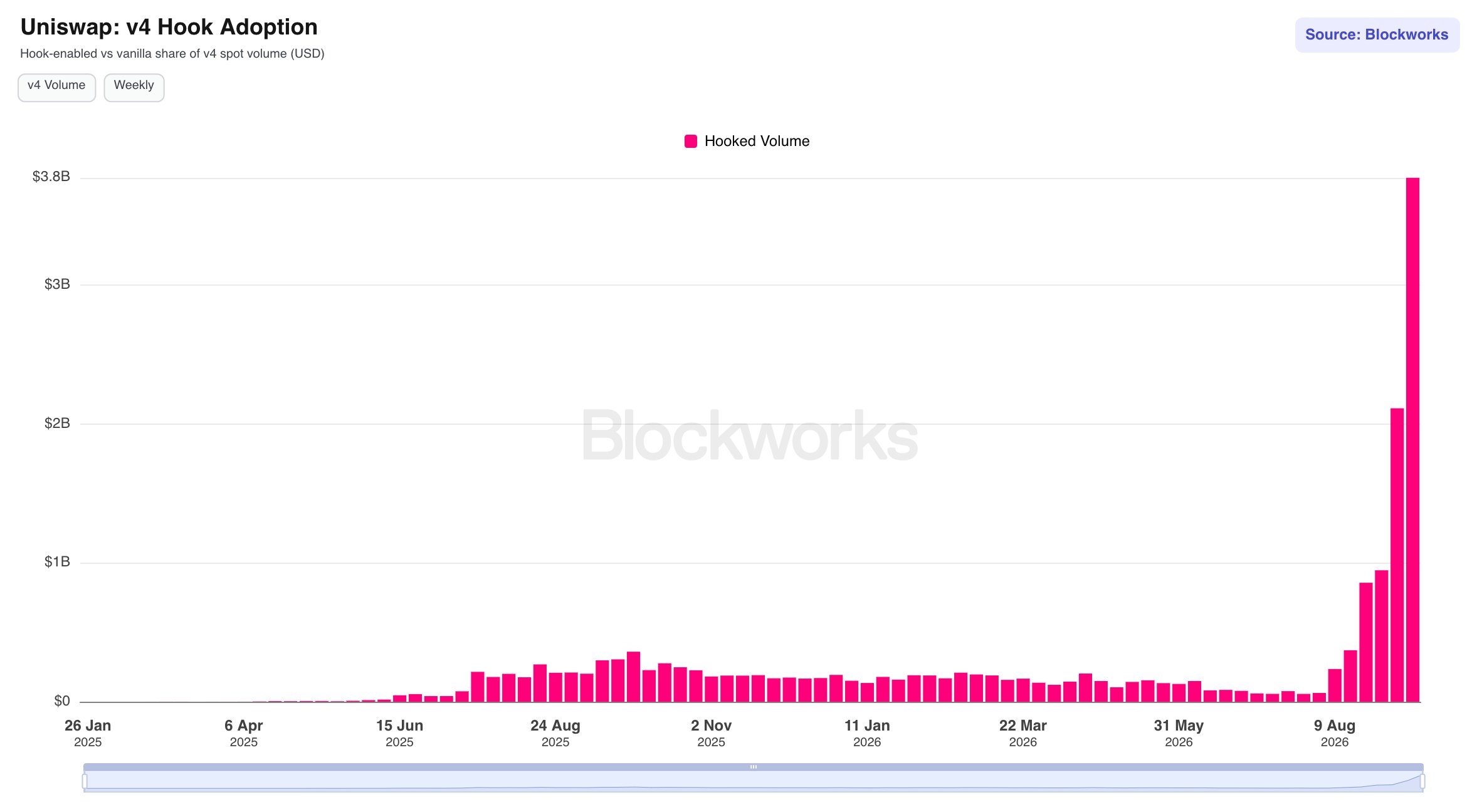
Weekly hook volume on Uniswap v4 has smashed through successive records since early August 2026.
The latest week alone pushed hooked volume near $3.8 billion, marking the fifth consecutive all-time high and a sharp break from the modest levels seen for most of the prior year.
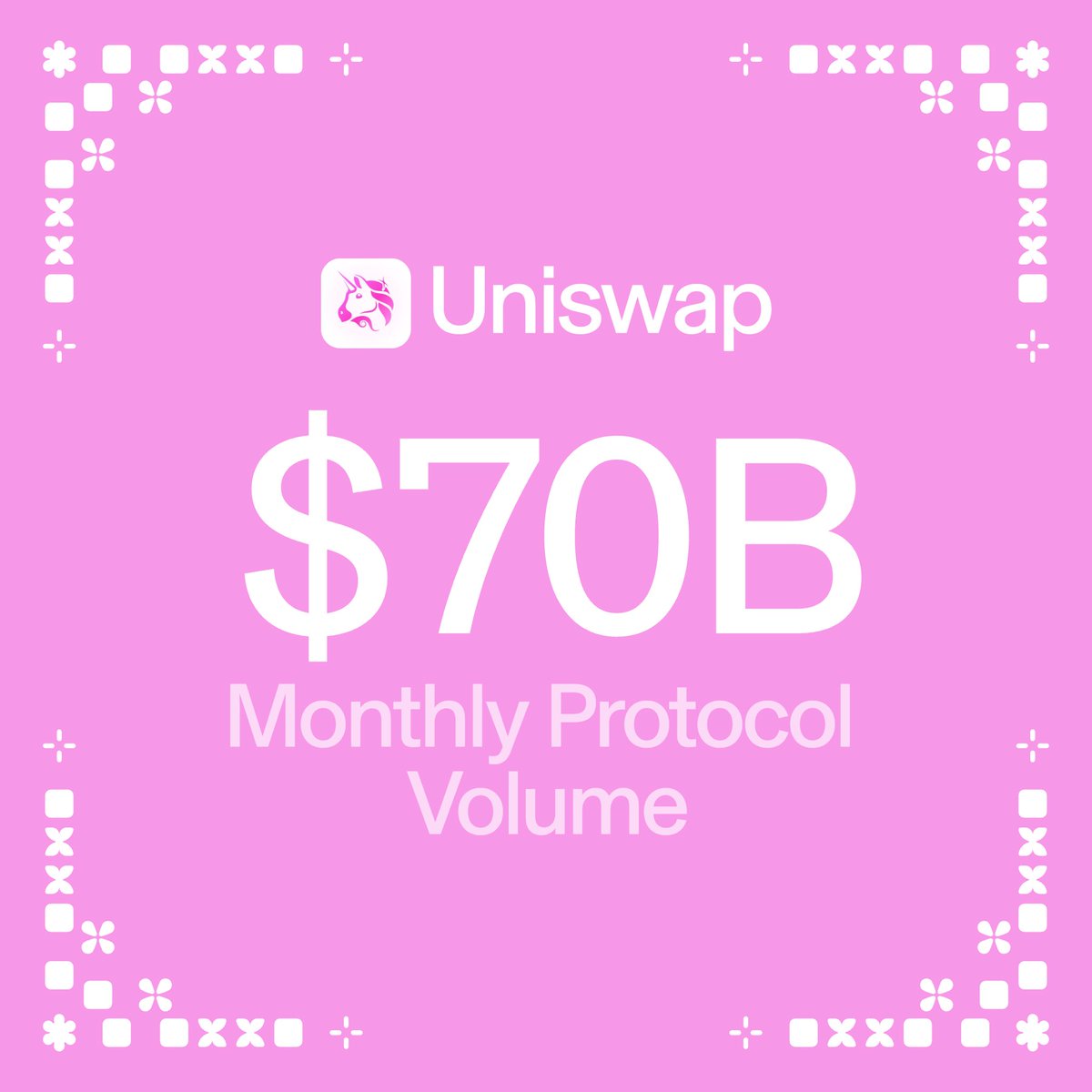
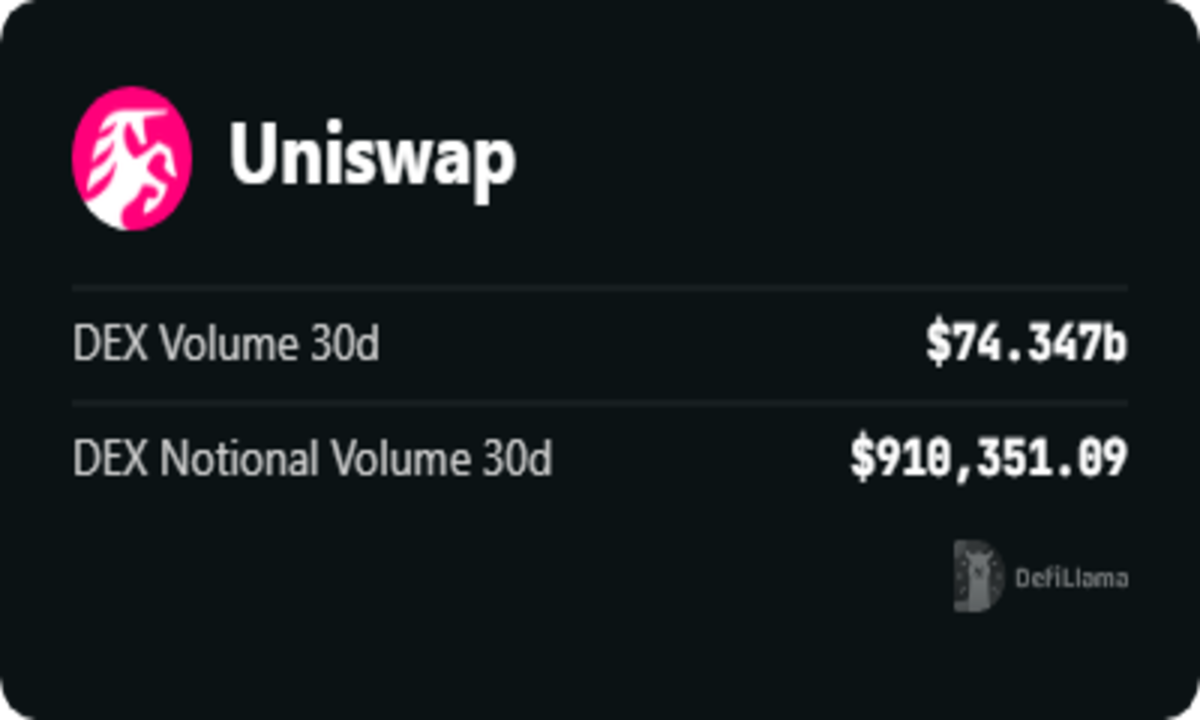
This surge arrives while Uniswap itself processes more than $70 billion in rolling 30-day volume, outpacing the next three decentralised exchanges (DEXs) combined.
The question now turns to how deeply these customisable plugins reshape liquidity, trading activity, and the value of the UNI token itself.
What Are Uniswap v4 Hooks and How Do They Work?
Uniswap Hooks function as external smart contracts that developers attach to individual liquidity pools.
Each pool can link to one hook, though a single hook contract may serve many pools. The PoolManager calls the hook at precise moments—before or after initialisation, liquidity addition or removal, swaps, and donations—so the custom code can intercept and reshape the flow.
In practice, a hook can adjust fees dynamically, enforce trading limits during token launches, internalise maximum extractable value (MEV) for liquidity providers (LPs), implement on-chain limit orders, or even replace the standard concentrated-liquidity curve with an entirely different pricing model.
Permissions live in the lowest bits of the hook’s own address, making the allowed behaviours transparent on-chain before anyone interacts with the pool.
Developers deploy these contracts through CREATE2 mining so the address carries the correct permission flags.
Once attached at pool creation, the hook stays fixed for that pool’s lifetime.
Vanilla pools continue to operate exactly like Uniswap v3 concentrated liquidity, while hooked pools open the door to programmable market structures that previously required separate protocols.
Why Has Hook Volume Hit Five Consecutive All-Time Highs?
Hook volume stayed relatively quiet for most of 2025 and the first half of 2026, often representing only about 1 percent of total v4 volume.
Then early August arrived and the numbers climbed week after week. Blockworks data visualised on Dune shows the weekly bars accelerating from hundreds of millions into the multi-billion range, culminating in the recent $3.8 billion peak.
Several forces converged. New projects began shipping production hooks for token launches, dynamic-fee stable pairs, MEV redistribution, and experimental markets.
At the same time, Uniswap Labs released its own StablePair Hook on September 10, which quickly became one of the highest-volume pools on Ethereum by offering improved returns for liquidity providers on correlated assets.
Messari noted that hook share of v4 volume jumped to roughly 14% in August, although some of the rise included pools exhibiting wash-trading patterns that analysts treat with caution.
Beyond the headline figures, the singleton architecture of v4 lowers the gas cost of creating and interacting with these customised pools.
That efficiency, combined with growing developer familiarity, turned what had been a quiet experimental layer into a measurable volume driver in a matter of weeks.
What Benefits Do Custom Hooks Offer Liquidity Providers and Traders?
Liquidity providers gain tools that earlier Uniswap versions simply could not deliver.
Dynamic-fee hooks adjust rates according to volatility or inventory, potentially lifting fee annual percentage returns (APR) when risk rises.
Other hooks capture arbitrage value that would otherwise leave the pool and redirect it to LPs.
Automated rebalancing, auto-compounding, and launch-protection mechanics further reduce the operational burden of active management.
Traders, meanwhile, encounter new order types and safer execution paths. Limit-order hooks fill at specific ticks without external keepers.
Anti-snipe and MEV-protection hooks limit front-running during volatile launches.
Aggregator-style hooks can even pull liquidity from external venues while still settling inside a Uniswap pool.
In short, the same capital and the same interface now support a far wider range of strategies.
Are Uniswap Hooks Safe, or Do They Introduce New Risks?
The Uniswap v4 core contracts have operated without major exploits since launch, backed by multiple audits and a large bug-bounty program.
Yet, every hooked pool shifts part of the security model from the protocol to the external contract.
A poorly written or malicious hook can alter swap amounts, skim fees, block withdrawals, or simply misbehave under edge conditions.
Recent analyses of tens of thousands of deployed hooks across multiple chains found that only a minority meet clear safety criteria, while more than half show malicious or highly suspicious patterns.
High-profile incidents involving specific hook-based projects have already cost users millions.
Because hooks execute with privileged access inside the swap lifecycle, users must treat each hooked pool as its own risk surface.
Reading the contract, checking permission flags, and preferring audited or Labs-labelled hooks remains essential due diligence.
How Is Growing Hook Adoption Driving Higher On-Chain Activity?
Hook adoption multiplies the reasons people interact with Uniswap.
Token-launch platforms route their primary markets through specialised hooks.
Lending protocols embed borrow-and-swap logic directly into pools.
Stablecoin pairs using dynamic fees attract volume that once stayed on specialized AMMs.
Each new use case generates swaps, liquidity events, and secondary activity that would not have occurred on vanilla pools alone.
Data from Blockworks and Messari show v4 already accounting for more than half of Uniswap’s Ethereum volume.
As the share of that volume flowing through hooks rises, overall on-chain metrics—unique addresses, transaction counts, and fee generation—tend to follow.
The recent five-week streak of record hook volume is the clearest signal yet that this expansion has moved from theory into measurable throughput.
How Would Uniswap Hooks Impact DEX Volume and UNI Price?
Higher hook-driven volume directly expands Uniswap’s share of decentralised trading.
With the protocol already processing over $70 billion in a recent 30-day window and v4 contributing the largest slice, every additional billion dollars of hooked activity compounds the network effect.
More volume means more fees, and after the UNIfication fee-switch activation on selected pools, a portion of those fees can flow toward protocol revenue and UNI burns.
Looking ahead, sustained hook growth could further differentiate Uniswap from competitors that lack the same degree of programmability.
Institutional and application-layer builders increasingly treat v4 as infrastructure rather than a simple swap venue.
That positioning supports both absolute volume growth and a higher share of total DEX activity.
For UNI itself, the link runs through fee generation and scarcity. If hook volume continues to climb and the fee switch captures a meaningful cut, buy-and-burn pressure strengthens.
At the same time, the expanding utility of the protocol raises the fundamental case for holding the governance token that steers its future.
While short-term price action still depends on broader market conditions, the structural rise in programmable liquidity gives UNI a clearer fundamental tailwind than it possessed in earlier protocol versions.
In the end, the five consecutive ATH weeks for Uniswap Hooks mark more than a statistical curiosity.
They show that customisable pool logic has crossed from experimental feature into a real volume engine.
How far that engine carries overall DEX activity—and the value of UNI—now depends on continued safe innovation and the willingness of capital to follow the new tools.