
Raydium tokenised stocks now command the clear majority of trading activity in Solana’s rapidly expanding on-chain equity market.
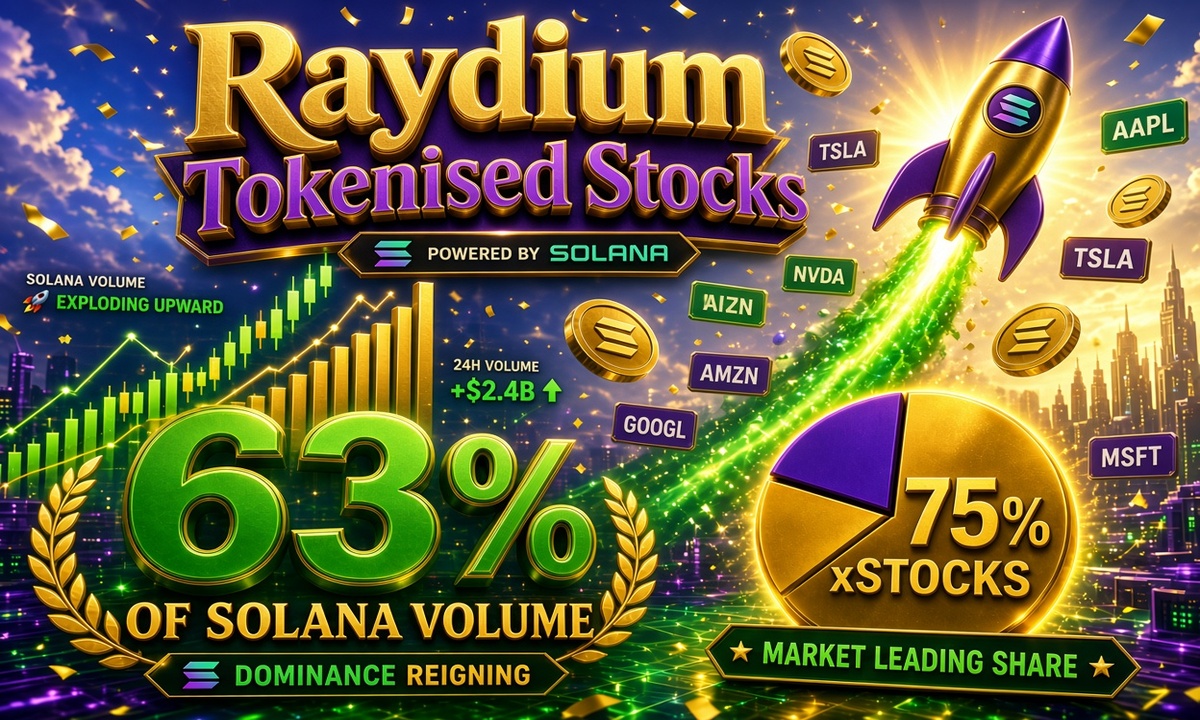
Recent data reveals that more than 63% of all Solana tokenised equity volume settles on Raydium.
That figure climbs even higher for specific platforms—75% of xStocks volume and 60% of Backpack securities volume flow through the same decentralised exchange (DEX).
This concentration arrives amid surging interest in real-world assets (RWA).
Tokenised equities on Solana already deliver 24/7 trading, fractional ownership, and seamless decentralised finance (DeFi) integration.
Meanwhile, Raydium has quietly become the primary venue where these products find deep liquidity and efficient execution.
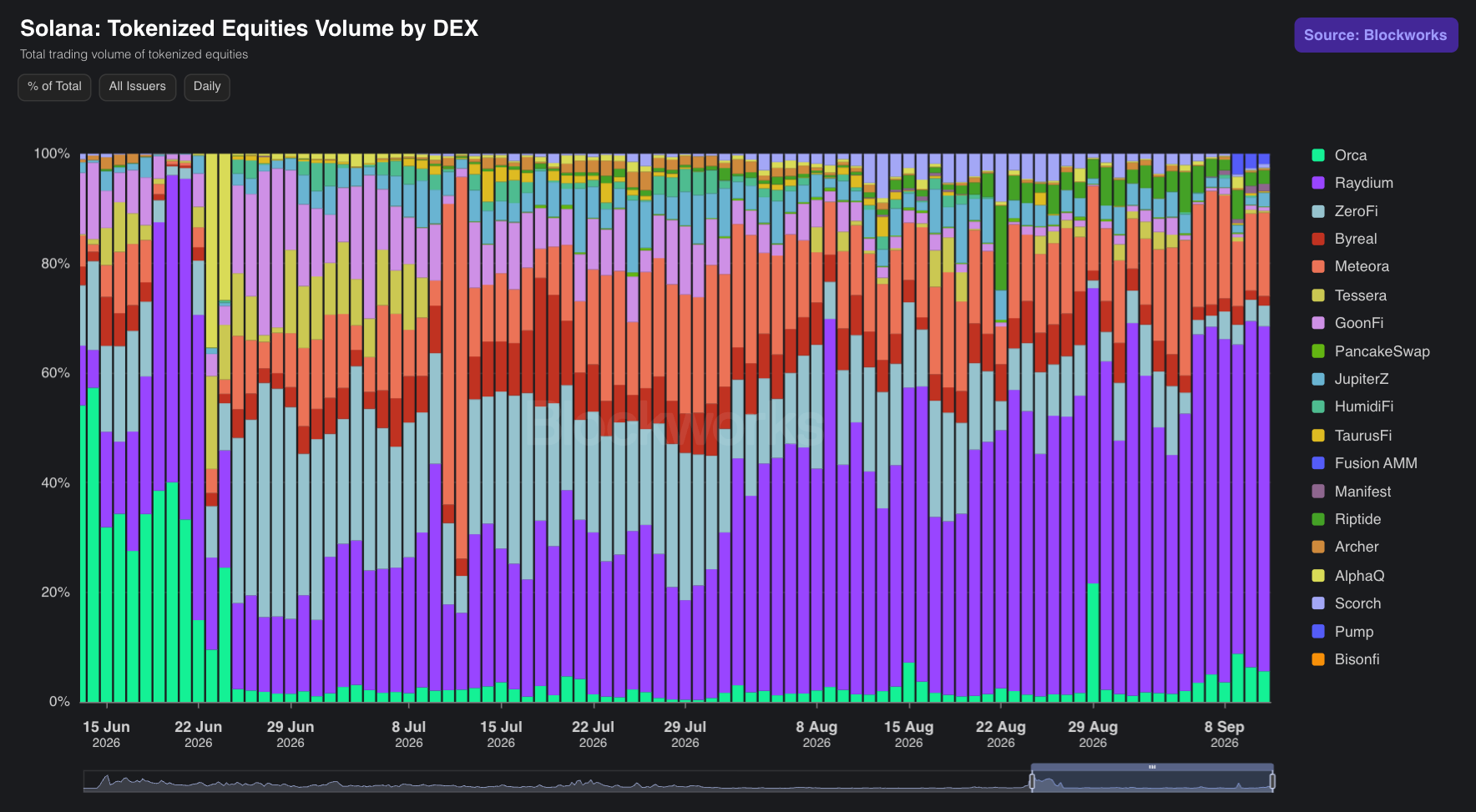
The chart from Blockworks illustrates how Raydium’s purple bars have consistently occupied the largest share of daily volume since mid-2026, often exceeding half and frequently approaching two-thirds of total activity.
Why Does Raydium Capture Over 63% of Solana’s Tokenised Equity Volume?
Raydium’s concentrated-liquidity model simply matches the needs of tokenised equities better than most alternatives right now.
Issuers and market makers prefer pools that can handle both steady flow during traditional market hours and the heavier overnight and weekend activity that defines on-chain trading.
In parallel, Raydium’s long-standing position as Solana’s deepest automated market maker (AMM) gives it an early-mover advantage.
Liquidity providers already park capital there, so new tokenised stock pairs launch with tighter spreads from day one.
Aggregators such as Jupiter further reinforce the loop by routing most order flow toward the pools that already hold the most depth.
Beyond pure liquidity depth, Raydium has introduced permissioned-pool features that let issuers add compliance gates without sacrificing the open nature of Solana.
That combination of capital efficiency and flexible controls has drawn both xStocks and Backpack listings in large numbers.
Looking at the daily breakdown, Raydium’s share rarely dips below 50 percent and often spikes higher during high-activity periods.
What Are xStocks and Backpack Securities, and How Do They Differ?
xStocks, issued by Backed Finance, represent 1:1-backed claims on real United States (U.S.) equities and exchange-traded funds (ETFs) held in regulated custody.
Holders gain exposure to names such as Apple, Nvidia, and the S&P 500 while retaining the ability to trade, lend, or provide liquidity on Solana.
The tokens themselves carry no traditional shareholder voting rights, yet they support fractional ownership and continuous markets.
Backpack Securities follows a similar 1:1 custodial model but routes its products through the Sunrise protocol and maintains a direct redemption path into its own brokerage system.
This structure has attracted prop-style market makers who often prefer Backpack’s single-name equities.
In practice, Backpack tokens have generated outsized volume relative to their smaller share of total supply, especially around high-profile listings such as SpaceX.
While both platforms deliver on-chain equity exposure, their liquidity profiles differ.
xStocks leans more heavily on classic AMM pools, whereas Backpack benefits from a higher proportion of proprietary market-making.
Still both channels funnel the majority of their activity onto Raydium.
How Safe Is Concentrating Tokenised Stock Trading on a Single DEX Like Raydium?
Concentration always carries trade-offs.
On one hand, a single deep venue produces tighter spreads and better price discovery for traders. On the other hand, any technical issue, liquidity withdrawal, or regulatory action targeting Raydium could temporarily disrupt a large slice of the market.
Observers have already flagged the risk. When more than 60% of an emerging asset class settles in one place, a smart-contract vulnerability or sudden liquidity flight becomes a systemic concern for that niche.
At the same time, Raydium’s multi-year track record, open-source code, and continuous audits provide meaningful reassurance.
In practice, the broader Solana ecosystem still offers secondary venues such as Orca, Meteora, and others.
Volume can migrate if conditions change. For now, the benefits of depth appear to outweigh the concentration risk for most participants, yet prudent traders continue to monitor liquidity distribution closely.
What Benefits Do Traders Gain from Raydium’s Dominance in On-Chain Equities?
Traders enjoy several practical advantages. First and foremost, deeper pools translate into lower slippage on larger orders.
Secondly, 24/7 markets let them react to news outside traditional exchange hours—something traditional brokers simply cannot match.
Moreover, the same tokens sit inside DeFi protocols, so holders can lend, borrow, or provide liquidity without leaving the Solana ecosystem.
Raydium’s dominance also improves capital efficiency. Market makers can concentrate inventory in fewer venues, which often produces tighter quotes.
Retail users benefit from the resulting competition among liquidity providers.
In short, the network effects that made Raydium the default venue now deliver tangible execution quality for anyone trading Raydium tokenised stocks.
Can Anyone Trade These Tokenised Stocks on Raydium, or Are There Restrictions?
Access remains geographically limited. Most issuers restrict U.S. persons, Canadian, U.K., and Australian residents because of unsettled securities regulations.
Eligible non-U.S. users in more than 100 countries can buy and sell freely once they hold a compatible Solana wallet.
On the technical side, anyone with SOL for fees can interact with the pools. No special permission is required beyond the usual wallet connection.
Some issuers may later introduce additional compliance filters through Raydium’s permissioned-pool tools, yet the base experience stays permissionless for allowed jurisdictions.
Always verify the latest terms from the specific issuer before trading.
How Does Raydium Tokenised Stocks Volume Impact Raydium As a DEX? Can It Challenge Uniswap and PancakeSwap?
The influx of tokenised equity volume strengthens Raydium’s overall metrics.
Higher trading activity generates more fees for liquidity providers and protocol revenue, which in turn attracts further capital.
Cumulative tokenised equity volume on Raydium has already crossed multiple billion-dollar milestones, giving the DEX a distinctive real-world-asset narrative that pure memecoin or stablecoin venues lack.
Whether this positions Raydium to challenge Uniswap or PancakeSwap depends on broader market dynamics.
Uniswap still leads global DEX volume by a wide margin, and PancakeSwap retains strong BNB Chain loyalty.
Yet, Raydium’s growing share of a high-value, sticky asset class—tokenised stocks—gives it a differentiated growth vector.
If Solana continues to capture the majority of on-chain equity trading, Raydium stands to benefit disproportionately.
How Does This Impact Raydium Token As Well As Solana (SOL) Token Price Performances in the Future?
Rising Raydium tokenised stocks volume supports two related narratives.
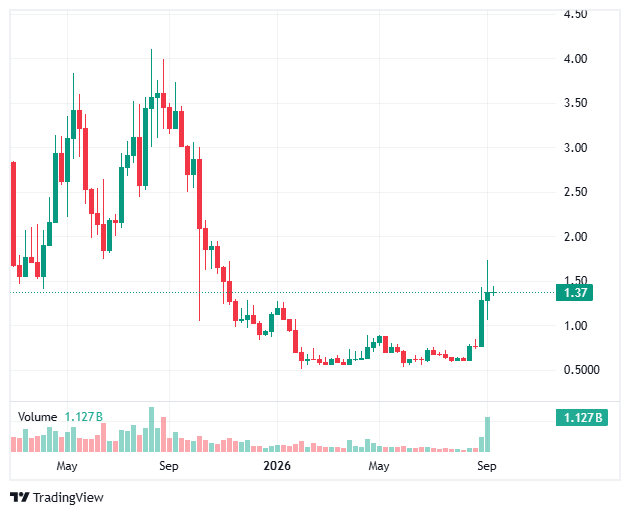
For the RAY token, higher protocol activity can translate into increased fee generation and potential value accrual if governance later activates or expands fee-sharing mechanisms.
Liquidity providers already earn more in active pools, which indirectly supports demand for the ecosystem.
For SOL itself, every additional transaction and every new user interacting with tokenised equities contributes to network fee burn and sustained demand for block space.
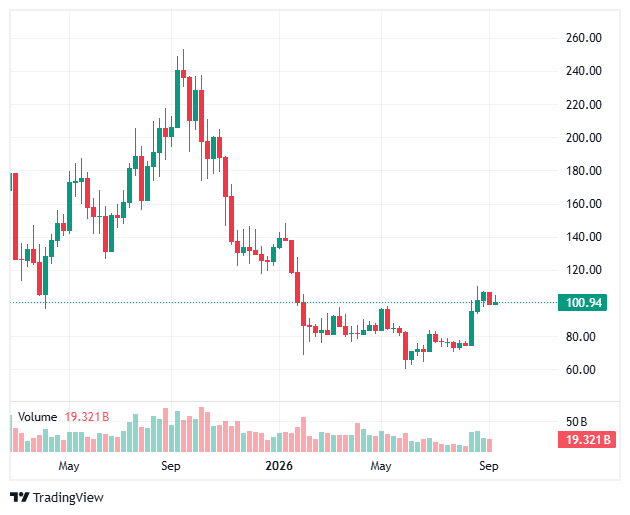
Tokenised stocks also attract a different user profile—participants interested in traditional finance exposure rather than pure speculation—which can broaden Solana’s long-term holder base.
Looking ahead, sustained growth in this category could reinforce positive feedback loops for both assets.
Volume growth alone does not guarantee price appreciation, yet it strengthens the fundamental case by expanding real utility and on-chain activity.
Market participants will watch whether Raydium maintains its 60-plus percent share as more issuers and competing venues enter the space.
Raydium tokenised stocks have moved from niche experiment to dominant market structure in a remarkably short time.
The 63% overall share, 75% of xStocks, and 60% of Backpack volume paint a clear picture: when traders want on-chain equity exposure on Solana, they most often turn to Raydium.
How the ecosystem manages the opportunities and risks of that concentration will shape the next chapter of tokenised finance.
