

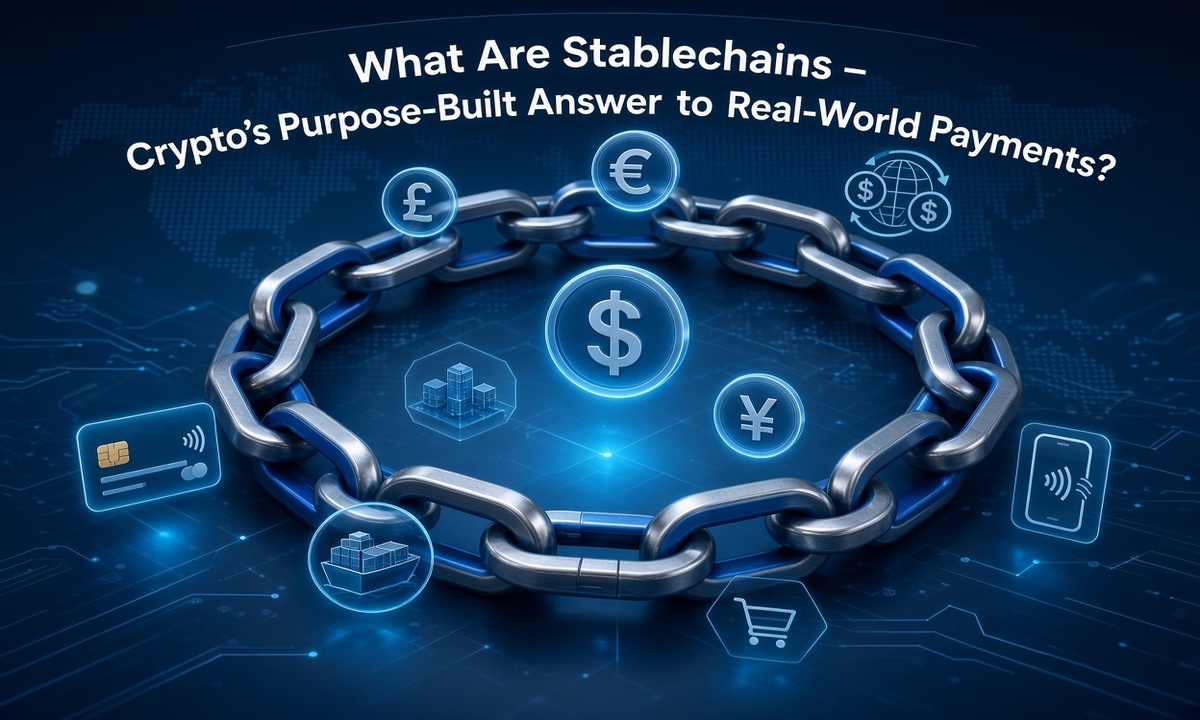
Stablechains is a new term within the crypto sphere and it was derived from stablecoins.
Stablecoins have already proven they can move value faster and cheaper than traditional banking rails.
Yet, most of them still ride on general-purpose blockchains that were never designed for pure payment flows.
Enter Stablechains — a new class of purpose-built networks that treat the dollar itself as the primary unit of account and settlement.
These chains flip the usual design logic. Instead of forcing users to hold a volatile gas token just to send stable value, they make the stablecoin the native medium for fees and transfers.
The result feels closer to a modern payment network than a traditional smart-contract platform.
In the sections that follow, we unpack exactly what Stablechains are, how their fee model works, why they still issue a native token, the real security trade-offs, and the traction they are already seeing in 2026.
What is a Stablechain and how is it different from a regular blockchain or a stablecoin?
A Stablechain is a Layer-1 (or sometimes Layer-2) blockchain engineered from the ground up for stablecoin payments and settlement.
Its core design goal is simple: let users send, receive, and settle dollars with predictable costs and minimal friction.
Regular blockchains such as Ethereum or Solana treat every transaction as a general computation.
They require a native volatile asset (ETH or SOL) for gas, and their fee markets can spike during periods of high demand.
A Stablechain, by contrast, denominates fees and balances primarily in a major stablecoin — most often USDT or an omnichain version of it.
A stablecoin itself is only the asset. A Stablechain is the specialised rail that moves that asset with payment-grade performance.
Think of the difference between a dollar bill and a dedicated clearing system built solely to transfer those dollars at scale.
Notably, projects in this category deliberately strip away features that add complexity for pure payment use cases.
High-throughput finality, free or near-free simple transfers, and stable fee denomination become first-class requirements rather than afterthoughts.
Messari’s research on the rise of these networks highlights this intentional specialisation as the key distinction from general-purpose chains.
How do gas fees work on a Stablechain if users pay in USDT (or another stablecoin)?
On a typical Stablechain, the user never needs a separate gas token. When you send USDT, the network deducts the fee directly from the same USDT balance.
Simple peer-to-peer (P2P) transfers are often fee-exempt at the protocol level, while more complex smart-contract interactions still settle in the stablecoin.
This design removes two classic pain points. First and foremost, users no longer face the risk of holding a volatile asset whose price can jump just when they need to pay fees.
Secondly, the cost of moving dollars becomes far more predictable because it is denominated in the same unit being transferred.
Under the hood, the chain still needs a mechanism to compensate validators. Rather than relying on inflationary emissions of a native token, many stablechains fund rewards from the USDT-denominated fees themselves.
The dual-token architecture keeps the user experience clean while still securing the network.
In practice, this means a merchant or institution can receive and settle large volumes of USDT without ever touching a second asset.
The fee model therefore aligns much more closely with traditional payment systems than with classic blockchain gas markets.
What is the point of the native token (e.g. STABLE) if users never need to hold it?
The native token exists for security and governance, not for everyday payments.
Validators stake it to participate in consensus, and holders use it to vote on protocol upgrades and parameter changes.
In the case of StableChain, the STABLE token follows a fixed-supply model and earns rewards funded by USDT fees rather than new token issuance.
This separation is deliberate. By keeping the payment medium (USDT) completely distinct from the security and governance asset, the chain avoids forcing users into exposure they do not want.
At the same time, the native token captures value from network activity through staking yields and potential fee-share mechanisms.
Sophisticated observers often ask whether this dual-token design creates weak value accrual.
The counter-argument is that a payments network only succeeds if the user experience stays simple.
Once that experience is protected, the security token can still capture economic upside from growing settlement volume.
In short, the native token is the bond that secures the chain and the instrument of decentralised (or foundation-guided) control.
Users themselves can remain blissfully unaware of its existence.
Are Stablechains more centralised or riskier than Ethereum, Solana, or Tron?
Stablechains introduce a different set of trust assumptions.
Because they are frequently backed by or closely aligned with major stablecoin issuers, the influence of those issuers on governance and infrastructure is higher than on a maximally decentralised chain such as Ethereum.
Validator sets tend to be smaller and more permissioned in the early stages, which can improve performance and finality but also concentrates operational risk.
In addition, the heavy reliance on a single stablecoin means any future regulatory action or technical issue affecting that stablecoin could impact the chain more directly.
On the positive side, the specialised design often delivers clearer compliance pathways and more predictable settlement guarantees — features that institutions actively seek.
Tron has long dominated USDT volume through low fees and high throughput, yet it still requires users to manage TRX for gas.
Stablechains remove that friction while accepting a more focused security model in exchange.
Ultimately the risk profile depends on the specific implementation.
Early networks prioritise payment reliability and issuer alignment over absolute decentralisation.
As the category matures, some will likely increase validator diversity and open governance, while others will remain more controlled environments optimised for institutional rails.
What real-world use cases and adoption are Stablechains actually seeing in 2026?
By mid-2026, several stablechains have moved beyond testnets into live production environments.
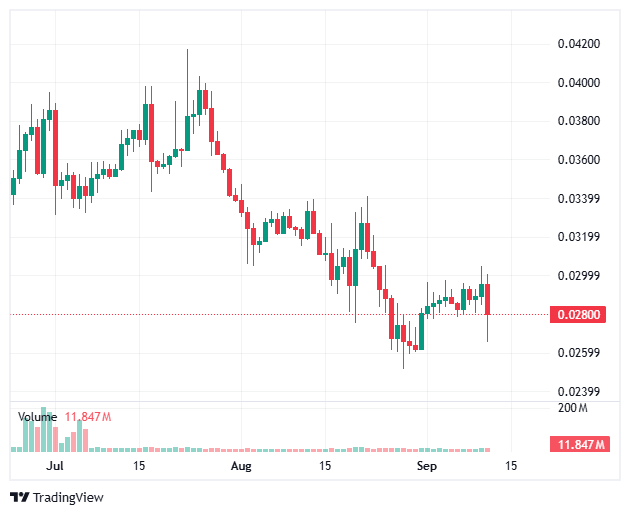
The most visible example, StableChain, launched mainnet in late 2025 and quickly attracted hundreds of millions in on-chain USDT deposits along with thousands of deployed contracts.
Daily transaction counts and active addresses have grown steadily as payment-focused applications and institutional desks test the rails.
Primary use cases currently include high-volume USDT settlement, cross-border business payments, and simple merchant acceptance where fee predictability matters more than complex DeFi features.
Some networks also support yield products that keep balances in stablecoins while still generating returns, further reducing the need for users to leave the dollar-denominated environment.
Institutional interest is rising in parallel. Payment companies and stablecoin issuers are exploring or launching their own specialised chains precisely because general-purpose networks introduce fee volatility and operational complexity they prefer to avoid.
Meanwhile, retail and small-business adoption remains early but is accelerating wherever the user experience feels closer to a traditional digital dollar transfer than a crypto transaction.
The category is still young. Nevertheless, the combination of measurable on-chain volume, issuer backing, and clear product focus has already placed Stablechains among the more closely watched infrastructure narratives of 2026.
Stablechains represent a pragmatic bet: that the next phase of crypto adoption will reward networks optimised for the assets people actually want to hold and move — dollars — rather than networks optimised for every possible computation.
Whether this specialised approach ultimately captures significant share of global payment volume remains an open question, yet the early design choices and live traction already make the category worth serious attention.
