
Balancer has proposed winding down its decentralised finance (DeFi) protocol after its recovery plan failed to restore revenue growth.
Marcus Hardt, a treasury council member and former Balancer Labs CEO, submitted the governance proposal Monday, September 14, 2026.
The plan would end new business development and gradually shut down the protocol.
It would also close the DAO to the extent required for its legal and practical operations.
Balancer token holders approved a restructuring plan in April to help the protocol reach profitability.
The plan cut costs, ended token emissions, simplified the BAL token model, and directed protocol revenue to the DAO.
Balancer also expected its v3 architecture to support future growth under the new structure.
However, the changes did not generate enough revenue to sustain the protocol.
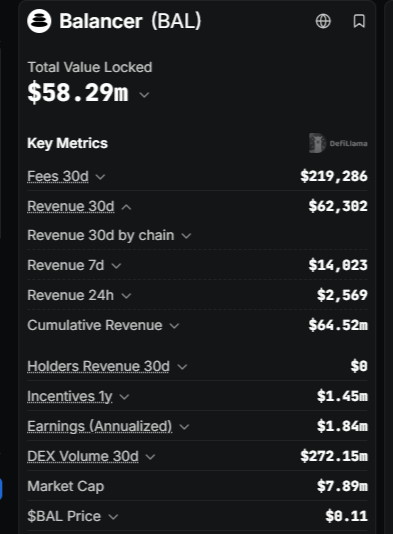
DefiLlama data showed that Balancer generated $1.13 million in protocol revenue in October 2025.
That figure fell to $371,000 in November after the protocol suffered a major exploit. The revenue continued falling this year and reached $56,781 in August. Revenue was $62,382 as of this writing.
Hardt said the restructuring reduced costs but failed to produce enough revenue.
Hardt also said most of Balancer’s revenue still comes from v2.
Meanwhile, v3 has not grown enough to replace the revenue from the older version.
The proposal would therefore cancel a previously approved BAL buyback plan.
Instead, Balancer would direct remaining treasury assets toward eligible BAL holders.
The $128M Hack Still Hurts Balancer
The November 2025 exploit remains a major factor behind Balancer’s financial pressure.
An attacker targeted Balancer v2 Composable Stable Pools across several networks on November 3.
The initial estimates placed the losses near $70 million before investigators identified additional transfers. The total losses later rose above $128 million.
Balancer later identified a rounding flaw in its upscale function as the technical cause of the attack.
The flaw allowed attackers to manipulate pool balances during token swaps. The attackers extracted assets including WETH, osETH, and wstETH from affected pools.
Balancer responded by pausing vulnerable pools and stopping rewards. Hardt said the exploit continued to hurt adoption even though it affected legacy v2 pools.
BAL Holders Could Get the Treasury
The proposed shutdown would begin in October with an end to new business development.
Liquidity providers would have until October 30 to prepare their exits. Balancer would then move eligible pools into withdrawal-only mode.
From November 1, the protocol would retain only the infrastructure needed to process withdrawals.
The DAO would also begin its shutdown process while a smaller team handles the remaining operations.
Balancer would reserve up to $400,000 from its treasury for wind-down expenses. The remaining treasury assets currently hold a value above $9 million.
Eligible BAL holders could receive those assets on a pro-rata basis after burning their tokens.
The first redemption period would open at the end of May 2027 and run for six months.
A second distribution would follow within two months after the first period closes. BAL held directly by the treasury would not qualify for the distribution.
However, the proposal includes a limited exception for holders of tetuBAL, a liquid staking wrapper token.
BAL holders will vote on the proposal through a snapshot vote from September 25 to September 29.
Balancer said the protocol will continue operating normally until the vote takes place.
Proposal’s effect on the token
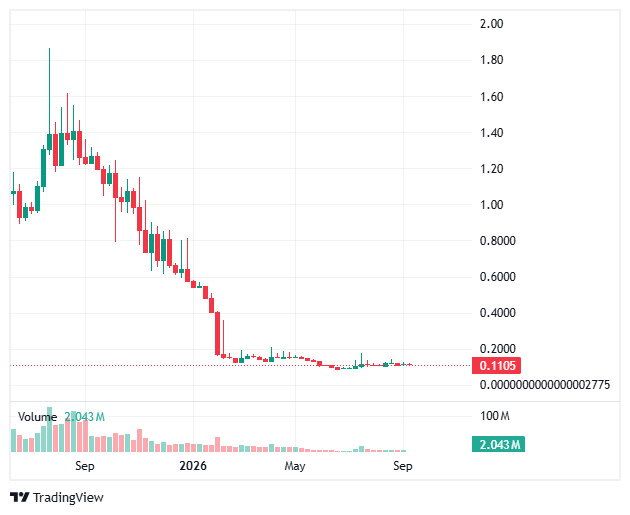
The proposed shutdown has had devastating consequences on the novel token. BAL was exchanging hands for $0.1104 and had a market capitalisation below $10 million.