

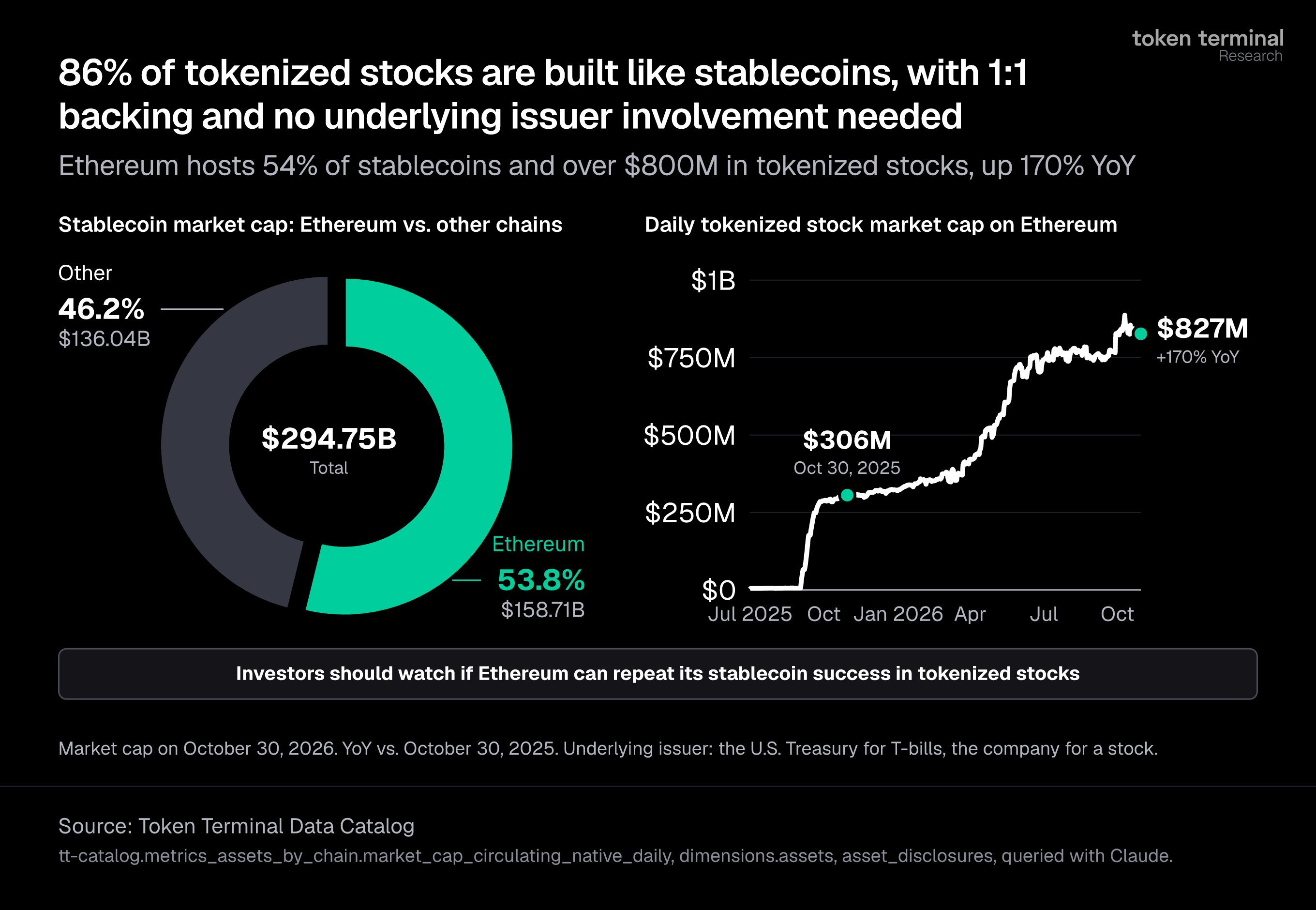
Ethereum continues to anchor the bulk of on-chain dollars. Data from Token Terminal shows the network hosts 54% of all stablecoins by issuance across dozens of chains, with roughly $162–163 billion created on it out of a total market near $300–301 billion.
Holdings sit closer to $144 billion, or about 48%, because bridging moves tokens elsewhere.
This lead did not appear overnight.
Ethereum’s deep liquidity, established decentralised finance (DeFi) rails, and long track record with major issuers such as Tether and Circle keep most new stablecoin supply landing there first.
Tron holds a distant second place near 31%, while other chains share the rest.
How do tokenized stocks mirror the stablecoin model?
A parallel market is taking shape. Tokenized stocks on Ethereum have climbed 170% year-over-year (YoY) to roughly $827 million.
Across all chains, the category now sits between $3.8 billion and $4.6 billion. Notably, 86% of these products follow the same 1:1 backing approach used by stablecoins: a third-party issuer holds the underlying shares with a custodian and mints tokens without requiring ongoing involvement from the original company.
BNB Chain currently leads the overall tokenized-equity category, yet Ethereum’s slice is expanding fastest in percentage terms.
Issuers such as Ondo, Backed Finance, and others have standardised this collateralised structure, lowering friction for new listings.

Could tokenized stocks follow stablecoins’ path on Ethereum?
The comparison is tempting. Stablecoins started small and later became the backbone of lending, trading, and payments once they gained real utility.
Tokenized stocks remain a fraction of that size—Ethereum’s entire equity book is still tiny next to its stablecoin base—yet the issuance model is already familiar.
If these tokens gain traction as collateral or settle inside DeFi protocols, the same network effects that cemented Ethereum’s dollar dominance could reappear.
Still, hurdles exist. Regulatory clarity, secondary-market depth, and genuine demand beyond speculation will decide the pace.
BNB Chain and Solana currently capture larger absolute shares of the equity market, so Ethereum must convert its stablecoin advantage into similar product-market fit for stocks.
Going deep into the last two months of 2026, investors monitoring the next wave of real-world assets (RWA) must keep their eyes on whether Ethereum’s infrastructure advantage again proves decisive.
The numbers already show the network’s staying power with digital dollars. Whether equities repeat that story remains the open question worth watching in the months ahead.
