


Bitcoin miner revenue climbed to a nine (9)-month peak in the latest monthly tally, reaching $1.14 billion.
The rebound arrives after a difficult stretch earlier in 2026 when lower prices and rising difficulty squeezed margins across the sector.
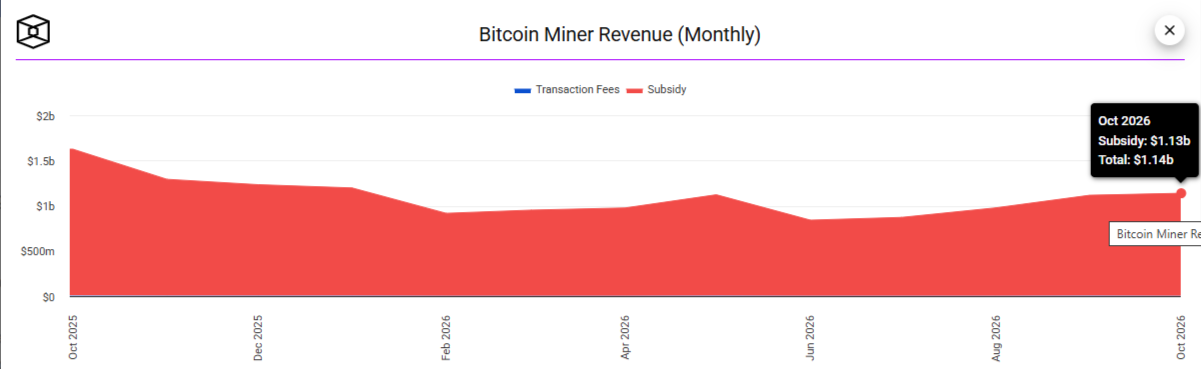
What is the current daily Bitcoin miner revenue and how has it recovered from the 2026 summer lows?
Daily revenue now sits near $35 million. That figure marks a solid recovery from the summer trough near $27 million in July.
Bitcoin’s price climb from the mid-$50,000s provided the main lift, while network hashrate also returned as operators switched machines back on.
The rebound eased immediate pressure on many fleets, yet recent difficulty adjustments have already trimmed some of those gains.

What is the current hashprice (revenue per PH/s per day) and why did it drop after the recent difficulty increases?
Hashprice currently hovers around $33 to $35 per petahash per second per day. Two October difficulty jumps—each near 5–6%—raised the computing work needed for the same expected reward.
Network hashrate climbed back above 1,000 EH/s as idle capacity returned, spreading the fixed block subsidy across more machines.
The result is lower revenue per unit of power even as total monthly figures improved.

How much of Bitcoin miner revenue currently comes from transaction fees versus the block subsidy?
Transaction fees contribute less than 1% of total miner revenue. The 3.125 BTC block subsidy supplies virtually all the income.
On a typical recent day, fees added only a few hundred thousand dollars while subsidies delivered the bulk of the $35 million total.
This heavy dependence on newly issued coins remains a defining feature of the current cycle.

Are Bitcoin miners still profitable after the October 2026 difficulty jumps and hashrate recovery?
Profitability varies sharply by efficiency and power cost. Operators running modern sub-20 J/TH machines on cheap industrial power still clear positive margins at today’s hashprice.
Older 25 J/TH equipment faces losses once electricity exceeds roughly 5–6 cents per kWh.
The October adjustments tightened the spread between efficient and inefficient fleets, pushing more marginal capacity offline or into alternative uses.

How is the industry’s pivot to AI/HPC affecting overall Bitcoin mining revenue and public miner earnings?
Many publicly listed miners are shifting power and facilities toward artificial intelligence (AI) and high-performance computing.
Contracted AI backlog now exceeds $100 billion across the sector, though only a fraction of that capacity currently generates revenue.
AI hosting can deliver higher and more stable returns per megawatt than Bitcoin mining under present hashprice conditions.
This pivot reduces pure mining hashrate growth while giving public companies a second earnings stream that cushions volatility in Bitcoin miner revenue.
The $1.14 billion monthly figure shows the industry’s resilience, yet the underlying economics remain tight.
Hashprice sits well below levels seen earlier in the year, fees stay negligible, and difficulty continues to climb with recovering hashrate.
Operators who secure low-cost power and efficient hardware keep mining attractive, while others accelerate the move into AI infrastructure.
The next few months will test whether Bitcoin price strength can offset further network growth or whether the AI shift accelerates even more.
