

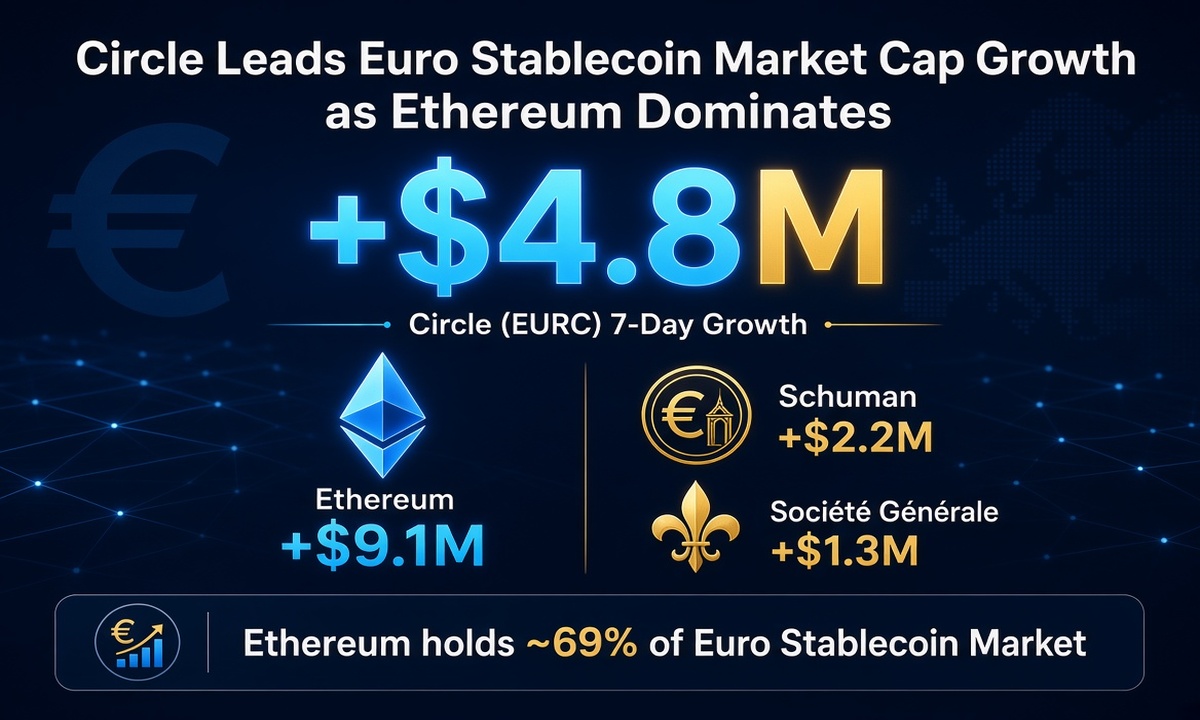
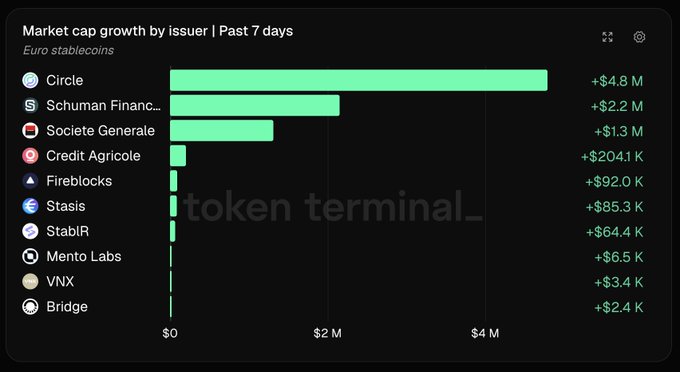
Circle just added $4.8 million to its euro stablecoin market cap over the past seven days.
Schuman Financial followed with a $2.2 million rise, while Société Générale contributed another $1.3 million.
At the same time, Ethereum captured the bulk of overall euro stablecoin inflows, reinforcing its clear lead across the sector.
Why Does Circle Keep Leading the Euro Stablecoin Race?
Circle issues EURC through its French-licensed entity and maintains full reserves under Markets-In Crypto Assets (MiCA) rules.
Investors and institutions keep choosing the token because it delivers transparent reserves, easy redeemability, and deep liquidity.
In particular, the product already holds roughly 60% of the entire euro stablecoin market.
Beyond simple market-share numbers, Circle’s existing USDC infrastructure lets users move between dollar and euro versions with minimal friction.
How Strong Is Ethereum’s Grip on Euro Stablecoins Right Now?
Ethereum absorbed $9.1 million in euro stablecoin market-cap growth during the same seven-day window.
The network currently hosts close to 69% of all euro-denominated stablecoin value.
Meanwhile, Arc and a handful of other chains posted smaller gains, yet none challenged Ethereum’s position.
Liquidity pools, established decentralised finance (DeFi) protocols, and institutional familiarity continue to pull new supply onto the mainnet.

What Role Do Traditional Banks Play in This Growth?
Société Générale’s EURCV and Schuman Financial’s EUROP both posted solid weekly increases.
European banks are stepping into the market with regulated products that appeal to corporate treasuries seeking on-chain euro rails.
In addition, these issuers bring established compliance frameworks that many pure crypto players still lack.
The parallel rise of bank-backed tokens and Circle’s EURC shows the market is no longer a one-horse race.
Where Does the Euro Stablecoin Market Sit Against Dollar Stablecoins?
The entire euro stablecoin sector sits near the $800–900 million range.
That figure remains a tiny fraction of the $300 billion-plus dollar stablecoin market.
Yet, euro supply has expanded far faster in percentage terms since MiCA rules took effect.
On top of that, payment firms and institutional desks increasingly treat euro stablecoins as a practical tool for cross-border settlement outside traditional banking hours.
Looking forward, Circle’s steady weekly gains and Ethereum’s network dominance signal continued institutional interest in regulated euro on-chain money.
More bank-issued tokens and multi-chain deployments will likely keep the segment expanding, even while it stays a small slice of the global stablecoin landscape.
