

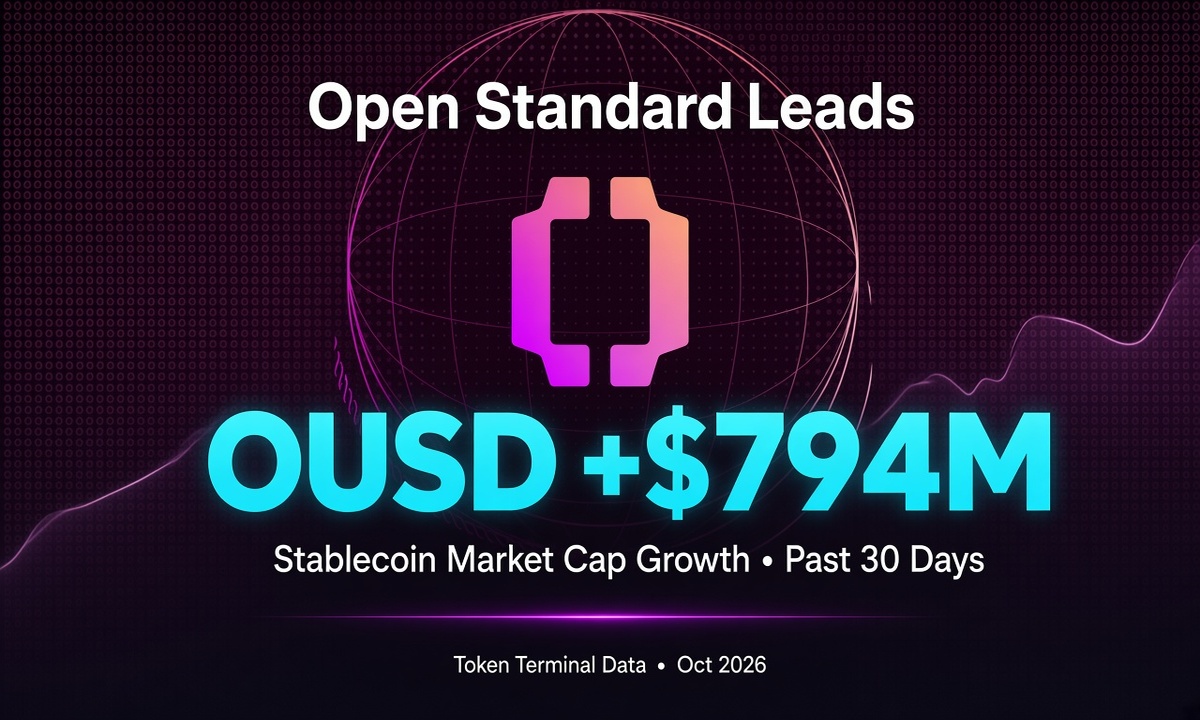
Open Standard has pulled ahead of every other stablecoin issuer in the past 30 days.
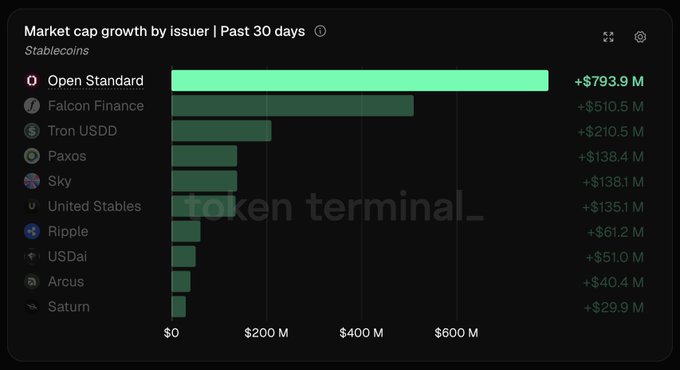
Its OUSD token alone added $794 million in market cap, according to the latest Token Terminal data released on Tuesday, 27th October, 2026.
That single figure places Open Standard at the top of the growth rankings while most established names posted far smaller gains.
Token Terminal tracks on-chain market-cap changes across issuers, and the numbers leave little room for doubt.
What Exactly Is Open Standard and Why Does Its Growth Matter Right Now?
Open Standard operates as an independent company whose founding partners include Coinbase, Mastercard, Shopify, Stripe and Visa.
The group designed OUSD as shared infrastructure rather than a single-company product.
Partners receive nearly all reserve earnings after a small management fee, and governance sits with a board drawn from those same partners.
Meanwhile, the token itself sits on four chains—Tempo, Ethereum, Base and Solana—and businesses can mint or redeem it at 1:1 with no fees and no volume caps.
Further, reserves stay with major institutions such as BlackRock, Lead Bank and BNY Mellon, with monthly attestations published.
These design choices help explain the rapid capital inflow.

How Did OUSD Reach Nearly $800 Million in Market Cap So Quickly?
OUSD went live on 30th September, 2026. Within weeks, it crossed $666 million, then $800 million, and the 30-day growth window captured most of that climb.
Tempo still holds the largest share of the supply, yet balances continue to appear across the other three chains.
In addition, zero-fee minting removes a common friction point that slows other stablecoins.
Next, the partner network now exceeds 200 companies, each with a direct economic incentive to drive usage.
Still, the speed of the ramp remains striking given the short time since launch.

Why Are Institutions Choosing Open Standard Over Traditional Issuers?
Traditional issuers keep most reserve yield. Open Standard returns that yield to the companies that actually distribute and use the token.
Although the model is still young, the alignment has already attracted large payment and fintech names.
Moreover, the absence of mint and redeem fees lowers operating costs for high-volume businesses.
Even so, the real test will come when transaction volumes scale further and the partner reward system faces real pressure.
What Does This Mean for the Broader Stablecoin Market?
The $794 million addition shows that new models can still capture meaningful share even in a market dominated by USDT and USDC.
Open Standard’s growth also highlights Tempo’s rising role as a settlement layer.
Later data will reveal whether the lead holds once the initial partner liquidity commitments fully deploy.
For now, the numbers from Token Terminal stand as the clearest signal that Open Standard has become the growth leader among stablecoin issuers over the past month.
