

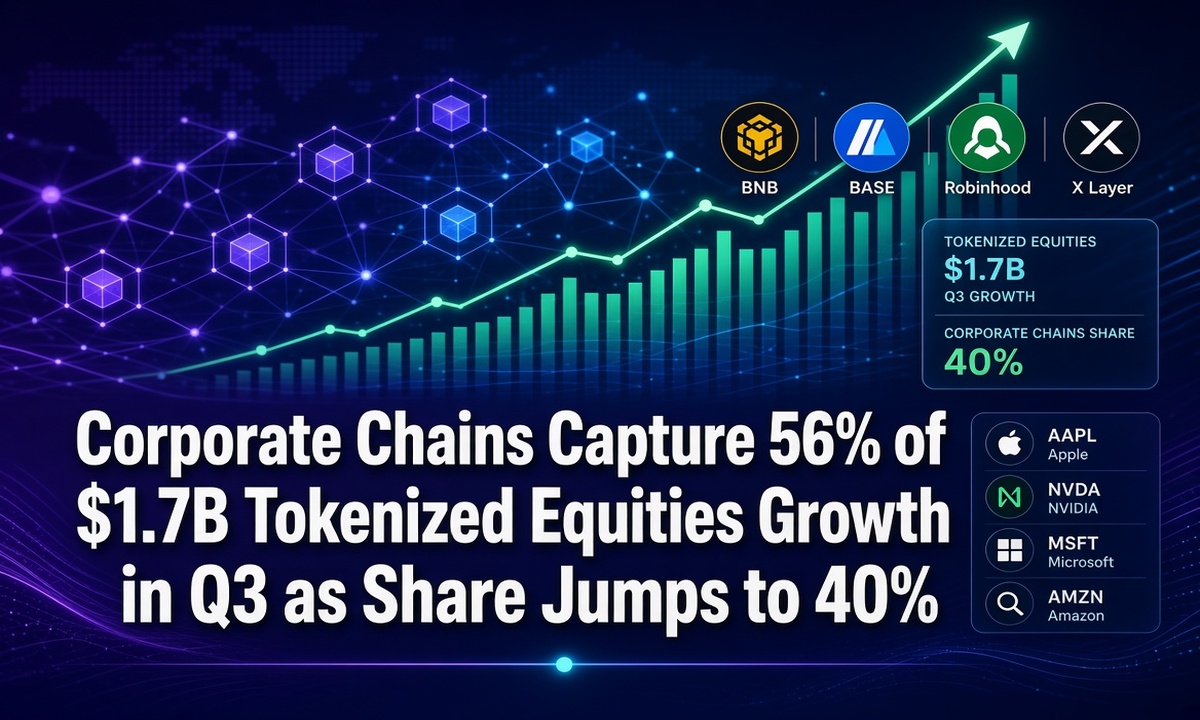
Corporate chains captured more than half of the fresh capital that flowed into tokenized equities during the third quarter (Q3) of 2026.
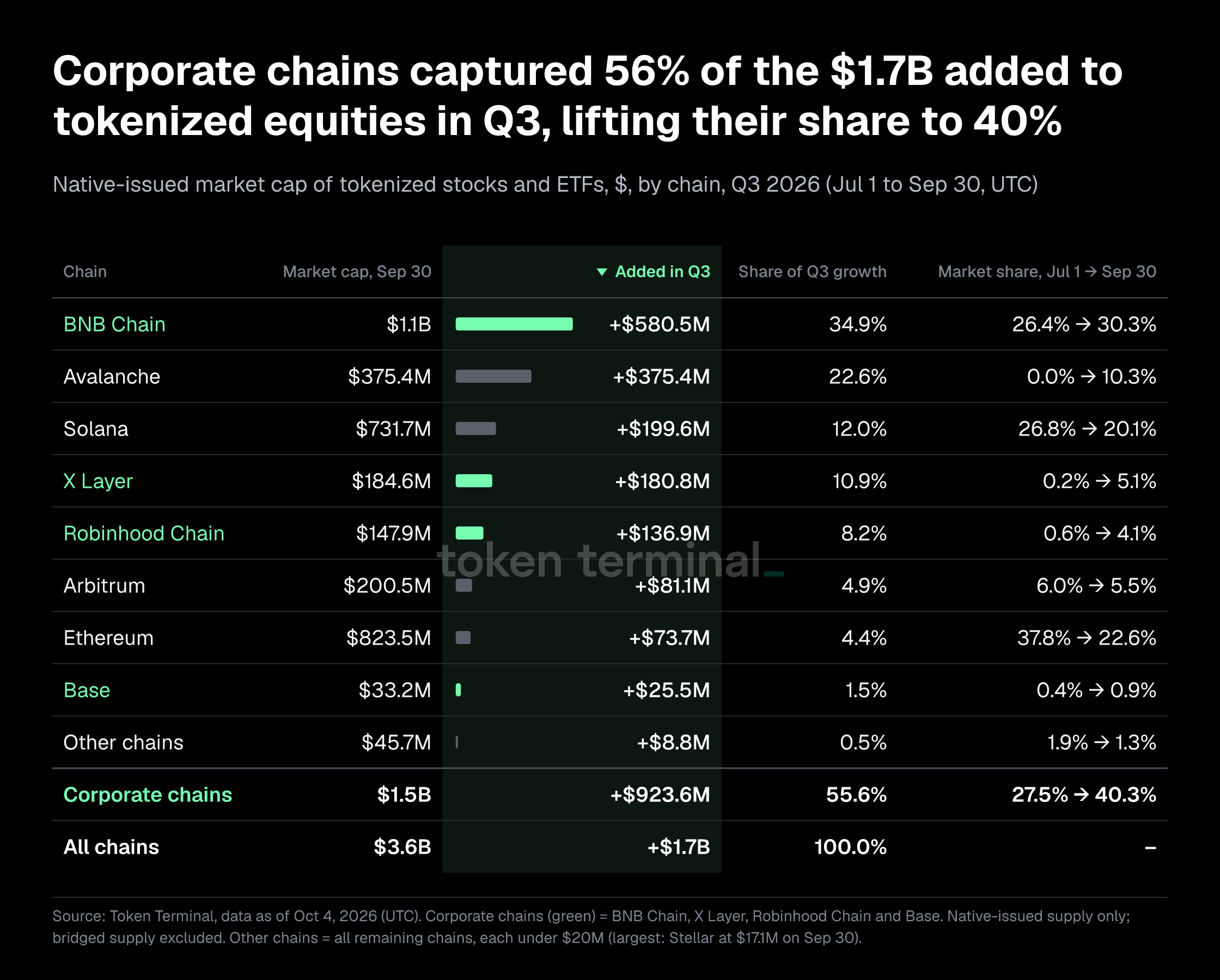
Token Terminal figures show these networks — BNB Chain, X Layer, Robinhood Chain and Base — absorbed 56% of the $1.7 billion added in Q3.
Their combined share of the overall market climbed from 28% to 40% in the process.
Looking at the numbers, the shift marks a clear change in where new tokenized equity value prefers to settle.
Meanwhile, traditional public chains continue to host significant activity, yet the corporate group now claims a much larger slice of recent growth.
Beyond the percentage jump, the concentration highlights how integrated ecosystems with strong retail reach and exchange ties pull capital faster than pure public alternatives.
What Are Tokenized Equities Corporate Chains?
Tokenized equities corporate chains refer to blockchains closely tied to major companies or exchanges — BNB Chain linked to Binance, X Layer associated with OKX, Robinhood Chain from the brokerage, and Base from Coinbase.
These networks often combine lower fees, built-in user bases and smoother on-ramps.
In parallel, they support tokenized stock products that let holders trade equity exposure around the clock while settling in stablecoins.
Why Did Corporate Chains Capture 56% of Q3 Growth?
Retail-friendly interfaces and existing customer funnels played a major role. At the same time, products such as bStocks and Robinhood Stock tokens expanded listings and improved liquidity on these networks.
Looking further, many users already hold accounts with the parent companies, so moving into on-chain equities feels like a natural next step rather than a separate journey.
Notably, faster finality and lower transaction costs also help these chains attract both new issuance and secondary trading volume.

How Did the Share of Tokenized Equities Corporate Chains Reach 40%?
The $1.7 billion of Q3 growth landed unevenly. Corporate chains took the majority, while other networks received smaller portions.
Beyond pure market-cap gains, holder counts and transfer activity also rose more sharply on the corporate group.
In parallel, issuers deliberately chose these chains for distribution because the parent platforms already serve millions of active users.

What Does This Shift Mean for the Broader Tokenized Equity Market?
The rising share of corporate chains signals that distribution and user access matter as much as pure decentralisation for this asset class.
Meanwhile, the overall tokenized equities sector keeps expanding, yet the growth engine has tilted toward ecosystems that already control large retail channels.
Looking ahead, competition among these corporate networks may intensify as each tries to lock in more equity products and liquidity.
Tokenized equities corporate chains now hold 40% of the market after capturing 56% of Q3’s $1.7 billion expansion.
The data shows how corporate-linked blockchains are reshaping where real-world equity value prefers to live on-chain.
