


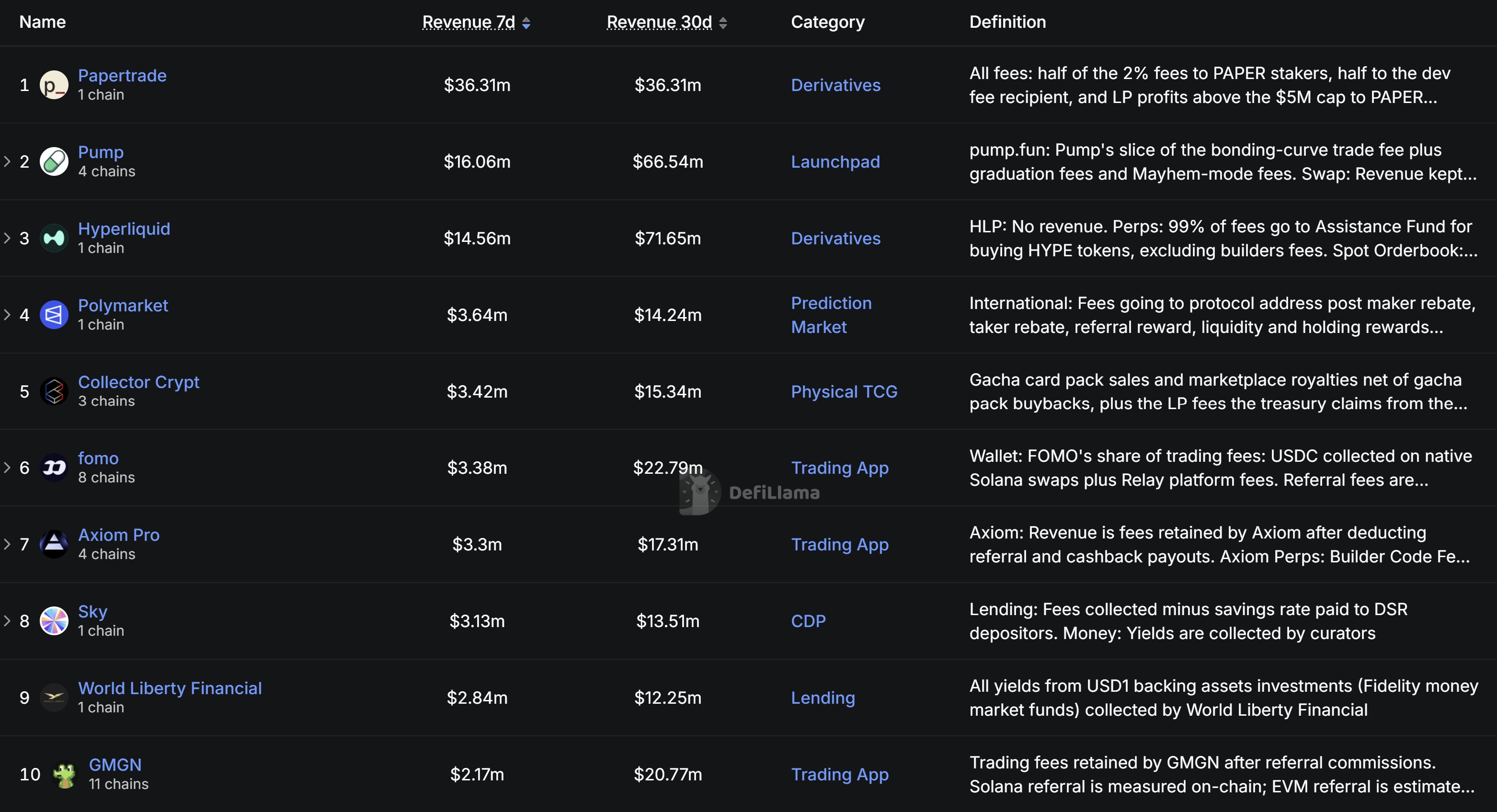
DefiLlama’s latest snapshot shows leading DeFi protocols revenue were more than $80 million across just seven days.
Trading-focused platforms and derivatives venues dominate the list, while classic lending and CDP products still claim spots further down.
This concentration of DeFi protocols revenue offers a clear window into where real fee generation currently sits.
Which Protocols Rank Highest by DeFi Protocols Revenue?
Papertrade leads with $36.31 million in seven-day revenue from its derivatives activity. Pump follows at $16.06 million through its launchpad fees, while Hyperliquid posts $14.56 million from perpetual trading.
Polymarket, Collector Crypt, fomo, Axiom Pro, Sky, World Liberty Financial, and GMGN round out the top ten.
Together, these ten protocols exceed the $80 million mark.
How Do Analysts Define DeFi Protocols Revenue?
DefiLlama tracks fees that protocols retain after maker rebates, referrals, and other payouts.
The figure captures what stays inside the protocol or flows to token holders rather than pure volume.
Different platforms report revenue in distinct ways—some route most fees to assistance funds or stakers, others keep a fixed share—yet the metric still allows side-by-side comparison.
Why Does Strong Decentralised Applications Money Matter Right Now?
High weekly revenue signals product-market fit more clearly than total value locked (TVL) alone.
Platforms that convert user activity into sustained fees tend to attract builders and capital even when broader markets stay quiet.
Meanwhile, revenue concentration in derivatives and launchpads highlights where speculative demand remains strongest.
Beyond pure numbers, the data helps separate protocols that generate real cash flow from those still relying heavily on token incentives.
Which Categories Drive Most of Today’s DeFi Protocols Revenue?
Derivatives and trading apps claim the largest shares. Papertrade and Hyperliquid sit in the derivatives vertical, while Pump, fomo, Axiom Pro, and GMGN operate as launchpads or trading interfaces.
Prediction markets and physical collectibles also appear, showing that fee generation now stretches beyond traditional lending and automated market makers (AMMs).
In parallel, Sky’s CDP model and World Liberty Financial’s lending yields prove that more established categories continue to monetize.
Can Elevated Revenue Support Long-Term Token Value?
Revenue itself does not automatically flow to token holders. Some protocols send the bulk of fees to assistance funds or buybacks, while others distribute directly.
Investors who examine the split between total revenue and holder revenue gain a sharper view of economic alignment.
At the same time, consistent multi-week performance often correlates with healthier fundamentals than one-off spikes.
The current leaderboard underlines a simple truth: DeFi protocol revenue still concentrates around high-velocity trading and speculative products.
Readers who track these rankings weekly can spot shifts early and weigh them against on-chain usage and incentive costs.
DefiLlama’s open data makes that ongoing comparison straightforward for anyone watching the space.
