

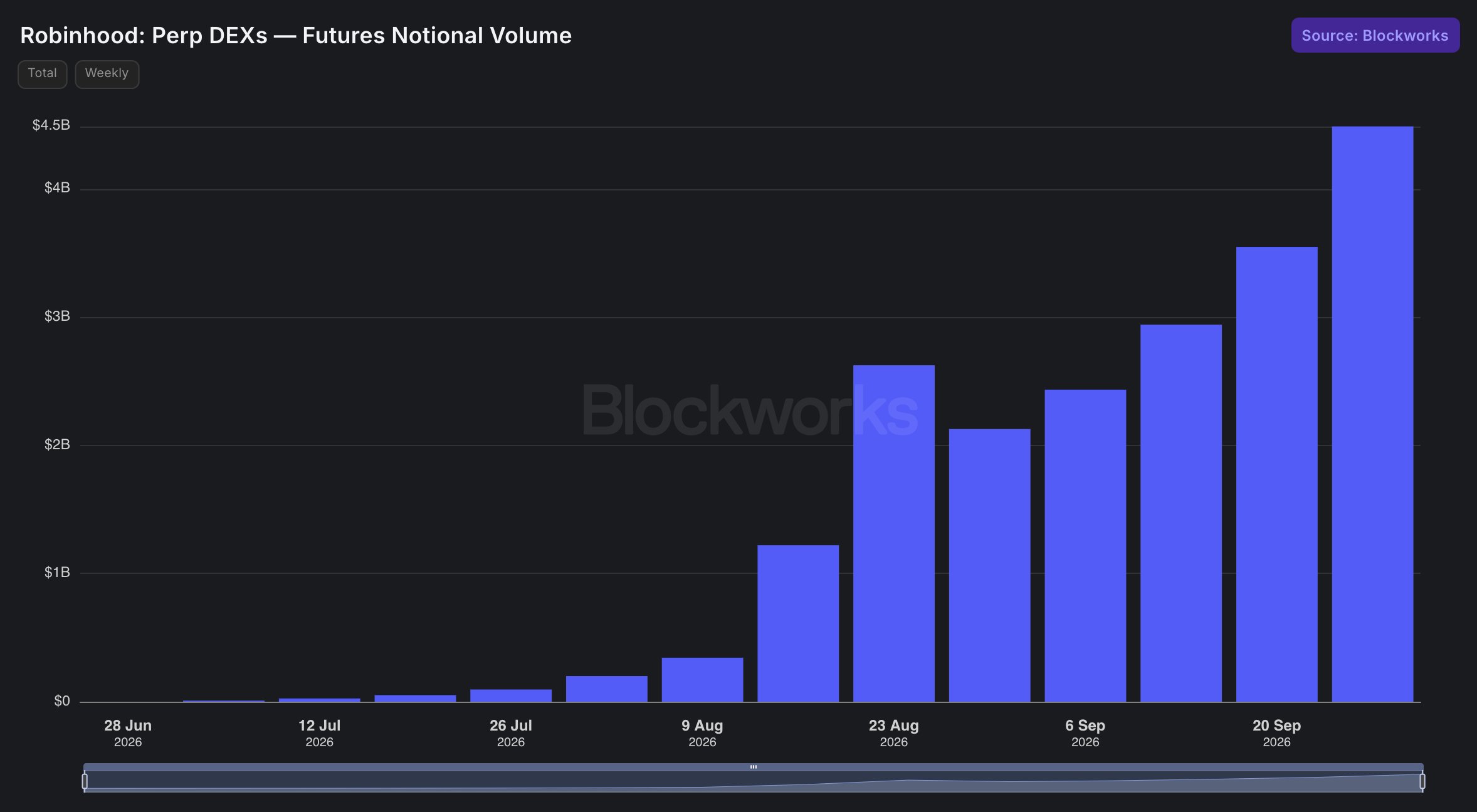
Robinhood Chain just posted a weekly all-time high in perpetual futures trading, with roughly $4.5 billion in perp volume during the week of September 21–27.
That figure, confirmed by on-chain trackers, marks a sharp climb for a network that only opened its mainnet on July 1.
MessariCrypto first flagged the milestone, and DefiLlama data places the exact total near $4.601 billion.
Open interest sat around $251 million at the time of the reading, while more recent snapshots show daily perp volume still running above $1 billion and 30-day totals near $15 billion.
The growth curve has been steep. From near-zero levels in late June 2026, the chain reached this high in about twelve weeks.
What Drove Robinhood Chain’s Perp Volume to a Weekly All-Time High?
Several forces lined up at once to help achieve this milestone. Capital already sitting on the chain from spot DEX activity created ready collateral for leveraged positions.
Stablecoin balances climbed past the billion-dollar mark. Meanwhile, Lighter’s integration inside the Robinhood wallet put perps only a few taps away for existing users.
That distribution advantage helped accelerate adoption faster than most new perp venues manage in their first year.
At the same time, broader market interest in tokenized equities and on-chain derivatives kept fresh liquidity flowing in.
Traders who first arrived for memecoins or stock tokens found an easy path into leveraged products once the infrastructure matured.
How Does Lighter Contribute to Robinhood Chain Perp Volume?
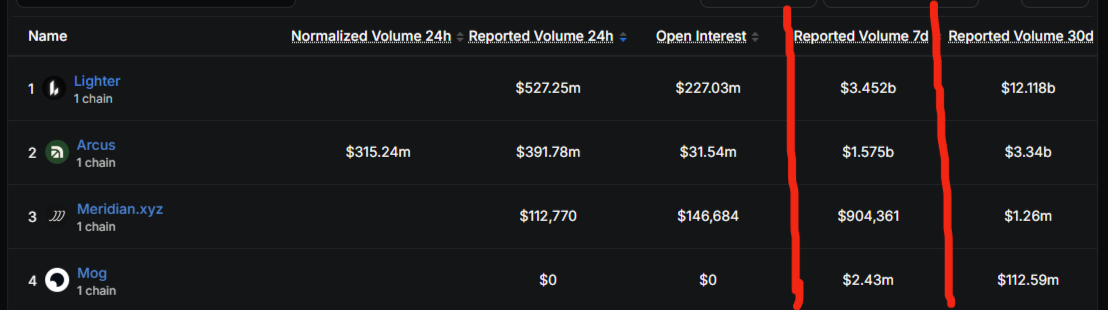
Lighter currently accounts for the bulk of activity. Over the record week, it generated about $3.45 billion, or roughly 75% of the chain-wide total.
Its 30-day figure sits near $12.1 billion, and total value locked (TVL) has climbed past $100 million.
Fees and protocol revenue have followed the volume upward, showing the platform is converting traffic into real economic activity.
Arcus holds a clear second place with roughly $1.58 billion in seven-day volume.
The gap between the two leaders and the rest of the field remains wide, yet the presence of a credible secondary venue reduces single-point risk for the overall market.
Why Is Robinhood Chain’s Perp Volume Growing So Quickly?
The chain benefits from built-in distribution that pure crypto-native platforms often lack.
Robinhood’s large retail base and wallet integration lower the barrier for users who have never traded perps before.
In parallel, rising spot volumes and tokenized stock activity create natural spillover into derivatives.
Once traders hold collateral on-chain, the next logical step is often a leveraged position.
Timing also played a role. Lighter’s wallet-level support arrived while the network was already attracting attention for its DEX numbers.
That combination produced a feedback loop: higher volume attracted more liquidity providers, which in turn supported larger open interest and smoother trading.
What Does This Mean for Traders and the Broader Crypto Market?
For individual traders, the upside is clearer access to leveraged exposure on a chain designed with retail users in mind.
Open interest above $250 million suggests enough depth for meaningful position sizes, though concentration in one venue still warrants caution.
For the wider market, the milestone signals that traditional finance (TradFi) brands can bootstrap on-chain derivatives faster than many expected.
Other L2s and DEX teams will likely study the distribution model closely.

Can Robinhood Chain Sustain High Metrics Levels?
Sustaining the current pace depends on continued wallet integration, steady stablecoin inflows, and healthy competition between Lighter and Arcus.
Open interest has continued to rise even after the record week, and daily volumes remain elevated.
If collateral keeps arriving and user experience stays seamless, the chain has room to grow further.
Concentration risk remains the main watch point; any prolonged outage on the dominant venue could temporarily compress total perp volume.
Overall, the $4.5 billion weekly mark shows how quickly a well-distributed Layer 2 can build a derivatives market.
The numbers are still early, yet the trajectory already ranks among the fastest ramp-ups seen in recent perp DEX launches.
