

Tokenized stocks just delivered a weekend punch that few expected this early.
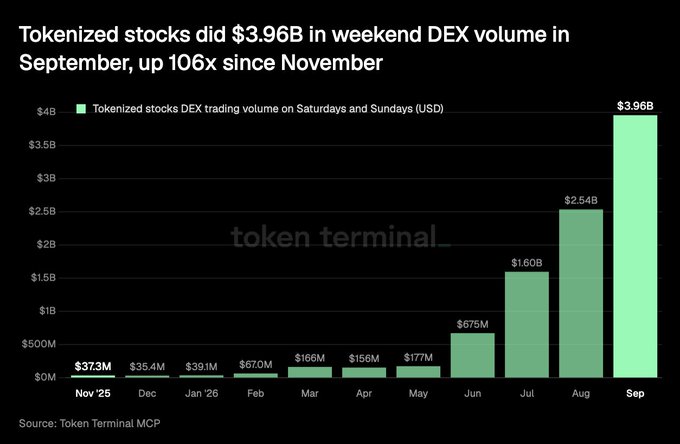
In September 2026 alone, these blockchain versions of traditional equities generated $3.96 billion in decentralised exchange (DEX) volume across Saturdays and Sundays.
That number sits 106 times higher since November 2025’s $37.3 million. This is a clear indication that traders no longer wait for Wall Street to open, they simply trade.
What Are Tokenized Stocks and Why Do They Matter?
Tokenized stocks are digital tokens that track the price of real shares or exchange-traded funds (ETFs).
Holders gain exposure to companies like Nvidia, Tesla, or funds such as QQQ without touching a traditional brokerage.
Because these tokens live on public blockchains, they move freely on decentralised exchanges at any hour.
Traditional markets shut down every weekend while tokenized stocks keep running.
This difference creates continuous price discovery and opens equity exposure to global crypto-native users who previously sat on the sidelines.
How Did Weekend DEX Volume Reach $3.96 Billion in September?
September’s weekend activity stood out even against a busy year. One snapshot earlier in the month already showed $2.95 billion in weekend volume inside a broader 30-day total near $15.75 billion.
Over the Labour Day holiday alone, volume crossed $1 billion—nearly matching a full weekday session.
Platforms never pause, so liquidity stayed available while cash markets stayed dark.
Token Terminal data captured the full-month weekend total at $3.96 billion, confirming the surge.
Why Has Volume Grown 106x Since November 2025?
Growth arrived through better product design and wider chain support. Early tokenized stock experiments barely registered.
Liquidity stayed thin and listings remained limited. Throughout 2026, issuers expanded offerings while DEXs added permissioned pools and deeper liquidity.
Active market capitalisation for tokenized equities climbed to roughly $4 billion by September 2026, a 314% year-to-date (YTD) rise.
Total value locked moved from $21.6 million in January to $289 million. Monthly volumes expanded into the multi-billion range.
Each improvement fed the next, turning a niche product into a measurable slice of overall DEX activity—now above 4% of spot volume compared with 0.1% at the end of 2025.

Which Platforms and Chains Drive This Activity?
Several venues share the load. Uniswap’s v3 and v4 pools frequently capture the largest share of tokenized stock flow, sometimes exceeding 60% of recent 30-day totals.
Robinhood Chain, Solana-based venues such as Raydium and Orca, BNB Chain’s bStocks, and Base all contribute meaningful volume.
During the Labour Day stretch, Robinhood Chain alone handled more than half the weekend activity.
Popular tickers include tokenized versions of QQQ, SPY, NVDA, and AAPL. Liquidity providers (LPs) and market makers now treat these pairs as serious venues rather than experimental side pools.

What Does This Mean for Traditional Markets?
Continuous trading changes the rhythm of equity markets. News that hits on a Saturday no longer waits until Monday.
Tokenized versions adjust in real time, and those moves often preview the direction of the opening gap.
Institutions still face regulatory and custody hurdles, yet the infrastructure already exists for 24/7 equity exposure.
Retail and crypto-native traders simply use it today. Over time, this pressure may push traditional exchanges toward longer hours or deeper after-hours tools.
Are Tokenized Stocks a Sustainable Trend?
The numbers suggest staying power rather than a one-month spike. Year-over-year (YTD) DEX volume for the category has grown more than 10,000%.
Cumulative activity across recent periods sits between $15 billion and $20.9 billion in 30-day windows.
Issuers continue adding symbols, while decentralised finance (DeFi) protocols experiment with tokenized stocks as collateral.
Risks remain—regulatory clarity varies by jurisdiction and underlying custody models differ—but the product now solves a real pain point: markets that never sleep meeting assets that previously did.
Tokenized stocks have moved from curiosity to infrastructure. September’s $3.96 billion weekend figure simply made the shift visible.
Traders already treat weekends as open for business. Traditional finance will eventually have to respond.
