
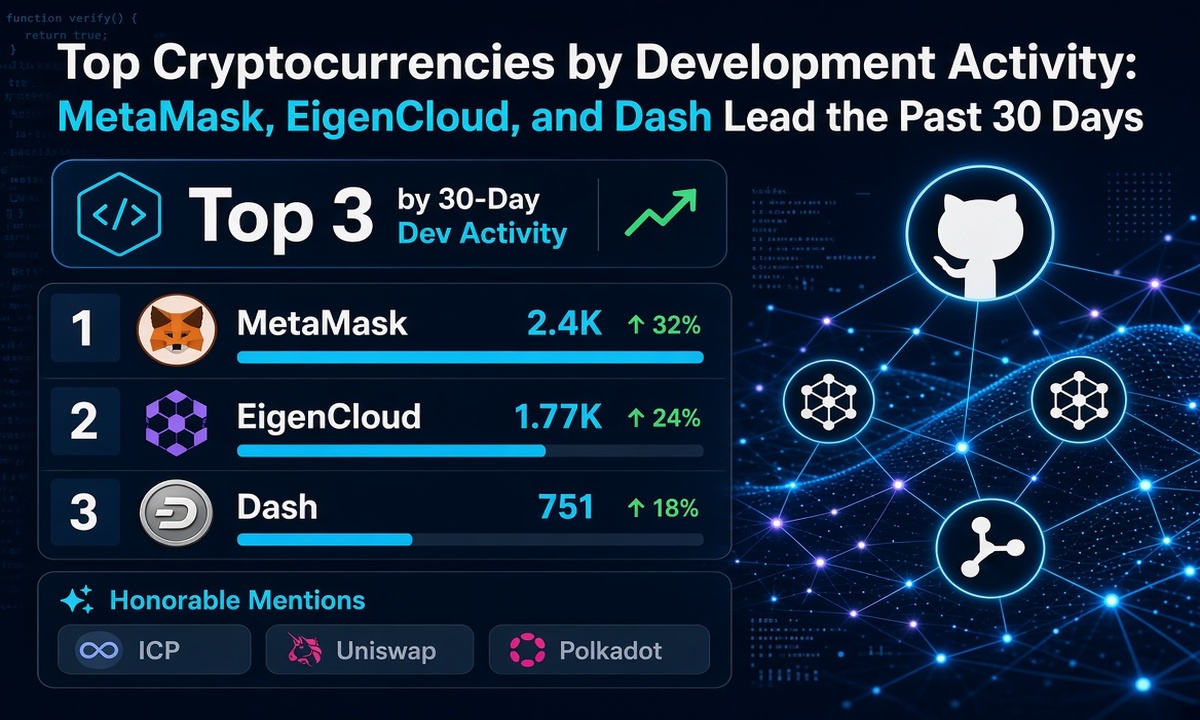
Fresh data from blockchain analytics firm Santiment reveals which crypto projects poured the most energy into code in the form of development activity over the last thirty (30) days.
MetaMask, EigenCloud, and Dash sit at the front of the pack, while several established networks trail close behind.
Development activity remains one of the clearest signals that teams keep shipping rather than merely talking.
How Santiment Tracks Development Activity
Santiment measures pure development activity by counting selected GitHub events in public repositories.
The metric deliberately ignores routine noise such as issue comments, forks, stars, and pure project-management clicks.
Instead, it focuses on the events that actually move code forward. This approach avoids the distortions that come from simply tallying commits, which can be inflated by inherited history or automated bots.
Which Projects Topped the Latest Ranking?
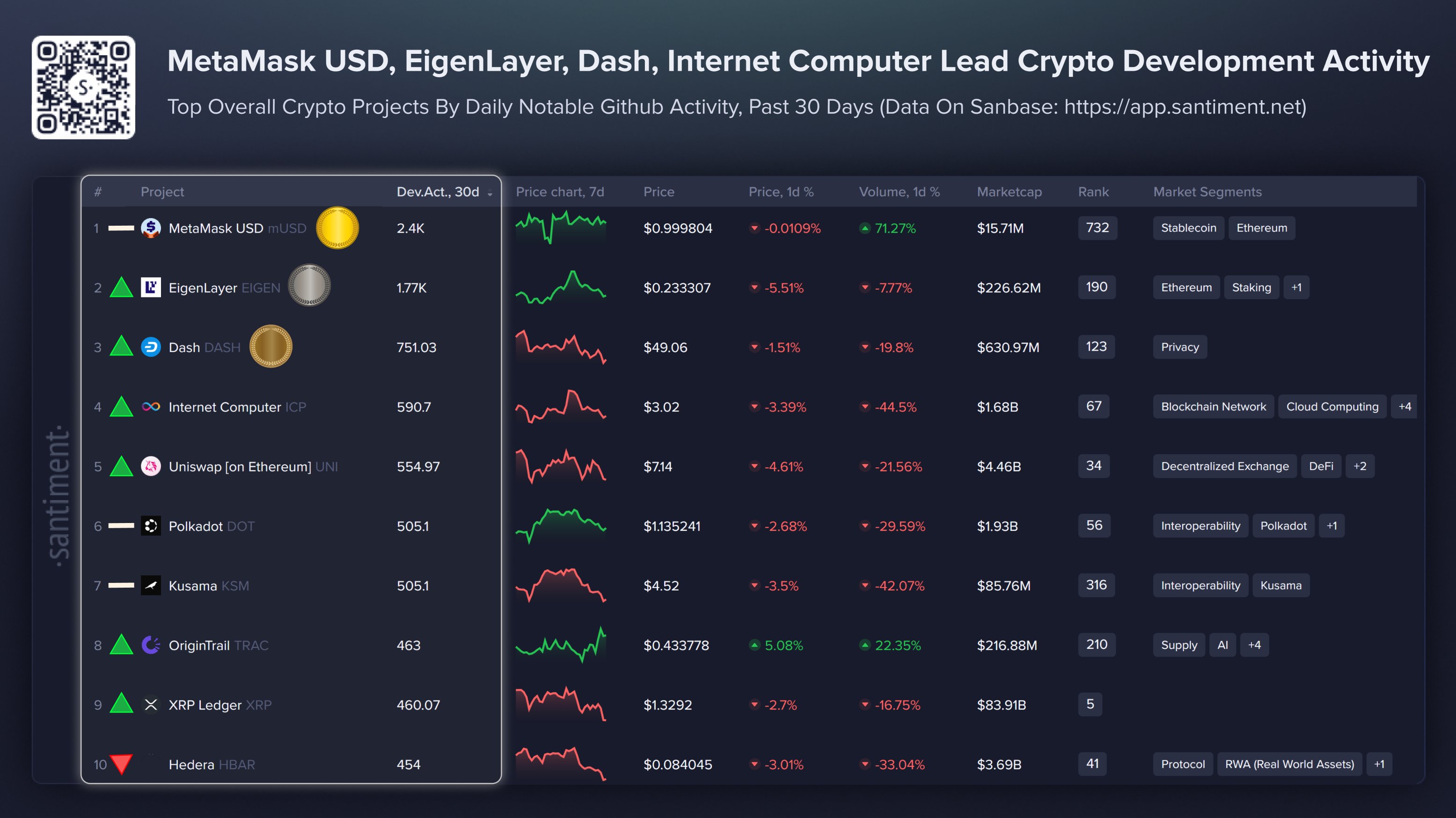
MetaMask USD (mUSD) claims the number-one spot with roughly 2.4K notable development events.
EigenCloud (tied to the EigenLayer ecosystem and $EIGEN) follows with 1.77K, while Dash records 751.
Internet Computer, Uniswap on Ethereum, Polkadot, Kusama, OriginTrail, the XRP Ledger, and Hedera complete the top ten.
Several of these names climbed in rank compared with the previous update, suggesting sustained or accelerating engineering work.
Why Does Strong Development Activity Matter Right Now?
Teams that keep their repositories busy tend to release features, fix vulnerabilities, and expand infrastructure even when market prices move sideways.
Investors often treat consistent development activity as a screening filter rather than a short-term buy signal.
Projects that appear month after month usually demonstrate genuine commitment rather than one-off publicity spikes.
Meanwhile, high activity does not automatically guarantee product-market fit, yet the absence of activity frequently precedes stagnation.
What Does High Development Activity Actually Signal for Investors?
It signals that engineers are still writing and reviewing code. In practice, this often precedes new product launches or protocol upgrades.
Traders who combine the metric with on-chain usage and social data can better separate active builders from marketing-heavy projects.
Still, private repositories remain invisible, so the numbers capture only the public portion of the work.

Can Development Activity Predict Price Moves?
Historically, sustained high development activity has correlated with longer-term resilience more than with immediate price pumps.
Short-term price action frequently decouples from GitHub charts. Therefore, many analysts treat the ranking as a quality filter rather than a timing tool.
Projects that repeatedly rank near the top tend to maintain roadmaps even during quiet market periods.
How Reliable Is GitHub Data for Crypto Research?
Santiment’s filtered-event method improves reliability over raw commit counts, yet limitations persist.
Work done in closed repositories never appears, and not every push equals high-value innovation.
Cross-checking the ranking against release notes and actual mainnet upgrades remains essential.
Overall, the metric still ranks among the more transparent open-source signals available to the market.
MetaMask’s lead reflects ongoing work around its native stablecoin and wallet infrastructure.
EigenCloud’s strong showing points to continued engineering around restaking and cloud services.
Dash’s third-place finish shows that older payment-focused networks can still generate meaningful code volume.
Together, these three projects illustrate that development activity spans wallets, infrastructure layers, and legacy coins alike.
Stakeholders who want the latest numbers can sort Santiment’s data screener by development activity at any time.
Tracking the same projects across successive 30-day windows often reveals which teams maintain momentum and which ones cool off.
In a market full of noise, steady code commits still offer one of the cleaner windows into real progress.
