

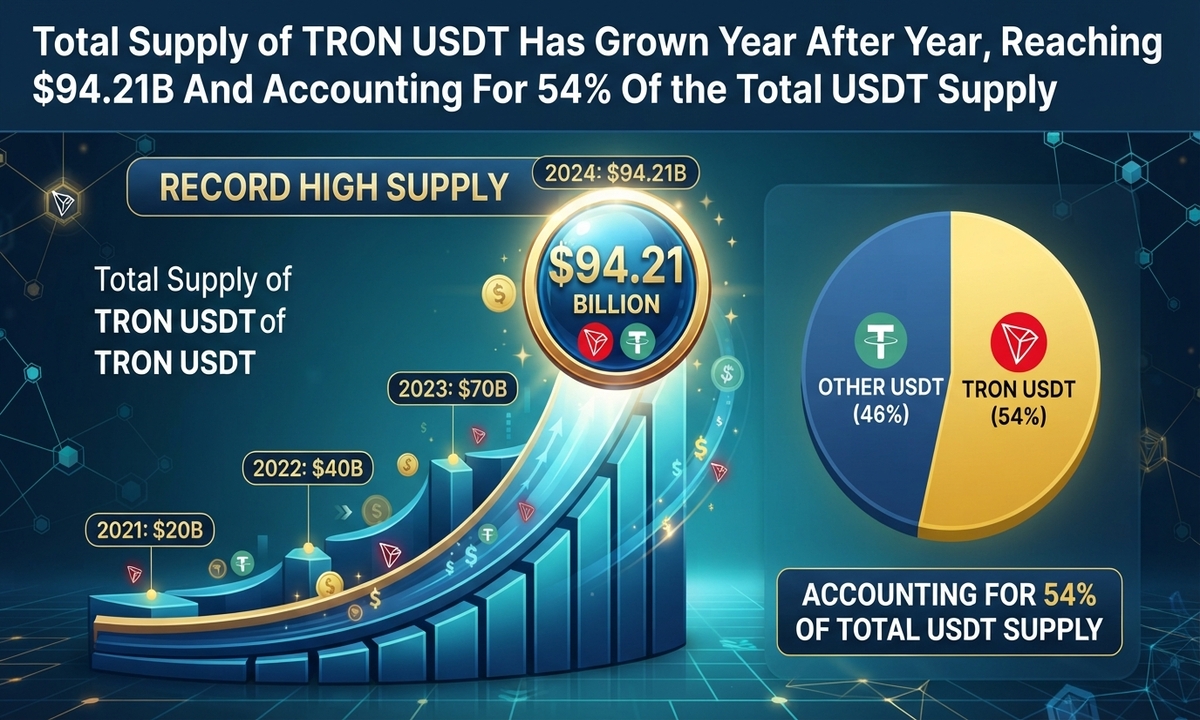
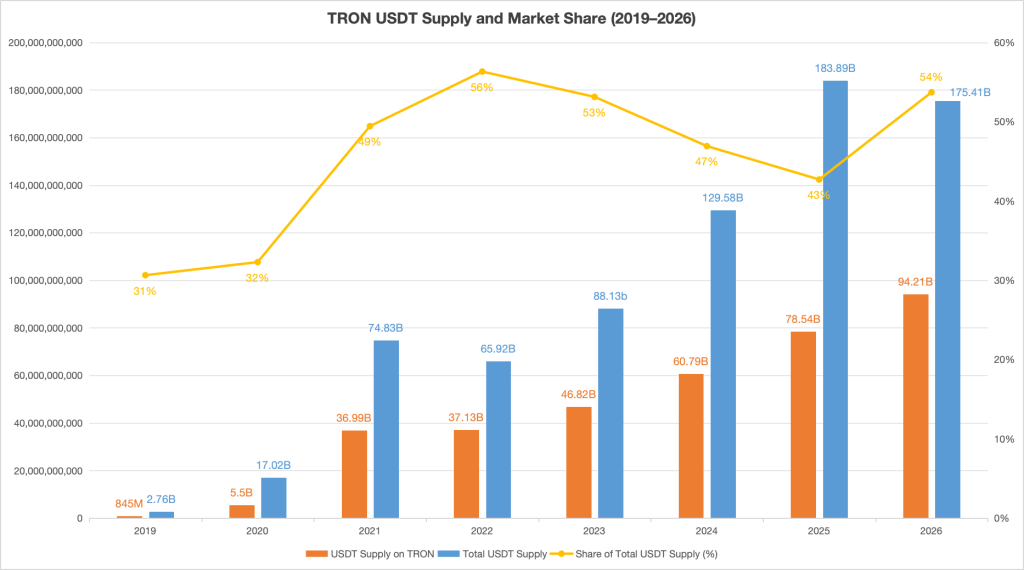
Lookonchain data released on November 18, 2026, shows the USDT supply sitting on the TRON network has climbed steadily for years and now stands at $94.21 billion.
That figure represents 54% of every USDT in circulation.
In practical terms, more than half of the world’s most used dollar stablecoin now lives on one chain.
This concentration did not appear overnight.
TRON has spent years building the cheapest and fastest path for moving digital dollars, especially across borders and in peer-to-peer (P2P) transfers.
Users and exchanges have responded by parking more USDT there than anywhere else.
Why Has TRON Become the Preferred Home for USDT?
Low fees remain the clearest driver. Transferring USDT on TRON costs a fraction of what the same move costs on Ethereum, and the network handles the load without congestion spikes that once plagued other chains.
High daily transfer volumes—often exceeding $20 billion—show real economic activity rather than idle capital.
Remittance corridors, OTC desks, and retail users in emerging markets treat TRON as their default settlement layer.
Year after year the supply has expanded because the product-market fit is genuine.
When people need to send dollars quickly and cheaply, they reach for TRON USDT first.
How Does This Compare With Ethereum and Other Chains?
Ethereum still hosts a large share of USDT, yet the gap has reversed.
Recent on-chain trackers place TRON ahead by several billion dollars.
BNB Chain, Solana, and smaller networks hold far less.
The split reveals two different use cases: Ethereum continues to dominate DeFi collateral and institutional flows, while TRON has captured the high-velocity payment and remittance traffic.
This specialisation explains why TRON’s share keeps rising even when overall crypto market conditions stay muted.
What Does 54% Concentration Mean for the Broader Market?
Holding more than half of all USDT on a single network creates both efficiency and risk.
Liquidity becomes deeper and spreads tighten for users on TRON.
At the same time, any major operational, regulatory, or technical issue on the chain could affect a large portion of global stablecoin activity.
Tether retains the ability to freeze addresses across networks, so control of the “switch” remains centralised even as the supply decentralises across blockchains.
Market observers now watch whether competing low-fee chains can erode TRON’s lead or whether the network’s first-mover advantage in payments proves durable.

Is the TRON Growth Sustainable and What Comes Next?
Past growth rates suggest the climb can continue if fees stay low and user habits remain sticky.
TRON already processes trillions of dollars in annual USDT transfers.
Further expansion into more remittance corridors and merchant tools would reinforce the trend.
Still, competition from other high-throughput chains and shifting regulatory scrutiny of stablecoins could slow the pace.
For now, the data is unambiguous: TRON has become the primary home for USDT.
The $94.21 billion figure and the 54% share mark a quiet but decisive shift in how digital dollars move around the world.
