

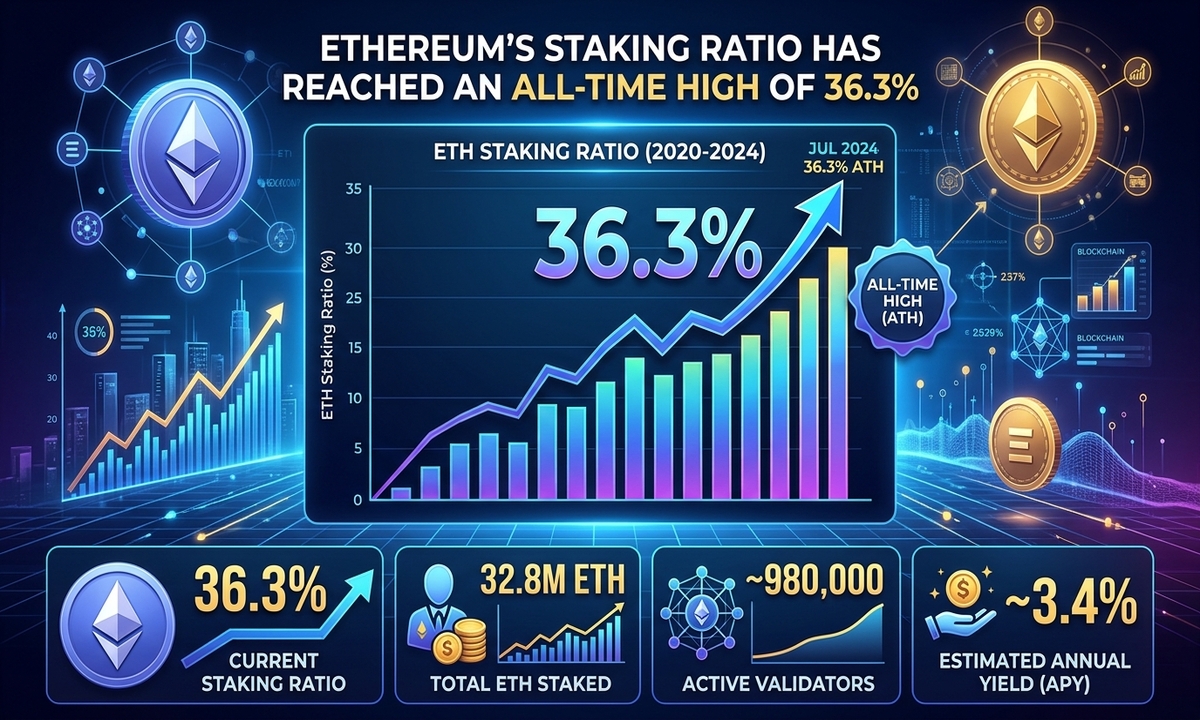
Ethereum just crossed a quiet but powerful threshold.
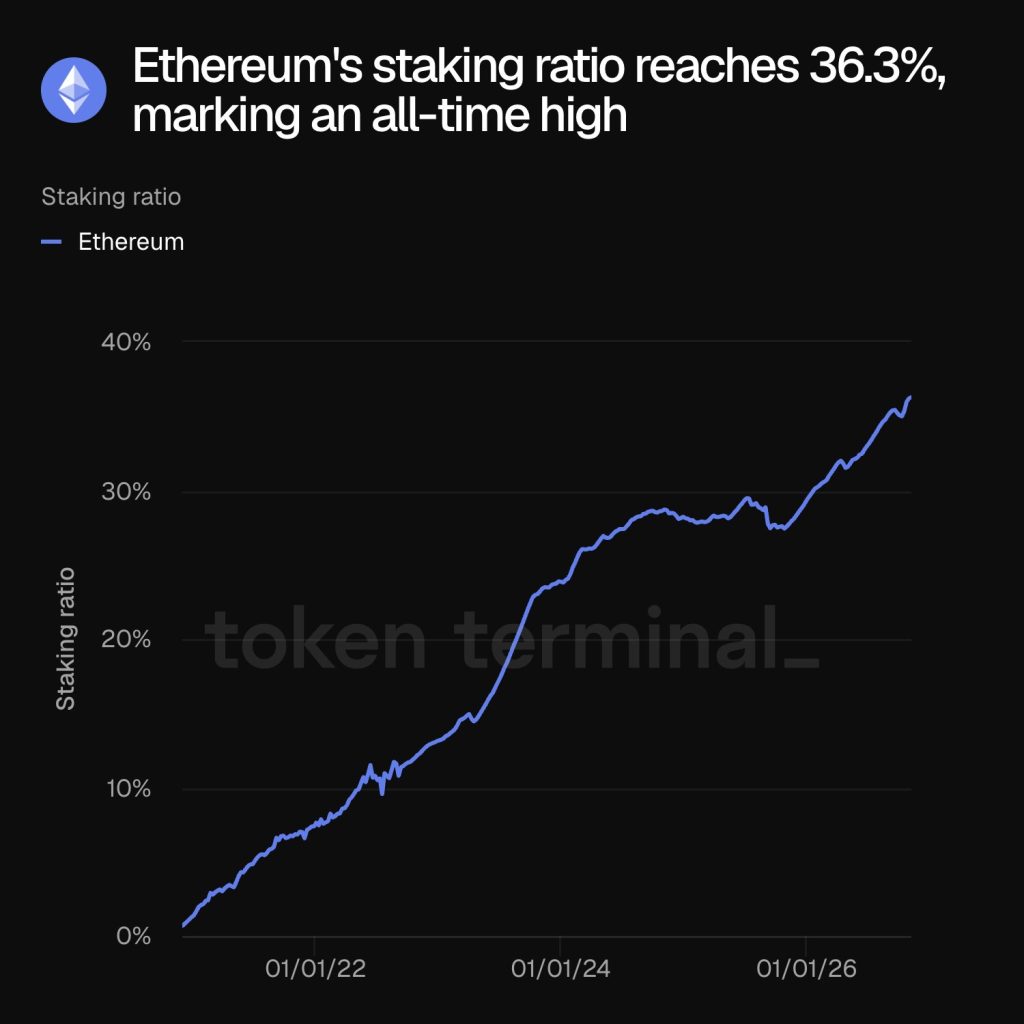
Token Terminal data shows the network’s staking ratio climbed to 36.3%, the highest level ever recorded.
More than one-third (1/3) of all circulating ethereum now sits locked in validators.
Holders appear to treat ethereum less like a trading chip and more like a long-term store of wealth.
What Does Ethereum’s Staking Ratio Actually Measure?
The staking ratio tracks the share of total ethereum supply deposited into the proof-of-stake (PoS) system.
Validators lock 32 ethereum each to propose and attest blocks.
In return, they earn newly issued ethereum plus a slice of transaction fees and MEV.
When the ratio rises, a larger portion of the asset moves out of liquid markets and into the consensus layer.
Right now that portion stands at roughly 44 million ethereum out of a total supply near 122 million.

Why Has the Ratio Climbed So Steadily?
Several forces pulled ethereum into staking at the same time.
Liquid staking tokens such as stETH kept the asset usable in decentralised finance (DeFi) while still earning yield.
Institutional desks and corporate treasuries added large blocks after the Shanghai upgrade removed the permanent lock-up.
Meanwhile, retail holders continued depositing even as annualised yields compressed toward the low-2-percent range.
Beyond the yield itself, many participants simply prefer ethereum to sit and secure the network rather than sit on an exchange.
The chart from Token Terminal shows a near-unbroken climb since early 2022, with only brief pauses.

How Does a Higher Staking Ratio Shape Ethereum’s Supply and Price Dynamics?
Every additional ETH that enters a validator reduces the liquid float available for sale.
In practice, this creates a thinner order book on the sell side during rallies.
At the same time, the network issues new ethereum as staking rewards, so the absolute supply still grows—yet, the growth now concentrates among stakers.
Yields have fallen as more capital competes for the same reward pool; current network annual percentage returns (APR) hovers near 2.3–2.6% depending on the provider.
Still, the reduced liquid supply can amplify price moves once demand returns.

What Risks Come With an Ethereum All-Time-High Staking Ratio?
Concentration remains the clearest concern. Liquid staking protocols, led by Lido, continue to control a large share of the total stake.
A high ratio does not automatically equal healthy decentralisation if a handful of operators dominate the validator set.
Exit queues can also stretch during market stress, delaying withdrawals.
Finally, the declining yield may eventually slow new deposits once the opportunity cost of locking capital becomes harder to ignore.
On the other side of the ledger, the same high ratio strengthens network security because an attacker would need to control even more capital to threaten consensus.

How Can Everyday Holders Still Participate in Ethereum Staking?
Solo staking still requires 32 ETH and reliable hardware, yet liquid staking and exchange products lower the barrier dramatically.
Users can deposit any amount, receive a liquid token, and remain free to trade or lend that token while the underlying ethereum earns rewards.
The trade-off appears in fees and smart-contract risk.
Anyone considering the move should compare current net yields after operator cuts and understand the withdrawal mechanics of each platform.
Ethereum’s 36.3% staking ratio signals a quiet shift in how holders value the asset.
Capital keeps flowing into the protocol even while price action stays range-bound and yields shrink.
That combination suggests many participants now view ethereum as infrastructure they want to own and secure rather than a short-term trading vehicle.
The next chapters will show whether the liquid float thins enough to matter for price discovery and whether the network can keep expanding participation without further centralising validation power.
