

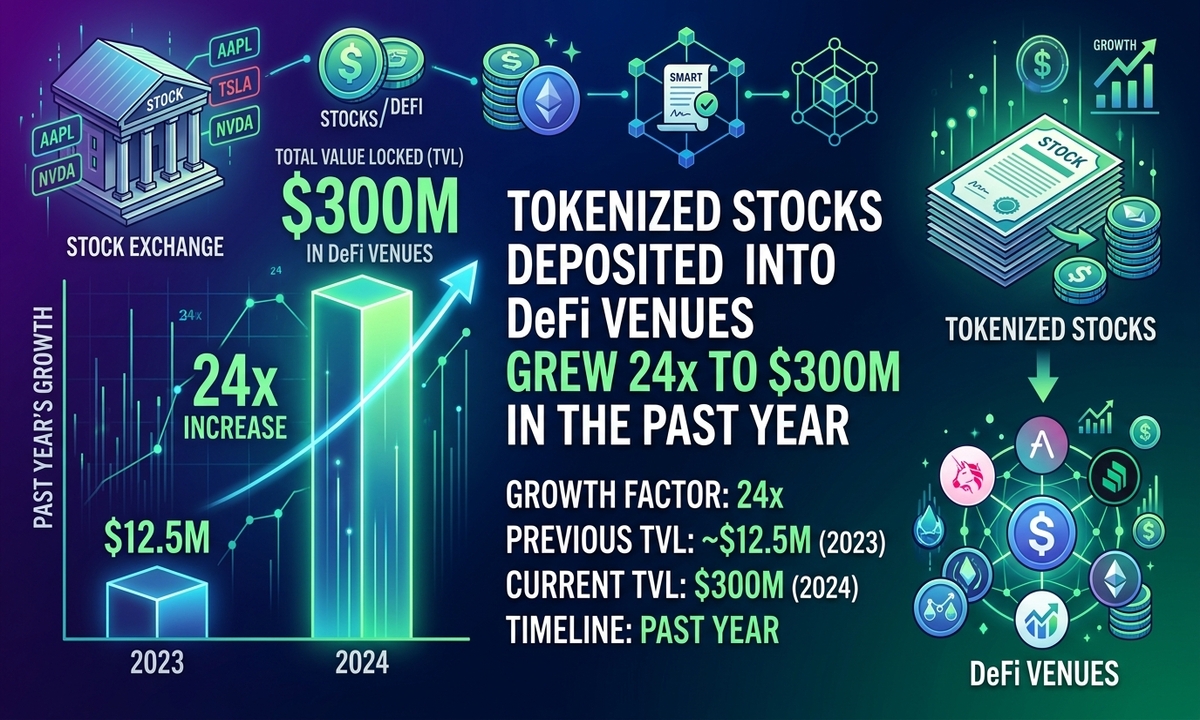
Tokenized stocks have shifted from passive holdings into active decentralised finance (DeFi) use at remarkable speed.
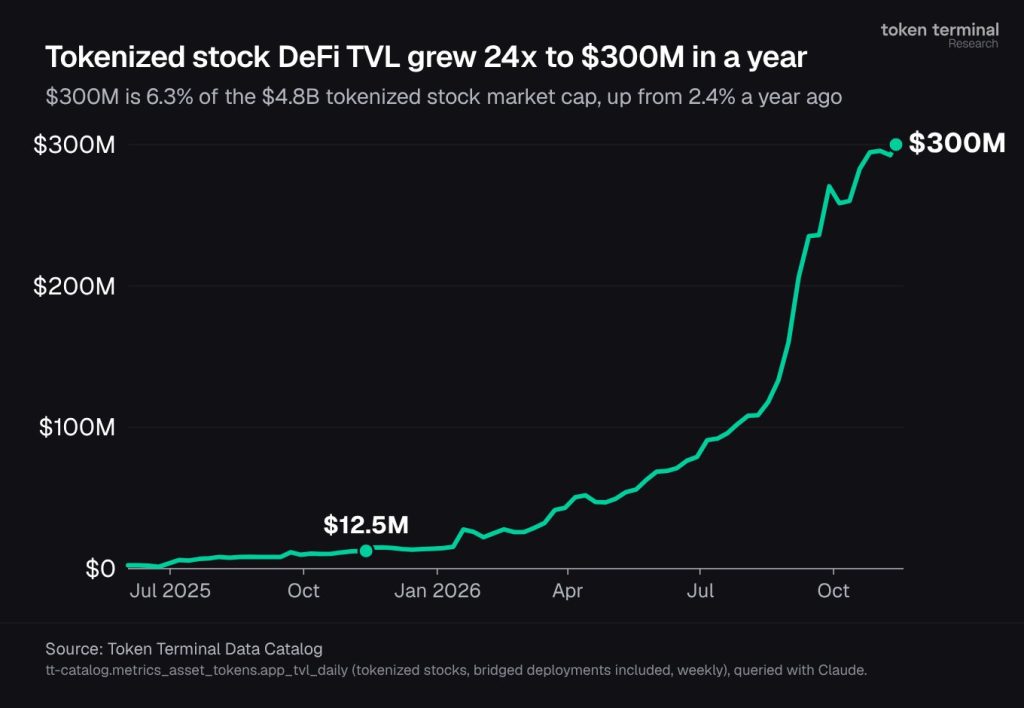
According to Token Terminal data shared on November 15, 2026, deposits of these assets into decentralised venues climbed 24 times to reach $300 million over the past year.
That same data shows deposits now represent 6.3% of the overall tokenized stock market capitalisation, rising from just 2.4% twelve months earlier.
Holders no longer simply sit on exposure to familiar equities. Instead, they post the tokens as collateral or supply them into trading pools, unlocking borrowing capacity and fee income while keeping price exposure.
The move marks a clear step from pure issuance toward productive on-chain utility.

What Are Tokenized Stocks and Why Do They Matter Now?
Tokenized stocks are blockchain tokens that track the price of listed shares or exchange-traded funds (ETFs), typically backed one-for-one by actual shares held with regulated custodians.
They trade around the clock and settle instantly. In the past year, the broader category has expanded rapidly, with market capitalisation figures recently reported near $4.8 billion.
Meanwhile, the share parked in DeFi protocols has grown even faster.
This gap between total issuance and active deployment reveals that many holders still treat the tokens mainly as portable ownership claims.
Yet, the rising deposit ratio signals that more capital is beginning to seek yield and leverage inside existing DeFi infrastructure.
How Did Deposits Reach $300 Million So Quickly?
Growth accelerated sharply in the second half of 2026 after several major issuers expanded availability and new chains onboarded the assets.
Solana, Robinhood Chain, and BNB Chain have absorbed the bulk of the activity. xStocks, Robinhood offerings, and Binance bStocks account for the largest portions of the deposited value across lending markets and liquidity pools.
In addition, protocols such as Kamino, Pendle, Uniswap, and others have integrated the tokens, giving users straightforward ways to earn fees or borrow against them.
The 24-fold rise therefore reflects both wider issuance and improving venue support rather than a single catalyst.
How Can Investors Actually Use Tokenized Stocks in DeFi?
Investors deposit the tokens into lending markets to borrow stablecoins while retaining equity exposure.
Others supply them to automated market makers and earn trading fees.
Some platforms also allow yield tokenization, letting holders separate and trade the income component.
Still, utilisation remains uneven. Commentators note that only a portion of the $300 million appears actively borrowed against so far, leaving room for further uptake as more users discover the tools.
What Does the Jump to 6.3% of Market Cap Signal?
The rise from 2.4% to 6.3% shows tokenized stocks are following a path similar to earlier crypto assets that gradually moved from wallets into productive contracts.
Each additional deposit adds liquidity for the next participant and generates returns for the supplier.
At the same time, the absolute numbers stay modest against both the multi-billion-dollar tokenized stock market and the much larger traditional equity universe.
The trajectory, however, points to growing comfort with on-chain equity collateral.
Looking Ahead for Tokenized Stocks in DeFi
Further integration with lending, trading, and structured-product protocols could push the deposit ratio higher.
Weekend trading already captures meaningful volume because traditional exchanges sit closed, giving on-chain venues a structural edge.
As more issuers and chains support the assets, and as interfaces simplify collateral management, deposits of tokenized stocks into DeFi venues may continue climbing from the current $300 million base.
The data from Token Terminal underscores that the productive phase of this market has begun in earnest.
