

Chainalysis just released fresh numbers that paint a clear picture of shifting ground within the crypto economy.
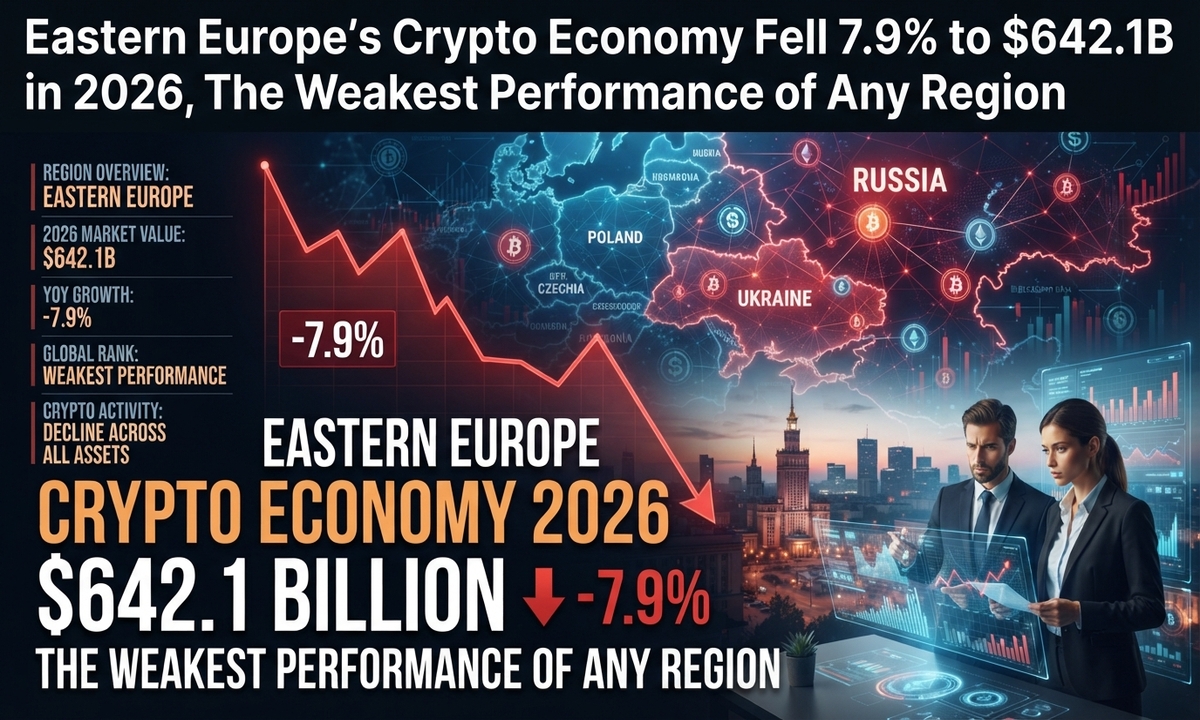
Eastern Europe’s overall crypto economy contracted 7.9% during the year ending June 2026, landing at $642.1 billion.
That marks the steepest regional drop among the eight areas the firm tracks.
Meanwhile, the global figure slipped only 1.6%, so the underperformance stands out sharply.
Large institutional-style flows pulled back hard. Transfers above $10,000 into crypto services fell 17.4%.
At the same time, ordinary users pushed in the opposite direction.
Domestic peer-to-peer (P2P) volume exploded 330%, and retail-sized transfers under $10,000 actually climbed 8.3%.
Those smaller payments now make up 13.1% of the value moving into services across the region—the highest share anywhere in the world.

Why Did the Regional Crypto Economy Shrink While P2P Exploded?
War, sanctions pressure and regulatory tightening squeezed formal channels.
Russia, still the biggest market at roughly 44% of the regional total, saw its activity drop 14.7% to $284.1 billion.
Poland, the third-largest market, declined 7.3% to $95.6 billion.
When centralised platforms and large transfers become harder or costlier, people simply route money through peer-to-peer rails that sit outside those constraints.
The 330% P2P surge shows that demand never disappeared—it just changed shape.

How Are Ukrainians Abroad Using Stablecoins Right Now?
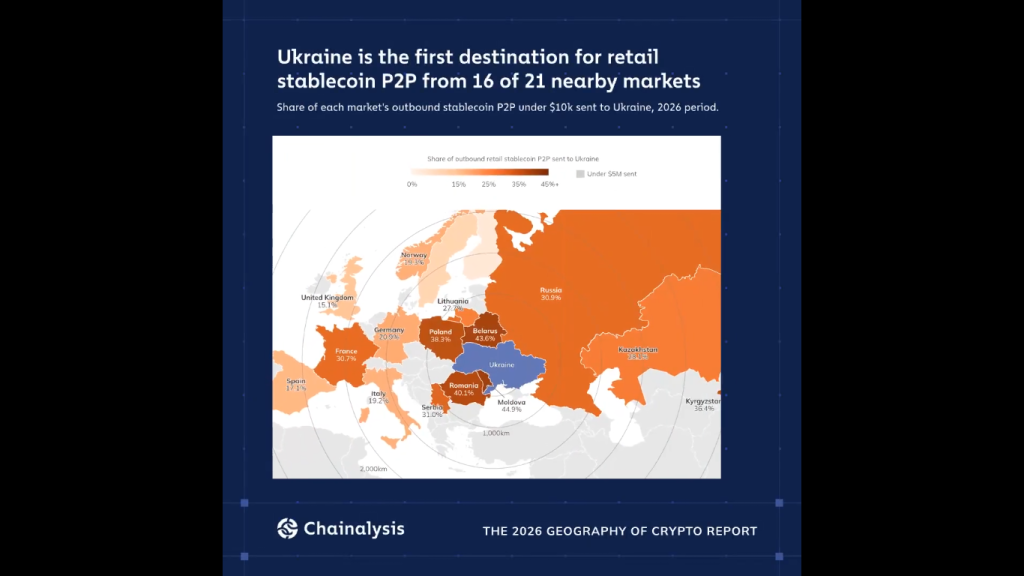
Cross-border stablecoin transfers into Ukraine reached about $12 billion over the period.
Of that sum, $2.41 billion arrived in retail-sized chunks.
Countries that host larger Ukrainian communities—both pre-war diaspora and newer refugees—send the heaviest flows.
Poland and Romania stand out as especially active sources.
These transfers keep family support lines open when traditional banking corridors face friction or delays.
What Role Are Crypto ATMs and Tax Changes Playing?
Poland has emerged as the clear ATM leader in the region.
Regional crypto ATM transaction volume nearly doubled to $33.9 million, and Poland alone delivered a 120% percent jump.
Stablecoins dominate those cash-to-crypto conversions.
In Romania, the July 2025 announcement of higher taxes on crypto gains triggered short-lived spikes on instant and decentralised exchanges (DEXs) as users moved quickly before the rules took effect.
Both trends illustrate how local policy and access points reshape everyday behaviour.
Which Countries Still Showed Growth in the Crypto Economy Despite the Broader Decline?
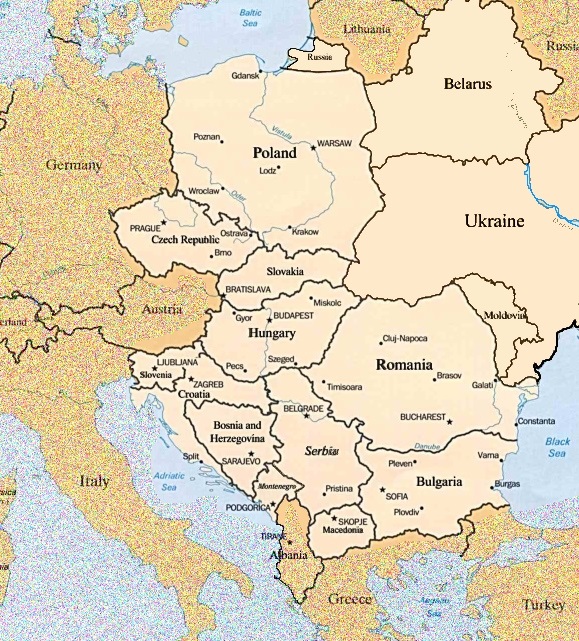
Four markets managed to expand. Belarus led with a 27.6% rise. Moldova gained 1.6%, Bulgaria added 0.6%, and Ukraine edged up 0.2% to $128.3 billion.
These pockets of resilience often reflect specific local conditions—stronger retail adoption, less exposure to large-volume institutional outflows, or heavier use of stablecoins for cross-border needs.
The data reveal a dual track. Headline crypto economy numbers in Eastern Europe have softened under geopolitical and regulatory weight.
Underneath that surface, however, retail users keep finding practical ways to move value.
Stablecoins, peer-to-peer networks and cash-based access points now carry a larger share of the load.
That adaptation may prove more durable than the temporary contraction in larger formal flows.
