

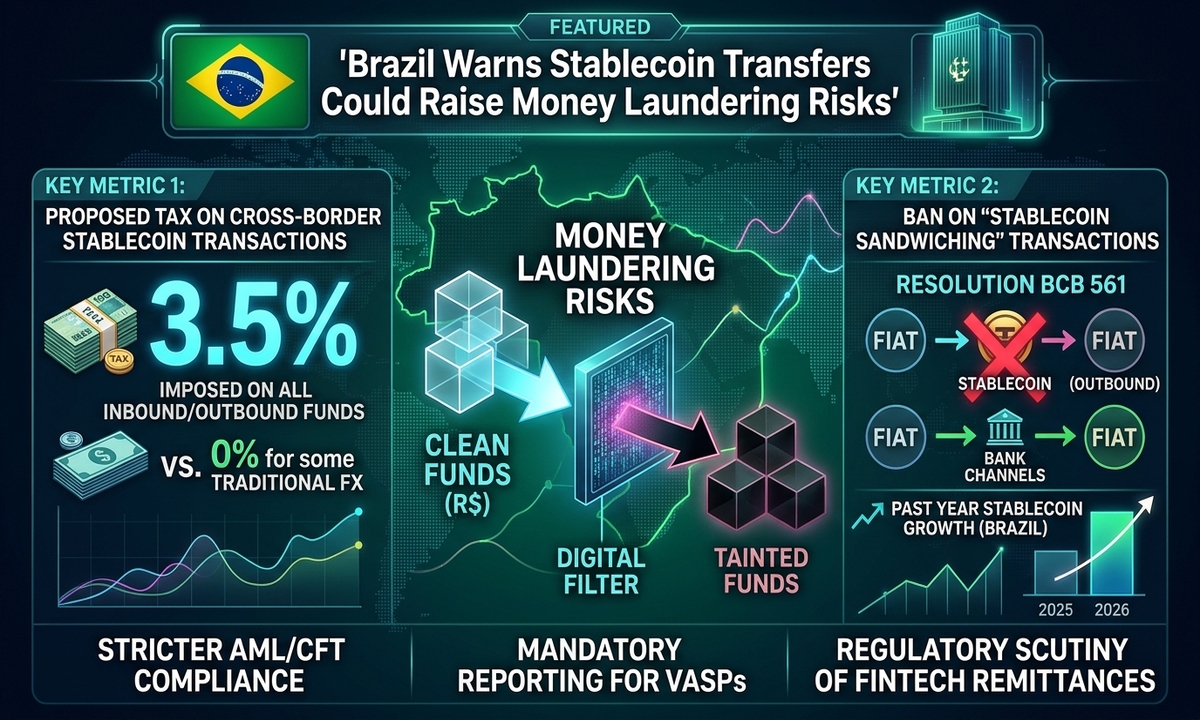
A senior central bank official from Brazil has warned that some stablecoin transactions could involve money laundering, even when funds come from legitimate sources.
Gerson Romantini, head of the Central Bank of Brazil’s foreign exchange division, raised the concerns during a closed-door meeting hosted by Exchange Informática.
He warned that companies could raise money laundering concerns when they use stablecoins to move legitimate funds across borders.
Romantini described the process as one where “good money becomes bad.” He also compared these transactions to the crypto version of dólar cabo, an informal system for moving money across borders outside traditional banking channels.
Romantini said stablecoins now provide another way to move money through similar channels. The central bank is examining how fintech companies handle these international transfers.
How Brazil Regulators Distinguish Between Two Stablecoin Transaction Models
The central bank has identified two ways financial companies use stablecoins to move money across borders, Romantini said. The industry refers to both arrangements as a stablecoin sandwich.
A payment company first receives Brazilian reais from a customer. It then converts the reais into dollar- or euro-backed stablecoins and transfers them overseas.
The recipient then exchanges the stablecoins for local currency. Companies can therefore use blockchain networks to transfer money without relying entirely on traditional banks.
After consulting its regulatory departments, the central bank decided that one model was allowed while the other was prohibited.
“One is allowed, and the other is not,” Romantini told meeting participants.
Under the permitted model, customers use a regulated institution to exchange their reais for foreign currency. The institution uses virtual assets to move the money to its overseas destination.
The institution can use digital assets for settlement instead of relying on traditional systems such as SWIFT.
The prohibited model requires companies to sell stablecoins directly to customers before converting the funds into foreign currency overseas.
Romantini said financial institutions cannot use this method to offer foreign exchange services. He said institutions cannot sell stablecoins to customers as a way of exchanging reais for foreign currency.
However, customers can still buy stablecoins on their own and use them for other purposes. Romantini said these purchases do not automatically create the same regulatory problem.

New Rules Increase Pressure on Crypto Payment Providers
The central bank of Brazil introduced the restrictions under Resolution BCB No. 561, which took effect on October 1.
The rules require regulated eFX providers to use conventional foreign exchange transactions or eligible Brazilian real accounts when paying overseas partners.
The rules also prohibit providers from using cryptocurrencies to settle these transactions.
However, they do not ban all cryptocurrency transfers. Companies without central bank authorisation must seek approval by May 31, 2027, to continue offering these services.
