

AI Crypto continues to attract strong attention in 2026 as developers, investors, and institutions seek decentralised alternatives to centralised artificial intelligence (AI) giants.
Projects that combine real infrastructure, measurable usage, and clear token utility stand out from pure narrative plays.
This article examines five AI Crypto projects with working products, active networks, and growth catalysts that could drive further upside while covering the key questions readers ask most often.
What are the top AI crypto projects in 2026?
Five projects currently lead conversations around AI Crypto because of their focus on actual infrastructure rather than marketing alone.
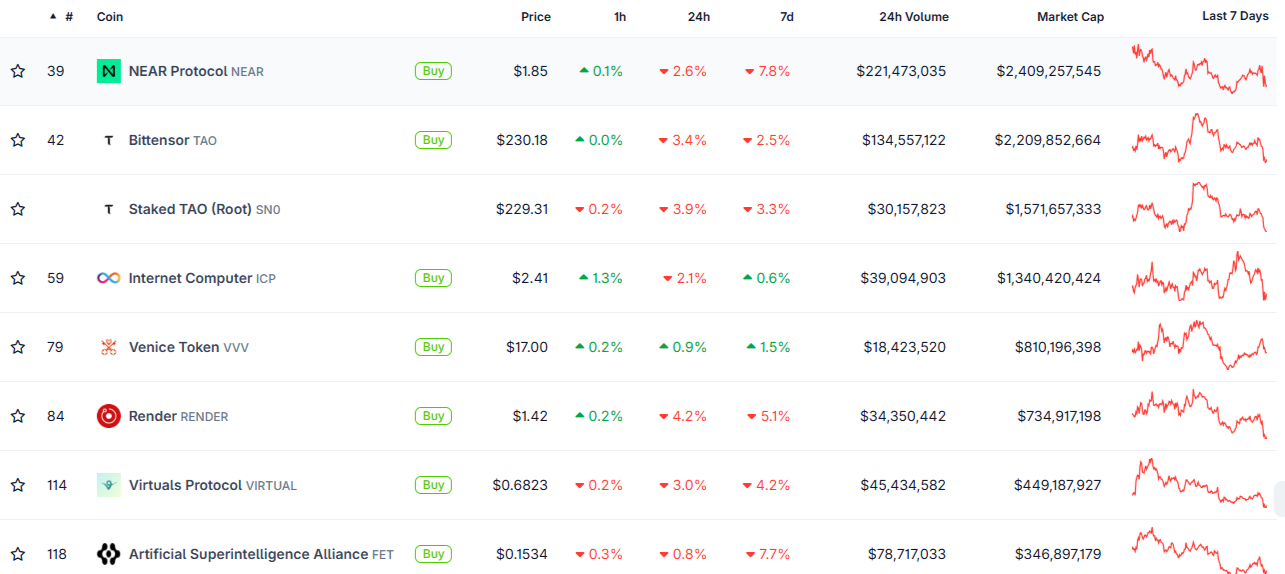
Bittensor (TAO) operates a decentralised marketplace for machine intelligence through competing subnets.
Render Network (RENDER) supplies decentralised graphic processing unit (GPU) compute for both rendering and AI workloads.
The Artificial Superintelligence Alliance token (FET) powers autonomous agents and related services after the earlier merger of Fetch.ai, SingularityNET, and (temporarily) Ocean Protocol.
NEAR Protocol (NEAR) functions as an AI-native Layer 1 that supports user-owned agents with high throughput.
Virtuals Protocol (VIRTUAL) enables the creation and commercialisation of tokenised AI agents on Base.
These names consistently appear across market-cap rankings and analyst reviews because they deliver live networks instead of roadmaps alone.
Which AI cryptocurrencies have the highest growth potential this year?
Bittensor and Render currently show the strongest combination of usage metrics and scarcity mechanics.
TAO completed its first halving in late 2025, cutting daily emissions and creating Bitcoin-like supply dynamics while subnet activity expanded past 100 active markets.
RENDER benefits from rising demand for GPU power as AI inference and training workloads grow.
FET gains from agent-launch infrastructure and ecosystem partnerships.
NEAR draws interest through its focus on on-chain AI agents and developer tools.
VIRTUAL captures speculative energy around tokenized agents while recording rising agent trading volume.
Growth potential remains tied to continued real-world adoption rather than short-term price spikes.
What makes an AI crypto project likely to explode in price?
Projects that combine three elements tend to move hardest: proven product usage, constrained token supply, and expanding demand for the underlying service.
Networks that process measurable AI workloads (compute hours, model evaluations, agent transactions) create organic token demand. Supply shocks such as halvings or burn mechanisms amplify that demand.
Clear narratives that match broader market themes—decentralised compute, autonomous agents, open AI marketplaces—attract both retail and institutional capital.
Projects lacking these fundamentals often fade once initial hype cools.

How do I choose the best AI blockchain projects to invest in?
Start by checking whether the project runs live infrastructure today. Look at on-chain metrics such as active subnets, GPU nodes online, agent transaction volume, or data queries processed.
Review tokenomics for inflation rate, unlock schedules, and utility beyond speculation.
Examine team background, partnerships, and development activity on GitHub or official channels.
Compare market capitalisation against actual usage to avoid overvalued narrative tokens.
Diversify across different layers of the AI stack—compute, agents, data, and marketplaces—rather than concentrating in one category.
Are AI crypto tokens a good investment in 2026?
AI Crypto offers exposure to one of the strongest technology narratives of the decade, yet it carries higher volatility than larger crypto assets.
Tokens with genuine utility and growing network activity have outperformed pure meme plays in several periods.
Still, many projects remain early, revenue generation stays limited relative to token incentives, and competition intensifies.
Investors who treat these positions as high-risk growth allocations and size them accordingly stand a better chance of navigating the space successfully.
Past performance never guarantees future results.

What is the difference between AI coins and regular cryptocurrencies?
Regular cryptocurrencies primarily facilitate payments, smart contracts, or store-of-value functions.
AI Crypto tokens specifically power or incentivize artificial intelligence infrastructure.
Some reward contributors who provide compute power or train models. Others govern marketplaces where AI services trade.
A third group enables autonomous agents that transact without constant human input.
The key distinction lies in the direct link between token utility and AI workloads rather than general blockchain activity.
Which AI crypto projects have real working products (not just hype)?
Bittensor runs more than 100 active subnets where models compete and earn rewards based on output quality.
Render Network connects thousands of GPUs and processes both creative rendering and AI inference jobs.
FET supports autonomous economic agents that can discover services, negotiate, and settle value.
NEAR hosts AI agent frameworks with high transaction throughput. Virtuals Protocol lets users launch and trade tokenised AI agents with measurable on-chain volume.
These platforms move beyond whitepapers into operational networks.
How do AI agents and decentralised AI networks actually work?
AI agents act as autonomous software entities that can observe data, make decisions, and execute actions—including on-chain transactions—without continuous human direction.
In decentralised networks, agents discover each other, request services, verify results, and settle payments using smart contracts.
Platforms like Bittensor create competitive markets where models improve through peer evaluation.
Compute networks such as Render and Akash supply the raw processing power. Agent frameworks on FET and NEAR handle coordination and economic incentives.
The combination creates machine-to-machine economies that operate around the clock.
What are the biggest risks of investing in AI cryptocurrencies?
Token prices can fall sharply when usage fails to match emissions or when broader crypto markets decline.
Many projects still rely heavily on token incentives rather than sustainable fee revenue.
Regulatory uncertainty around AI and crypto remains high in several jurisdictions.
Technical risks include smart-contract vulnerabilities and network downtime.
Competition from both centralised AI providers and other decentralized projects can erode market share.
Liquidity varies widely, especially for smaller-cap names, which increases slippage during exits.

Which AI crypto projects are backed by strong teams or partnerships?
Bittensor has attracted institutional interest, including reported large holdings and exchange-traded funds (ETFs) filings from major asset managers.
Render maintains relationships with creative studios and AI labs that need GPU capacity.
The ASI Alliance (FET) draws on the combined experience of its founding teams and continues to announce enterprise collaborations.
NEAR benefits from a mature developer ecosystem and ongoing AI-focused tooling.
Virtuals Protocol has grown through rapid agent launches and community-driven activity on Base.
Strong backing does not eliminate risk, yet it often signals longer-term commitment.
How can I buy the top AI crypto tokens safely?
Purchase major AI Crypto tokens on established centralised exchanges that list them with strong liquidity, such as Binance, Coinbase, Kraken, or Bybit.
Enable two-factor authentication and withdraw to a self-custody wallet once the trade settles.
For tokens primarily available on decentralised exchanges, use reputable interfaces, verify contract addresses carefully, and start with small test amounts.
Always confirm official links through project websites or trusted aggregators rather than social media messages. Hardware wallets add an extra layer of protection for larger holdings.

Will AI crypto continue to outperform the market in 2026?
AI Crypto has captured significant mindshare and capital relative to many other narratives.
Continued growth depends on whether network usage scales faster than token supply and whether institutional products such as potential ETFs materialise.
Broader crypto market conditions, interest rates, and regulatory developments will also influence relative performance.
Projects that convert attention into measurable activity stand the best chance of sustained outperformance, while pure narrative tokens face greater risk of underperformance once capital rotates.
What metrics should I look at when evaluating AI blockchain projects?
Track active users or nodes, daily or monthly compute hours or model evaluations, transaction or agent volume, fee revenue versus emissions, developer activity, and partnership announcements.
Market-cap-to-usage ratios help identify relative value. Token unlock schedules and inflation rates reveal potential sell pressure.
On-chain data from explorers and dashboards provides more reliable signals than social media sentiment alone.
Compare these metrics across projects in the same category for clearer context.
Are there any undervalued AI crypto gems under $100M market cap?
Smaller projects focused on specialised niches—such as verifiable data pipelines, smartphone-based confidential compute, or niche agent coordination—occasionally trade below $100 million.
These names carry significantly higher risk of failure or illiquidity. Thorough due diligence on product readiness, team execution, and token distribution becomes essential.
Most capital still concentrates in larger, more liquid AI Crypto projects, yet selective research can surface early-stage opportunities for risk-tolerant investors.
How does the AI narrative compare to previous crypto narratives (like DeFi or NFTs)?
Decentralised Finance (DeFi) introduced composable financial primitives that generated real revenue and remain core infrastructure years later.
NFTs created cultural moments and new ownership models but saw sharper boom-bust cycles.
AI Crypto sits closer to DeFi in its potential for lasting infrastructure value because it addresses ongoing demand for compute, data, and autonomous systems.
At the same time, it shares NFT-like speculative intensity during peak attention periods.
The projects that survive will likely be those that deliver measurable utility beyond the current cycle’s enthusiasm.
AI Crypto remains a dynamic sector where infrastructure progress and market sentiment interact closely.
The five projects highlighted here—Bittensor, Render, FET, NEAR, and Virtuals—offer distinct entry points into decentralised intelligence, compute, agents, and related services.
As an investor, you should conduct independent research and supplement it within the information found in this article.
Always assess personal risk tolerance, and monitor ongoing network metrics before making any decisions.
