


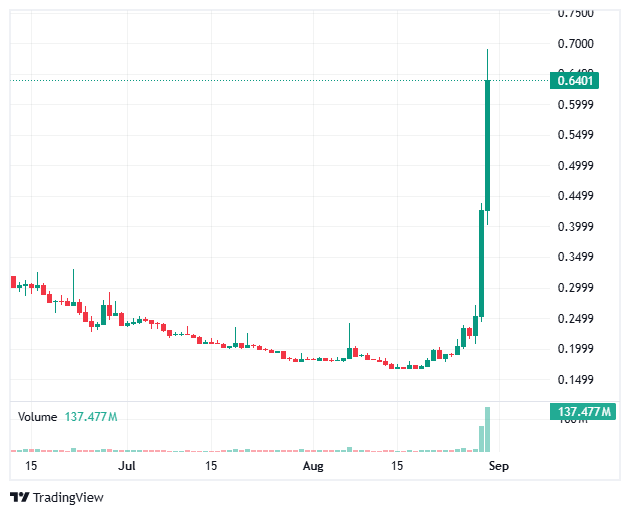
Helium just ripped higher and landed among the top trending coins after posting gains that crossed the 100% mark in a single day.
Traders watched HNT climb from the low $0.20s into the $0.60–$0.68 range while daily volume exploded past $100 million.
The move added tens of millions to market capitalisation and pushed the token into the spotlight once again.
The spark came from a practical real-world deployment in Celina, Texas. City officials converted existing public Wi-Fi at the library, senior centre, and downtown businesses into Helium carrier coverage.
Phones from major carriers now hand off automatically without new towers or special apps. Those sites already move roughly 100 GB of traffic each day.
Market participants treated the announcement as proof that decentralised wireless can scale inside fast-growing American cities.
Celina itself ranks as the fastest-growing U.S. city over 20,000 residents, having added more than 12,700 people in one year for a 24.6% jump.
Helium’s model fits that growth pattern perfectly: leverage infrastructure that already exists instead of waiting years for traditional tower builds.
What is HNT and how does the Helium Network work?
Helium operates as a decentralised physical infrastructure network, or DePIN.
Everyday people and businesses deploy hotspots that supply wireless coverage for Internet-of-Things (IoT) devices on the LoRaWAN band and for mobile-carrier offload. In return those providers receive HNT.
Users or carriers burn HNT to create Data Credits, the only currency accepted for network usage.
Every byte transferred therefore removes HNT from circulation. The design flips the usual telecom model.
Instead of a few giant companies owning the towers, thousands of independent operators own the radio nodes and share the economic upside.
The network now runs on Solana after its migration. That choice delivers fast finality and low fees while preserving the original coverage-and-usage economics.
Major carriers including AT&T already route traffic through Helium in congested venues. Telefonica has brought the same capability to millions of subscribers in Mexico.
Helium Plus lets commercial Wi-Fi operators on Cisco, Aruba, Meraki and similar platforms convert their existing access points into Helium coverage with almost no hardware change.
How do Helium Hotspots work and how do you earn HNT rewards?
Hotspots come in two main flavours. IoT Hotspots focus on long-range, low-power LoRaWAN sensors used by asset trackers, environmental monitors and smart-city devices.
Mobile Hotspots and Helium Plus installations handle higher-bandwidth carrier offload for smartphones.
In earlier years Hotspots earned through a combination of Proof-of-Coverage challenges and actual data transfer.
Recent Helium Improvement Proposals shifted the emphasis hard toward real traffic.
Deployers now receive the bulk of rewards only when their radios carry genuine carrier or IoT bytes.
Coverage-only Hotspots that sit idle see sharply lower payouts.
Location still matters. Dense urban or high-traffic venues generate more rewardable data.
Newer proposals under discussion introduce location multipliers that can boost earnings in strategically valuable spots by several times the base rate.
Helium Plus converted Wi-Fi sites earn the same way once they pass traffic.
Rewards arrive in HNT and can be claimed through the Helium Wallet or compatible Solana wallets.
Profitability depends on local demand, competition from nearby Hotspots, electricity costs and the current HNT price.
Many operators report that high-traffic commercial or municipal deployments clear expenses more reliably than pure residential IoT boxes.
What is HNT tokenomics, max supply, and the burn-and-mint model?
HNT carries a hard-cap maximum supply of 223 million tokens. Circulating supply sits near 186.3 million as of late August 2026.
Emissions follow a two-year halving schedule that began at network launch.
The core economic loop is simple and active. Hotspot operators receive newly minted HNT for useful work.
Network users and carriers burn HNT to mint Data Credits at a fixed USD rate. Those burns permanently remove tokens from supply.
When burn volume exceeds the scheduled emission in an epoch, net emissions keep the reward pool healthy without unlimited inflation.
Governance token holders can lock HNT for veHNT voting power. Longer locks receive higher weight. A portion of sub-network emissions flows to active voters.
Recent proposals also introduced an operations-and-growth vault that temporarily increases effective supply to fund expansion, yet the long-term hard-cap philosophy remains.
Because every data transfer burns HNT, rising network usage directly tightens circulating supply. That mechanism sits at the heart of the bullish thesis many holders cite.
Why is HNT price surging / up recently (August 2026)?
The immediate catalyst is the Celina, Texas deployment announced on August 28.
Helium’s official post showed city-owned Wi-Fi turning into seamless mobile coverage for residents and visitors.
Traders immediately connected the dots: a high-growth American city solved coverage gaps without capital-intensive towers and generated measurable daily traffic.
Volume exploded more than 1,000% in 24 hours. Short liquidations added fuel as leveraged bearish positions got squeezed.
Broader DePIN sentiment also improved as investors looked for projects with actual carrier partnerships and on-the-ground usage rather than pure narrative tokens.
HNT had already climbed roughly 90–130% over the preceding thirty days before the final vertical move.
The Texas news simply accelerated an existing recovery from the August 14 low near $0.167.
Market participants now watch whether other municipalities and venue operators copy the Celina template.

Is HNT still worth it / how do I buy, store, or deploy a Helium Hotspot in 2026?
Whether Helium remains worth pursuing depends on your goal. Speculators see a low market-cap DePIN token with proven carrier relationships and a clear burn mechanism.
Operators evaluate local traffic potential, hardware cost and current reward rates after the shift to usage-based payouts.
You can buy HNT on major exchanges including Coinbase, Gate, Bybit, KuCoin, Kraken and others.
After purchase, move tokens to a Solana-compatible wallet such as Phantom, Solflare or the official Helium Wallet.
Because the network lives on Solana, standard Solana seed phrases and transaction practices apply.
Deploying a Hotspot starts with choosing the right hardware. Mobile or Helium Plus units make more sense in commercial or high-density areas.
Register the device through the Helium app, assert its location, and begin earning once it carries traffic.
Check current onboarding fees and any location multipliers before committing capital. Electricity draw is modest, yet dense competition in saturated areas can dilute rewards.
Risks remain real. Token price volatility is extreme—HNT still trades more than 98% below its 2021 all-time high.
Regulatory treatment of DePIN rewards, changes in carrier contracts, and future governance votes can all affect economics.
Always size positions carefully and verify the latest HIP outcomes before deploying hardware.
Helium’s latest rally shows what happens when a DePIN project delivers visible, usable infrastructure instead of promises.
The Celina conversion turns ordinary city Wi-Fi into carrier-grade coverage and gives traders a concrete story to trade.
Whether HNT continues higher hinges on more cities and venues following the same path, sustained growth in data-credit burns, and the network’s ability to keep rewarding the operators who actually move traffic.
The next few months of municipal and commercial adoption will tell the real story.
