

Development activity within blockchains serves as the vital heartbeat of the Web3 world.
As developers push boundaries, this metric reveals how ecosystems innovate, attract talent, and build resilient infrastructure.
Moreover, recent data from Sanbase highlights a dynamic yet challenging landscape, where leading chains maintain dominance even as overall activity experiences notable shifts.
The Pulse of Blockchain Innovation and Development Activity
Developers actively shape the future of decentralised technologies through consistent coding, protocol upgrades, and application launches.
Development activity, measured by events such as commits, pulls, and issues, underscores real progress beyond hype.
Thus, ecosystems that sustain high engagement position themselves for long-term success in areas like decentralised finance (DeFi), non-fungible tokens (NFTs), and scalable Layer 2 solutions.
Furthermore, the Web3 narrative continues to unfold with smart contract advancements and cross-chain interoperability gaining traction.
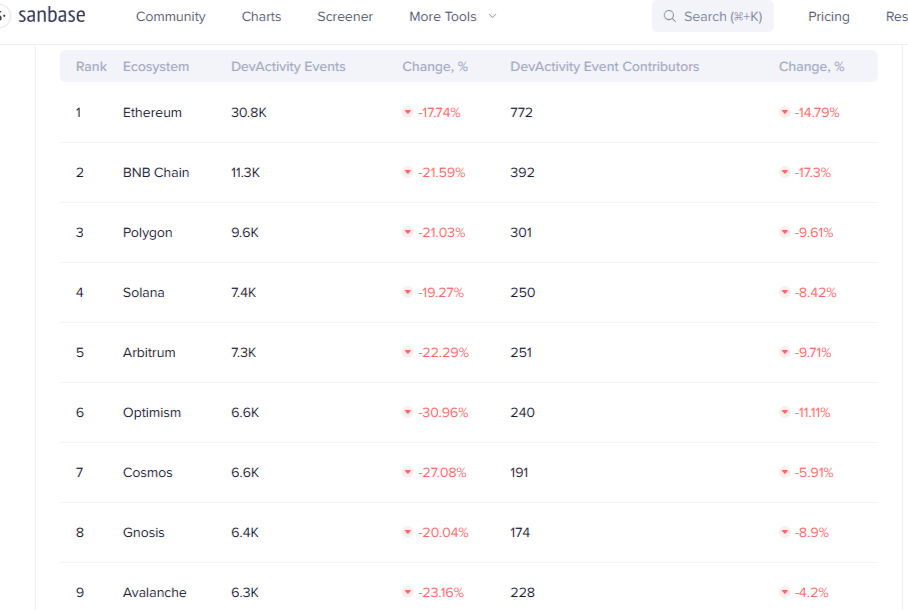
However, broader market conditions influence this momentum. Recent figures illustrate this vividly, showing Ethereum leading with an impressive 30.8K development events and 772 contributors, despite a 17.74% drop in events and 14.79% decline in contributors.
Leading Ecosystems Drive the Charge
Ethereum remains the cornerstone of blockchain development activity. Its vast ecosystem fosters groundbreaking tools and standards that ripple across the industry.
Developers continue enhancing its Layer 2 scaling solutions, such as Arbitrum and Optimism, which themselves rank high.
Arbitrum logs 7.3K events with 251 contributors, while Optimism records 6.6K events and 240 contributors.
These Layer 2 chains actively address Ethereum’s scalability needs, accelerating transaction throughput and reducing costs for users.
Meanwhile, BNB Chain secures second place with 11.3K events and 392 contributors. This performance reflects Binance Smart Chain’s appeal for efficient DeFi protocols and gaming applications.
Polygon follows closely at 9.6K events and 301 contributors, thriving as a versatile sidechain that supports NFT marketplaces and enterprise adoption.
Solana, known for its high-speed architecture, contributes 7.4K events and 250 contributors, attracting builders focused on decentralised exchanges (DEXs) and real-time applications.
Additionally, ecosystems like Cosmos, Gnosis, and Avalanche demonstrate strong engagement.
Cosmos achieves 6.6K events with 191 contributors, emphasising its focus on sovereign blockchains and IBC interoperability.
Avalanche logs 6.3K events and 228 contributors, while Gnosis posts 6.4K events with 174 contributors.
These projects actively pioneer modular designs and privacy-centric innovations that enrich the multi-chain Web3 environment.
Declines Signal Strategic Shifts
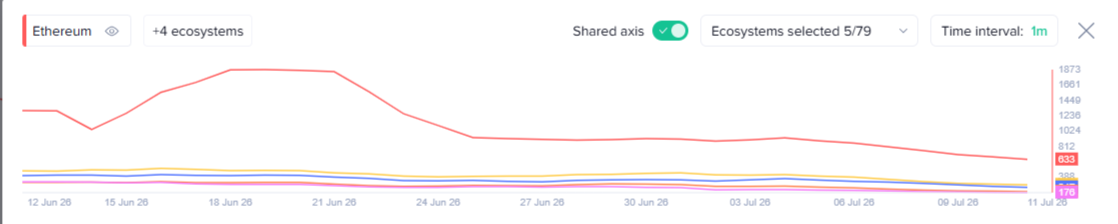
Nevertheless, the data reveals widespread contractions in development activity.
Optimism experiences the steepest event drop at 30.96%, followed by Arbitrum at 22.29% and Avalanche at 23.16%. Contributor numbers also dip across the board, with BNB Chain seeing a 17.3% reduction.
This trend does not necessarily indicate stagnation. Instead, teams consolidate efforts after intense growth phases, prioritising quality over quantity.
Developers refine existing codebases, audit smart contracts for security, and integrate advanced features like zero-knowledge proofs.
Moreover, macroeconomic factors and shifting investor sentiment influence resource allocation, prompting projects to focus on sustainable, high-impact contributions rather than rapid expansion.
Development Activity and the Implications for Web3 Growth
Such fluctuations in development activity carry profound implications. Strong foundational work on Ethereum and its Layer 2s builds confidence among institutions exploring tokenised assets and decentralized finance.
High contributor counts signal robust communities capable of weathering volatility.
Furthermore, competitive dynamics spur innovation. As Solana and Polygon vie for mindshare, they drive breakthroughs in user experience and developer tooling.
This healthy rivalry accelerates the maturation of Web3 technologies, from account abstraction to cross-chain bridges.
Thus, users benefit from more seamless, secure, and scalable decentralised applications (dApps).
Future Outlook: Sustaining Momentum
Looking ahead, development activity within blockchains will likely rebound as new narratives emerge.
Teams actively explore AI integrations, real-world asset tokenization, and enhanced privacy protocols.
Ecosystems that maintain transparent metrics and community governance will attract top talent.
Ultimately, sustained development activity fuels the Web3 vision of a decentralized internet.
By monitoring these trends, stakeholders gain valuable foresight into which chains will lead the next wave of adoption.
As the landscape evolves, developers remain the architects, turning challenges into opportunities that redefine blockchain’s role in global technology.
