


Morgan Stanley MSBT ETF (exchange-traded fund) just delivered one of the cleaner institutional Bitcoin signals of the month.
Over the past 20 trading days, the fund quietly added $51.5 million worth of Bitcoin and recorded zero net outflows on any single day.
That streak stands out because most other spot Bitcoin products have seen mixed or negative flow days during the same window.
On-chain data from Arkham first highlighted the pattern on September 19, 2026, showing consistent accumulation rather than the stop-start buying that often accompanies market volatility.
The numbers matter because they come from a product that already carries unusual weight inside traditional finance.
MSBT is the first spot Bitcoin exchange-traded product launched by a major U.S. bank-affiliated asset manager.
It began trading on NYSE Arca on April 8, 2026, under the ticker MSBT, and it tracks the CoinDesk Bitcoin Benchmark Rate.
Its 0.14 percent expense ratio undercut the majority of competitors at launch and still ranks among the lowest in the category.
What Exactly Is the Morgan Stanley MSBT ETF?
MSBT is a pure-play spot Bitcoin trust. It holds actual Bitcoin rather than futures or derivatives.
Coinbase Custody and The Bank of New York Mellon share custody and administration duties, giving the product a dual-rail structure that appeals to clients who want both crypto-native security and traditional banking oversight.
Investors receive exposure through ordinary brokerage accounts without managing private keys or wallets.
Morgan Stanley’s wealth-management platform supplies the real distribution engine.
The firm’s advisor network oversees trillions in client assets and has published formal Bitcoin allocation ranges of 0 to 4 percent for certain client profiles.
That guidance turns MSBT into more than another ticker; it becomes a ready-made recommendation that thousands of advisers can place inside existing portfolios.
How Much Bitcoin Has the MSBT ETF Accumulated Lately?
Arkham’s tracking shows the fund purchased roughly $51.5 million of Bitcoin across the most recent 20 trading sessions.
Parallel reporting from portals noted a series of transfers from Coinbase Prime totalling around 640 BTC and approximately $50–52 million over a similar two-week stretch in September.
Both data sets point in the same direction: steady, uninterrupted buying.

By mid-September, the fund’s total net assets sat between roughly $580 million and $700 million, with cumulative net inflows since launch exceeding $538 million. Those figures arrived only five months after the product opened for trading.

Why Has the Morgan Stanley MSBT ETF Posted Zero Outflows During This Stretch?
Investor stickiness stands out as the clearest feature. Across its entire life, the fund has recorded only one day of net outflows—May 29, when about $5.26 million left the product.
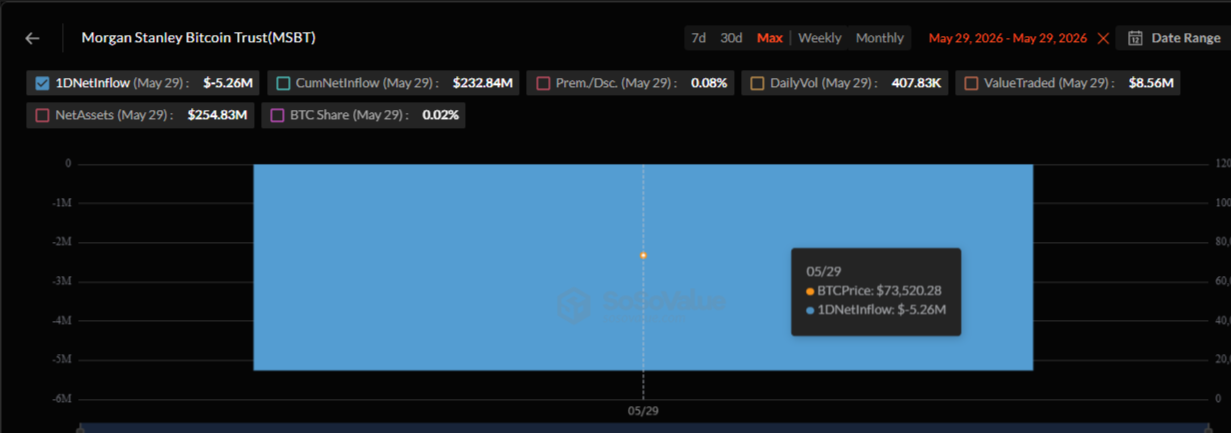
Every other session has been flat or positive. The latest 20-day window simply extends that pattern.
Several factors reinforce the resilience. The low 0.14% fee reduces the incentive to rotate into cheaper alternatives.
The bank’s advisor network tends to place longer-horizon allocations rather than short-term trades.
And the product’s dual-custody setup lowers the operational friction that sometimes triggers redemptions at purely crypto-native funds.
Together, these elements keep capital inside MSBT even when broader Bitcoin ETF flows turn choppy.
How Does MSBT Compare With Other Spot Bitcoin ETFs?
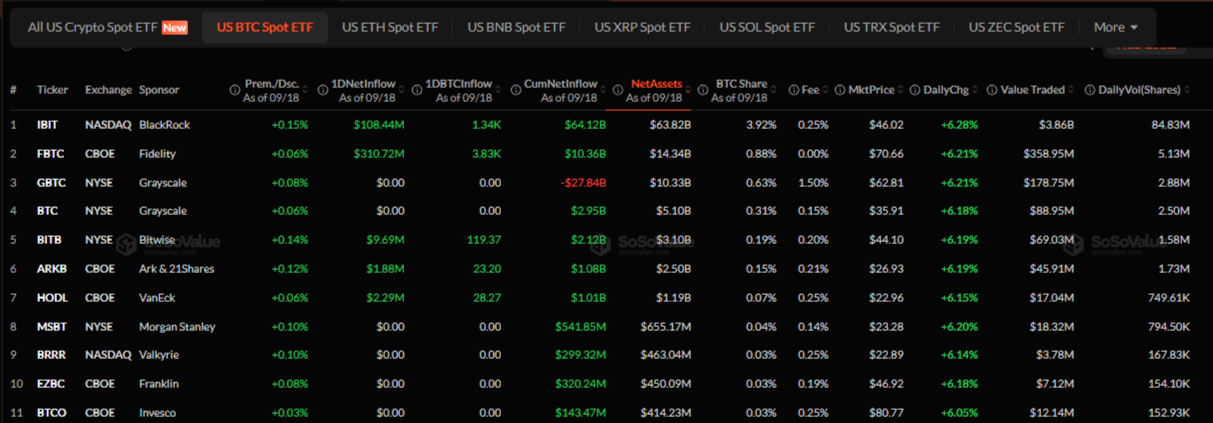
BlackRock’s IBIT still dominates on absolute size and daily trading volume.
Fidelity’s FBTC and several other products also manage multi-billion-dollar asset bases.
Morgan Stanley MSBT ETF remains smaller by those measures, yet it has carved a distinct lane.
Its fee sits below most peers, its distribution pipeline runs through one of Wall Street’s largest advisor forces, and its flow profile has been unusually consistent.
Where other funds have posted intermittent redemption days in September, MSBT has not.
That difference highlights how bank-affiliated products can behave differently from pure-play asset-manager ETFs when client capital arrives through discretionary advisory channels rather than purely retail or hedge-fund flow.
What Does This Buying Pattern Suggest About Institutional Demand?
The recent accumulation arrives against a backdrop of recovering Bitcoin prices and renewed interest in regulated vehicles.
U.S. spot Bitcoin ETFs as a group posted strong single-day inflows around the same period, yet MSBT’s zero-outflow streak remains notable because it occurred inside a bank-sponsored wrapper.
Advisers appear to be using the product to implement the firm’s published 0–4% allocation ranges.
That behaviour converts abstract research recommendations into actual share purchases.
In turn, the on-chain visibility that Arkham provides lets market participants watch the process in near real time rather than waiting for delayed regulatory filings.
The combination of traditional distribution power and transparent blockchain data creates a clearer signal than either channel alone.

As An Investor, What Should You Watch Next?
Continuous monitoring of daily creations and redemptions will show whether the 20-day streak extends.
Any shift in Morgan Stanley’s formal allocation guidance or changes in the advisor education materials would also carry weight.
On the competitive side, fee pressure across the entire spot Bitcoin ETF complex remains intense, so MSBT’s ability to maintain its cost advantage while scaling assets will matter.
For now, the picture is straightforward. A major bank’s Bitcoin product is adding exposure in size, recording no outflows, and doing so through channels that ordinary retail investors rarely see.
That combination of quiet accumulation and institutional plumbing is exactly the kind of detail that often precedes broader shifts in how traditional portfolios treat Bitcoin.
The MSBT story is still young. Five months of nearly uninterrupted inflows and a fresh $51.5 million buying wave offer a useful data point for anyone tracking how traditional finance (TradFi) continues to absorb Bitcoin exposure.
