

U.S. Spot Bitcoin ETFs recorded a sharp $450.4 million net outflow on Tuesday, September 15, 2026.
The figure marks the largest single-day redemption since late June and quickly drew attention across trading desks and research teams.
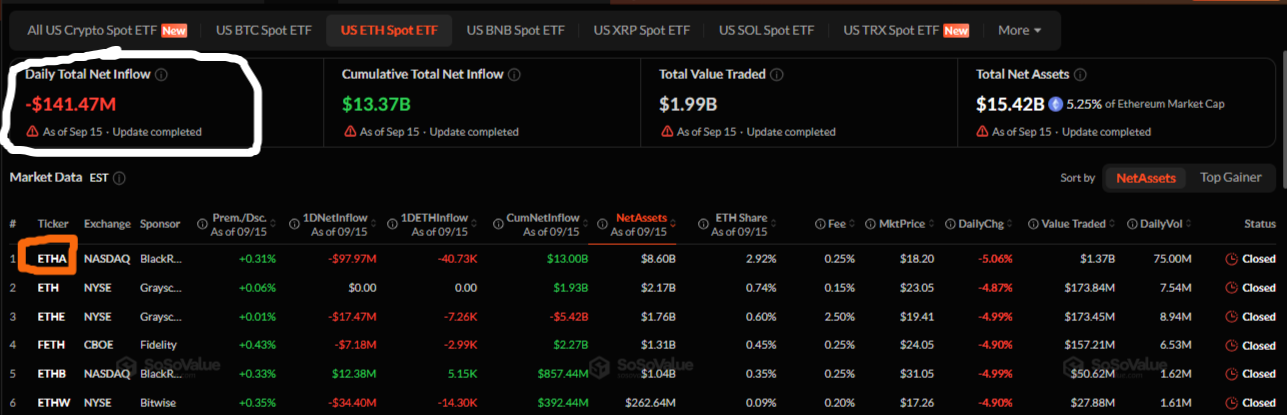
At the same time, Spot Ethereum ETFs posted $141.5 million to $142.3 million in outflows, signalling a broader risk-off move rather than an isolated Bitcoin event.
Data trackers including Farside Investors and SoSoValue confirmed the numbers within hours, and the market immediately began pricing the shift in institutional flows.
The scale stands out because the products had only recently returned to modest inflows. One day earlier, the same funds had attracted nearly $160 million.
The sudden reversal highlights how quickly sentiment can flip when macro catalysts align against risk assets.
What caused the $450M outflow from Spot Bitcoin ETFs?
Macro pressure provided the clearest trigger. Markets entered the session with elevated expectations for a Federal Reserve rate decision and ongoing uncertainty around U.S. crypto legislation.
The stalled progress of the CLARITY Act in the Senate added another layer of caution for institutional allocators who prefer regulatory clarity before committing fresh capital.
In parallel, Bitcoin’s own price action turned softer, slipping roughly 2.5% and testing lower support levels.
Portfolio managers who had added exposure during the stronger inflow days of early September chose to reduce risk rather than ride out the near-term noise.
The combination of rate uncertainty, legislative setbacks, and price weakness created the conditions for the largest single-session redemption in nearly three months.

Which Bitcoin ETFs saw the biggest redemptions?
Fidelity’s FBTC led the way with $214.8 million in net outflows. BlackRock’s IBIT followed closely with $161.7 million. Grayscale’s GBTC contributed another $44.1 million, while ARK 21Shares’ ARKB and Bitwise’s BITB added $17.4 million and $12.4 million respectively.
The concentration in the two largest products by assets under management is notable.
Both FBTC and IBIT have historically absorbed the bulk of both inflows and outflows, so their heavy redemptions amplified the overall total.
Smaller funds remained relatively quiet, reinforcing the view that the selling originated primarily from larger institutional or wealth-management channels rather than retail-driven panic.

How does this compare to previous large outflow days?
The $450.4 million figure ranks as the biggest one-day net outflow since June 25, 2026, when the funds shed roughly $469 million to $696 million depending on the exact tracker.
That earlier episode occurred during a broader risk-asset sell-off linked to equity market weakness.
Tuesday’s move sits well below the multi-day or weekly extremes seen in prior periods, yet it still represents a meaningful single-session event.
For context, the products had posted strong inflows earlier in September, including a $730 million day on September 3.
The rapid swing from heavy buying to heavy selling underscores the sensitivity of Spot Bitcoin ETFs to short-term macro signals.

What does this mean for Bitcoin price and institutional sentiment?
A single $450 million outflow does not by itself dictate Bitcoin’s medium-term trajectory.
Total assets under management across the Spot Bitcoin ETF complex still sit in the high tens of billions, so the redemption equals less than one percent of overall holdings.
Yet, the optics matter. Institutional investors often treat consecutive outflow days as a caution signal, and the simultaneous Ethereum ETF redemptions suggest a wider reduction in crypto beta exposure.
Traders watching order books noted that the selling pressure arrived alongside softer price action, creating a feedback loop that kept Bitcoin under modest pressure into the following session.
Sentiment remains constructive on longer time frames, but near-term flows have clearly turned more defensive.
Are Spot Ethereum ETFs showing the same pattern?
Yes, Spot Ethereum ETFs recorded $141.5 million to $142.3 million in net outflows on the same day.
BlackRock’s ETHA accounted for the largest share at roughly $98 million, with additional redemptions from ETHW, ETHE and FETH. A handful of smaller products posted modest inflows, yet the net figure still turned deeply negative.
The parallel move between Bitcoin and Ethereum products points to a broad risk reduction rather than an asset-specific story.
When both major crypto ETF categories experience sizeable outflows on the same session, the common driver usually sits outside the individual networks—most often macro policy expectations or shifts in overall risk appetite.
The $450 million single-day outflow from Spot Bitcoin ETFs serves as a clear reminder that institutional capital remains highly responsive to the macro calendar.
While the absolute size is manageable relative to total assets under management (AUM), the speed of the reversal and the accompanying Ethereum outflows show that allocators are still quick to reduce exposure when uncertainty rises.
Market participants will watch the next several sessions closely for signs that the selling has exhausted itself or that further redemptions are still in the pipeline.