

Institutional interest in privacy coins once faced heavy skecticism but ZEC and ZCash ETF (exchange-traded fund) seems to have challenged this narrative.
Compliance teams worried about regulatory risk, and many large platforms simply excluded the sector.
The ZCash ETF has come in to alter the calculation. Because the product sits inside the familiar brokerage infrastructure and relies on Coinbase Custody for the underlying tokens, it clears internal risk committees more easily than direct coin holdings.
Furthermore, the technology behind ZCash—particularly its shielded pool and zero-knowledge (zK) proofs—has matured.
Protocol upgrades have improved usability without sacrificing the privacy guarantees that originally set the network apart.
Portfolio managers who already allocate to Bitcoin and Ethereum now see Zcash as a distinct return stream rather than a pure speculative bet.
At the same time, the broader crypto market has recovered strongly in 2026.
Bitcoin’s advance above previous highs and renewed interest in alternative layer-1 narratives create a more favourable backdrop for specialised products.
The ZCash ETF therefore arrives at a moment when capital is searching for differentiated exposure, and privacy fits that search.
What Does the Upcoming Share Split Mean for ZCash ETF Investors?
On September 18, Grayscale announced a 3-for-1 forward share split. Shareholders on record as of market close on September 28 will receive two additional shares for every share they already own.
Trading on a split-adjusted basis is scheduled to begin September 30.
The economics of each investor’s position remain unchanged. One pre-split share simply becomes three post-split shares, each representing one-third of the previous net asset value.
The practical effect, however, is a lower per-share price. Lower sticker prices often improve accessibility for retail accounts that face minimum share requirements or prefer smaller dollar increments.
In addition, a lower share price can tighten the bid-ask spread over time as more participants enter the market.
Market makers typically find it easier to intermediate when the unit price sits in a more familiar range.
The split therefore functions less as a cosmetic change and more as a deliberate attempt to broaden the investor base just as the ZCash ETF nears the $1 billion threshold.
Is the ZCash ETF’s Growth Sustainable Amid Privacy Coin Momentum?
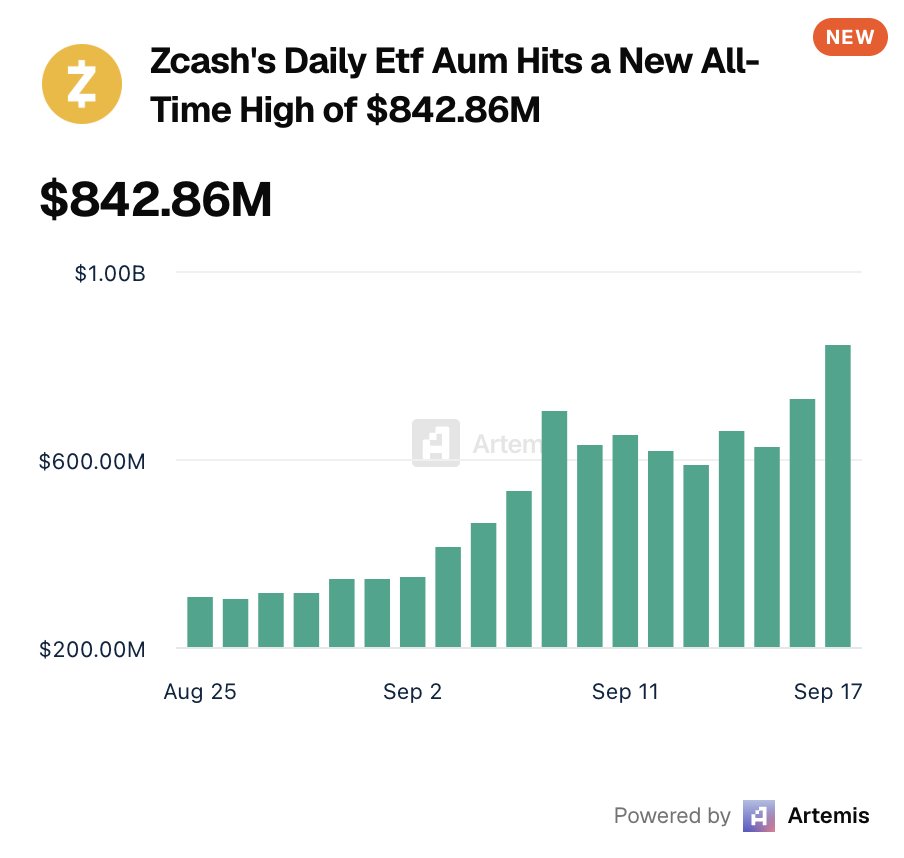
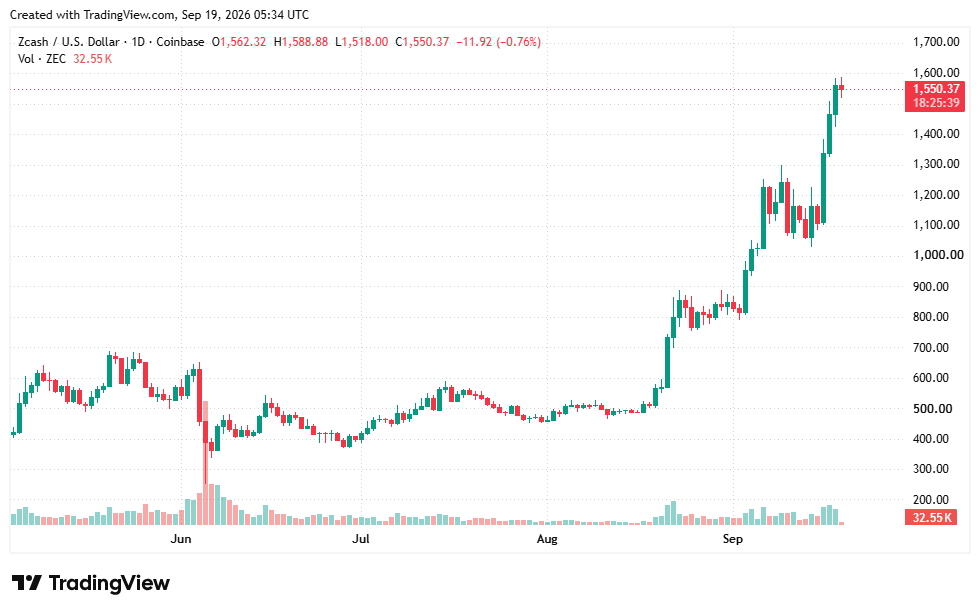
Sustainability depends on three continuing conditions. First and foremost, ZEC price stability or further appreciation will keep the existing assets under management (AUM) elevated even if new inflows slow.
Secondly, ongoing creation activity requires sustained demand from both institutional and retail channels.
Moreover, the regulatory environment must remain constructive toward privacy-focused products.
On the positive side, the fund already demonstrates real third-party demand beyond the initial affiliate contribution.
Options open interest provides another measure of engagement. Mining difficulty and hashrate on the Zcash network have also risen to multi-year highs, suggesting that infrastructure providers remain committed.
Nevertheless, privacy coins still carry higher regulatory and reputational risk than more mainstream digital assets.
Any sudden shift in enforcement priorities or exchange delistings could pressure both the token and the ETF.
As an investor, you must watch not only the AUM number but also the quality and persistence of the inflows behind it.
How Does the ZCash ETF Compare to Other Crypto ETFs?
Most U.S. crypto ETFs track Bitcoin or Ethereum. Those products benefit from massive scale, tight spreads, and years of operational history.
The ZCash ETF operates in a much smaller niche. Its 2.5% management fee sits higher than the large Bitcoin and Ethereum products, reflecting both the specialised nature of the asset and the earlier stage of the market.
Yet, the comparison is not purely about size or cost. No other listed vehicle currently offers pure-play exposure to a privacy-centric protocol.
That uniqueness gives the ZCash ETF a distinct role inside diversified digital-asset portfolios.
While Bitcoin ETFs dominate total crypto AUM, the ZCash product captures a different thesis: the growing institutional appetite for confidentiality features that public blockchains cannot provide.
In short, the ZCash ETF does not compete directly with the largest crypto funds.
Instead, it expands the menu of regulated choices available to investors who already accept digital assets.
What Risks Should Investors Consider With the ZCash ETF?
The product is not registered under the Investment Company Act of 1940, so it lacks certain investor protections that apply to traditional mutual funds and ETFs.
Its value moves in lockstep with ZEC, an asset known for high volatility. The 2.5% annual fee compounds over time and will drag on returns relative to simply holding the token directly—if an investor can manage the custody and operational complexity.
Liquidity remains thinner than in the major Bitcoin and Ethereum products, although volume has improved markedly.
Premiums or discounts to net asset value can appear during periods of market stress.
Finally, the privacy features that attract many buyers also invite ongoing regulatory scrutiny.
None of these risks is new, yet they become more relevant as the ZCash ETF grows larger and attracts a broader audience.
Careful position sizing and a clear understanding of the underlying technology remain essential.
The ZCash ETF’s rapid climb toward $1 billion in assets under management marks more than a numerical milestone.
It signals that institutional capital is prepared to allocate meaningful sums to privacy technology when the vehicle is familiar, regulated, and liquid.
Whether the fund ultimately crosses and holds the billion-dollar level will depend on continued price support for ZEC, steady creation demand, and a stable regulatory climate.
For now, the trajectory remains unmistakably upward, and the market is watching closely.
