


Selecting the best AI tokens in 2026 requires more than dealing with the metric of tracking market capitalisation.
Strong projects combine real utility, active development, and clear demand drivers.
Moreover, the artificial intelligence narrative continues to attract attention across crypto.
Therefore, investors benefit from focusing on tokens that power meaningful infrastructure rather than pure speculation.
AI tokens support decentralised compute, data networks, autonomous agents, and oracle services.
Furthermore, the sector includes both established protocols and newer entrants. As a result, quality varies widely. In addition, rankings shift frequently with market conditions.
Nevertheless, several projects currently stand out for their positioning and activity.
Leading Infrastructure and Oracle AI Tokens
Chainlink remains a foundational player among AI tokens. It delivers decentralised oracle services that connect smart contracts to real-world data.
Moreover, reliable data feeds support many AI-related applications on-chain. Meanwhile, its established network effects and broad integrations give it a durable role.
Therefore, Chainlink often appears in discussions of essential infrastructure tokens.
NEAR Protocol also holds a prominent position. It focuses on scalable blockchain performance and user-friendly development tools.
In addition, its technology supports AI and machine learning use cases through efficient execution.
Thus, developers exploring on-chain AI applications frequently consider the network.
Furthermore, ongoing ecosystem growth strengthens its relevance within the broader AI tokens category.
Decentralised Intelligence and Compute Projects
Bittensor leads in decentralised machine learning (ML). The protocol creates a marketplace where participants contribute and access intelligence.
Moreover, its token coordinates incentives across the network. Meanwhile, Staked TAO provides a related liquid staking option that allows holders to participate while maintaining flexibility.
As a result, both tokens attract attention from those interested in decentralised AI training and inference.
Render focuses on decentralised graphics processing unit (GPU) rendering and compute resources.
Creative and AI workloads often require significant processing power. In addition, the network connects unused GPU capacity with demand.
Therefore, Render serves a practical purpose within the AI and graphics computing space.

Similarly, Internet Computer aims to extend blockchain capabilities toward full-stack decentralised applications, including AI-related services.
ICP, the novel token of Internet Computer showed a lot of promise when it was introduced in May 2021.
With the aim of decentralising everything on the internet, ICP has withstood crypto winter, and could bring massive gains to long term holders.
Emerging and Specialised AI Tokens
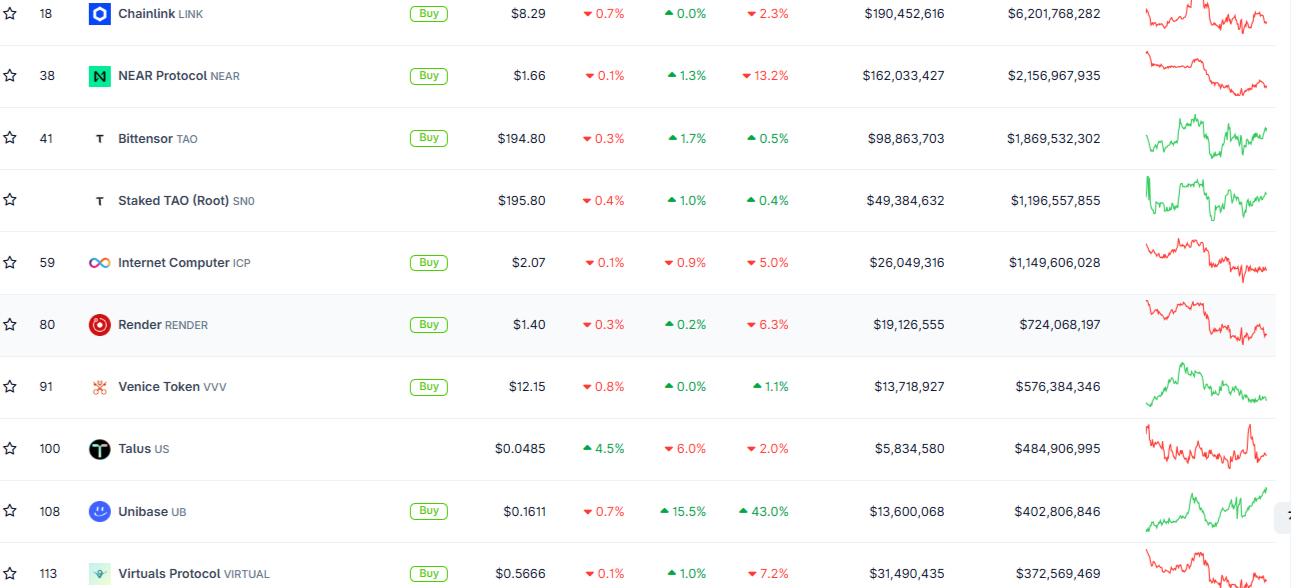
Newer projects continue to expand the landscape. Venice Token (VVV), Tatus (US), Unibase (UB), and Virtuals Protocol (VIRTUAL) represent more recent or specialised entries.
Moreover, Virtuals Protocol has gained notice for its focus on AI agent creation and related tools.
Meanwhile, these tokens often target narrower use cases or experimental models. As a result, they carry higher uncertainty alongside potential upside.
Furthermore, smaller-capitalisation AI tokens can deliver stronger percentage moves during narrative-driven rallies.
However, they also experience sharper declines when sentiment shifts. Therefore, position sizing and ongoing research become especially important with emerging names.
Key Evaluation Factors for 2026
Utility remains the most important filter. Strong AI tokens enable measurable activity such as compute usage, data transactions, or agent operations.
In addition, transparent tokenomics and consistent development improve long-term prospects.
Meanwhile, projects that rely mainly on hype without delivery face greater risk of underperformance.
Market conditions also influence outcomes. Broader interest in artificial intelligence supports the sector.
Nevertheless, competition from centralised AI providers and other crypto narratives can redirect capital quickly.
As a result, diversification and risk management matter more than concentration in any single token.
Final Thoughts on AI Tokens
The best AI tokens in 2026 combine functional technology with sustainable incentives.
Chainlink, NEAR, Bittensor, Render, and Internet Computer currently rank among the more established names.
Moreover, newer projects such as Virtuals Protocol and others add experimentation and specialised capabilities.
Furthermore, liquid staking options like Staked TAO expand participation methods.
In summary, AI tokens offer exposure to one of crypto’s most active narratives. However, success depends on careful selection, realistic expectations, and continuous evaluation.
By prioritising real usage, transparent design, and manageable risk, participants can navigate the AI tokens landscape with greater clarity and discipline throughout 2026.
