

Ethereum traders and long-term holders currently debate whether the upcoming Glamsterdam Upgrade can push ETH significantly higher.
The network continues refining its architecture while the market weighs broader conditions.
This article examines the most common price-related questions and connects them to the potential impact of the Glamsterdam Upgrade.
What is the Current Price of Ethereum? / How Much is ETH Today?
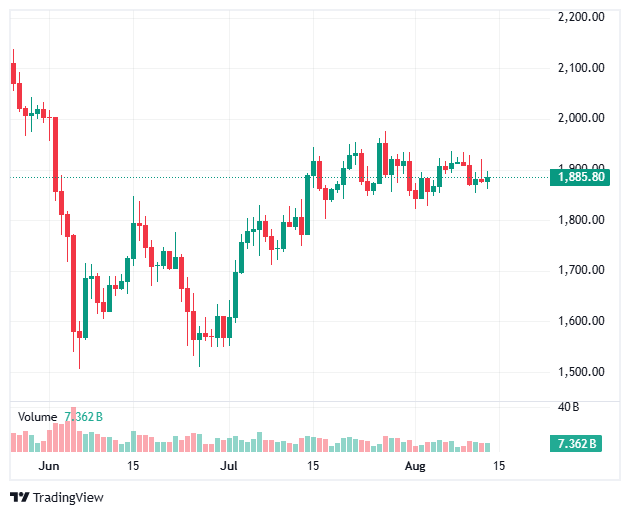
Ethereum currently trades near the $1,800–$1,900 range in mid-August 2026.
Market participants watch this level closely because it sits well below previous peaks. Moreover, daily fluctuations remain typical for the asset.
Thus, the present price provides the baseline against which any Glamsterdam-related optimism must be measured.
Therefore, understanding today’s valuation helps frame realistic expectations for future moves.
What is the Ethereum Price Prediction for 2026?
Analysts offer a wide range of 2026 forecasts. Some base-case estimates cluster between $3,000 and $4,500, while more optimistic scenarios reach toward $7,000–$8,000 under favourable conditions.
However, these projections depend heavily on successful network upgrades and improving macro sentiment.
Furthermore, the Glamsterdam Upgrade features prominently in several bullish narratives because it targets higher capacity and improved block production.
As a result, many observers treat Glamsterdam as a potential catalyst rather than a guaranteed price driver.
Ultimately, predictions remain speculative and subject to rapid change.
What Will Ethereum Be Worth in 2030? / How Much Will 1 ETH Be Worth in 2030 After Glamsterdam Upgrade?
Longer-term forecasts for 2030 vary even more widely. Conservative models suggest levels between $5,000 and $10,000, while optimistic institutional scenarios extend toward $15,000–$25,000 or higher.
Moreover, these outlooks assume continued dominance in smart contracts, stablecoin settlement, and real-world asset tokenisation.
In addition, successful execution of the broader roadmap—including Glamsterdam and subsequent upgrades—underpins many of the higher targets.
As a result, the 2030 price depends less on any single fork and more on sustained adoption and competitive positioning.
Therefore, investors should treat distant forecasts as directional scenarios rather than precise targets.
Will Ethereum Reach $10,000 On the Back of Glamsterdam Upgrade?
A move to $10,000 appears in several bullish analyst ranges for the later stages of this cycle or the following one.
However, reaching that level would require a combination of strong network growth, significant capital inflows, and supportive macroeconomic conditions.
Furthermore, the Glamsterdam Upgrade could contribute by improving scalability and reducing certain structural frictions.
In contrast, competition from other Layer-1 networks and potential regulatory headwinds could delay or prevent such a move.
As a result, $10,000 remains a possible but far-from-certain milestone.
Ultimately, the path depends on multiple reinforcing factors rather than any single upgrade.
What Factors Affect / Influence the Price of Ethereum?
Several forces shape ETH’s price. Network activity, including decentralised finance (DeFi) usage, stablecoin volume, and Layer-2 adoption, influences demand for block space and ETH itself.
Moreover, macroeconomic conditions such as interest rates and risk appetite affect capital flows into crypto.
In addition, progress on the technical roadmap—including the Glamsterdam Upgrade—can shift sentiment when investors anticipate improved capacity or efficiency.
Regulatory developments and competition from rival blockchains also play important roles.
As a result, price moves rarely stem from one isolated cause. Therefore, successful delivery of Glamsterdam may support sentiment, yet broader market forces will still dominate short-term direction.
Is Now A Good Time to Buy Ethereum Before Glamsterdam Upgrade?
Whether the present moment offers an attractive entry depends entirely on individual circumstances.
Some investors view current levels as a reasonable accumulation zone after the significant drawdown from 2025 highs, especially if they believe in the long-term roadmap.
However, others prefer to wait for clearer confirmation of trend reversal or further clarity on upgrade timelines.
Furthermore, position sizing and time horizon matter more than precise timing for most participants.
In addition, the upcoming Glamsterdam Upgrade adds a potential positive catalyst that some buyers factor into their decisions.
As a result, no universal answer exists. Ultimately, each investor must align any purchase with personal risk tolerance and portfolio goals.
What is Ethereum’s All-Time High (and All-Time Low)?
Ethereum reached an all-time high near $4,946 in August 2025. In contrast, its all-time low stands at approximately $0.43, recorded in the early years of the network.
Moreover, the distance between the current price and the 2025 peak illustrates the scale of the recent correction.
Consequently, many market participants measure progress against that previous high when evaluating recovery potential.
Therefore, the Glamsterdam Upgrade arrives at a time when ETH still trades at a substantial discount to its most recent peak.
Why is Ethereum’s Price Down / Up Right Now?
Price action in any given period reflects a mix of profit-taking, macro sentiment, exchange-traded fund (ETF) flows, and shifting narratives around competing networks.
When ETH declines, reduced risk appetite or temporary disappointment with near-term catalysts often plays a role.
Conversely, upward moves frequently coincide with rising network activity, positive upgrade developments, or broader crypto market strength.
Furthermore, anticipation surrounding the Glamsterdam Upgrade periodically supports sentiment, even before activation.
As a result, short-term direction remains highly sensitive to both technical progress and external market conditions. Ultimately, no single factor explains every daily move.
Is Ethereum bullish or bearish at the moment?
Market structure in mid-2026 shows mixed signals. Some technical indicators and on-chain metrics suggest stabilisation after the earlier decline, while others highlight continued caution.
Moreover, longer-term holders often maintain a constructive view based on the network’s fundamental position and upcoming upgrades.
In contrast, shorter-term traders frequently adopt a more neutral or defensive stance until clearer trend confirmation appears.
As a result, the overall tone sits between cautious optimism and residual bearishness.
Therefore, the successful rollout of the Glamsterdam Upgrade could help tip sentiment in a more positive direction if it delivers tangible improvements.
What is the Daily Trading Volume of Ethereum?
Ethereum consistently ranks among the highest-volume crypto assets, with daily trading volumes typically measured in the billions of dollars.
High volume supports efficient price discovery and allows larger participants to enter or exit positions with relatively limited slippage.
Moreover, sustained volume reflects ongoing interest from both retail and institutional traders.
In addition, volume often expands during periods of heightened upgrade anticipation or broader market volatility.
As a result, ETH maintains deep liquidity that distinguishes it from many smaller digital assets.
Ultimately, robust daily volume provides a supportive backdrop for any potential price appreciation linked to network improvements such as the Glamsterdam Upgrade.
The Glamsterdam Upgrade represents a meaningful step in Ethereum’s scaling and structural roadmap.
While it can improve capacity, block production efficiency, and long-term competitiveness, it does not automatically guarantee a move toward $5,000 or any specific price target.
Market outcomes will depend on the interaction between technical progress, capital flows, macroeconomic conditions, and competitive dynamics.
Investors who focus on verifiable network improvements rather than short-term price targets position themselves more effectively for whatever path ETH ultimately follows.
