
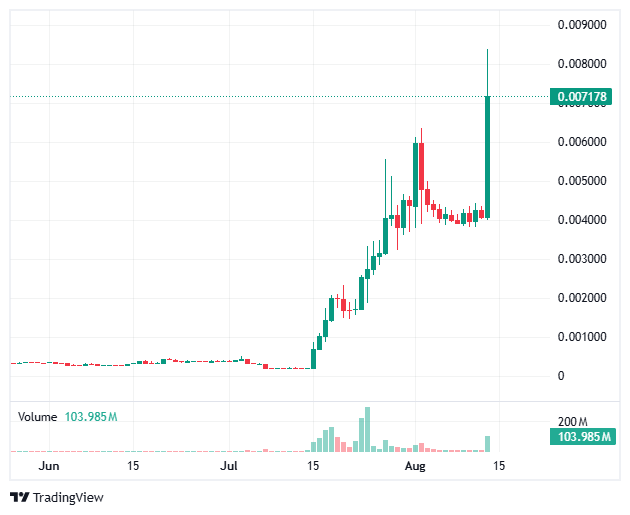
AKEDO has recently attracted significant attention after posting sharp gains and leading gainer rankings on major tracking platforms.
Traders now ask whether the token can sustain momentum and eventually reach the psychologically important $1 level.
This article examines the project through the most common questions and evaluates the realistic path toward higher valuations.
What is AKEDO (AKE)?
AKEDO is an artificial intelligence (AI)-powered multi-agent framework and launchpad designed for creating games and digital content.
Users generate playable experiences through simple natural language prompts rather than traditional coding.
Moreover, the platform aims to lower barriers for creators and connect AI generation with on-chain monetisation tools.
Thus, AKEDO positions itself at the intersection of generative AI and Web3 gaming.
Therefore, understanding this core purpose helps explain both the recent interest and the longer-term challenges the project faces.
How Does AKEDO Work?
Specialised AI agents handle different parts of the creation process. World-building agents generate maps, rule-design agents define mechanics, balancers adjust gameplay, and storytellers craft narratives.
Furthermore, creators submit text prompts and receive playable output in a short time frame.
In addition, the platform supports publishing and tokenisation of the resulting games through its launchpad.
As a result, the workflow attempts to compress development cycles dramatically.
Ultimately, real adoption depends on whether the output quality and user experience satisfy both creators and players over time.

What Is the Utility of the $AKE Token?
The $AKE token serves several concrete functions inside the ecosystem. Users spend AKE to pay for AI prompts and game publishing fees.
Moreover, holders can stake AKE to receive a share of protocol revenue. In addition, the token supports governance participation and provides liquidity pairing for new game tokens launched on the platform.
Thus, demand for AKE links directly to platform activity. Therefore, sustained usage remains essential for any meaningful long-term value accrual.
What Are the Tokenomics of AKE?
AKE has a maximum supply of 100 billion tokens. Circulating supply currently stands near 22.8 billion, leaving a large portion still subject to future unlocks.
Furthermore, the allocation includes significant portions for community rewards, investors, ecosystem growth, and early contributors, each with its own vesting schedule.
In addition, protocol fees follow a clear split: 33 percent burned, 33 percent distributed to stakers, and 33 percent retained as platform revenue.
As a result, the tokenomics combine inflationary unlock pressure with a usage-based burn mechanism.
Ultimately, the balance between new supply entering the market and actual fee-driven burns will heavily influence price behaviour.
Is AKEDO A Scam Or What Are the Main Risks?
AKEDO is a live project with public documentation, token trading, and platform activity; however, it carries notable risks common to early-stage tokens.
Holder concentration remains elevated, with a relatively small number of wallets controlling a large share of supply.
Moreover, substantial token unlocks are still scheduled, which can create selling pressure. In addition, the project operates in the competitive and fast-moving AI-plus-gaming sector, where user retention is difficult.
Consequently, investors face both execution risk and market-structure risk. Therefore, careful position sizing and ongoing monitoring of on-chain distribution and platform metrics are essential.
What Blockchain is AKEDO Built On?
AKEDO issues its AKE token as a BEP-20 asset on the BNB Smart Chain. This choice provides access to established liquidity, fast transactions, and lower fees compared with some alternative networks.
Furthermore, the project has explored broader accessibility across other ecosystems for user acquisition.
In addition, BNB Smart Chain settlement keeps core economic activity on a single, high-throughput chain.
As a result, users benefit from relatively straightforward wallet compatibility and trading infrastructure.
Ultimately, the network choice supports accessibility while still exposing the token to the broader BNB Chain market dynamics.

How Do I Create Or Publish A Game On AKEDO?
Creators begin by submitting natural language prompts that describe the desired game.
The multi-agent system then generates the experience, after which users can refine and publish it.
Moreover, the platform charges fees in AKE—typically a small amount per prompt and a higher flat fee to publish.
In addition, successful games can move onto the launchpad for tokenisation and further monetisation.
Thus, the process aims to make creation accessible to non-technical users. The quality of the AI output and the ease of the publishing flow will determine whether creators continue using the platform.
What Is the Difference Between AKE And vAKEDO?
AKE is the on-chain cryptocurrency that trades on external markets and powers the economic layer of the platform.
In contrast, vAKEDO is a virtual, off-chain token used inside the AKEDO application for playing games.
Furthermore, new users often receive free vAKEDO to experience the platform without immediately needing cryptocurrency.
In addition, vAKEDO cannot be withdrawn to external wallets because it exists only within the application environment.
As a result, the two tokens serve clearly separated purposes. Ultimately, understanding this distinction prevents confusion between platform play currency and the tradable AKE asset.
Does AKEDO Have A Burn Mechanism?
Yes. The protocol permanently burns 33 percent of all platform fees. This mechanism directly links token supply reduction to real usage of the creation and publishing tools.
Moreover, the burn operates alongside the 33 percent allocation to stakers and the 33 percent retained by the platform.
In addition, consistent fee generation would gradually reduce circulating supply over time.
Consequently, the burn introduces a potential deflationary pressure that scales with adoption.
Therefore, the effectiveness of this feature depends entirely on sustained platform activity rather than one-time events.
When Did AKEDO Launch And Where Can I Buy AKE?
AKEDO conducted its token generation event in 2025, including a KuCoin Spotlight IEO. The token began trading shortly afterward across multiple venues.
Furthermore, AKE is available on various centralised and decentralised exchanges that support BNB Smart Chain assets such as KuCoin, Gate, Kraken, LBank, and MEXC Global. In addition, liquidity has expanded as the project gained visibility.
As a result, most users can acquire AKE through standard trading interfaces that already support BEP-20 tokens. Ultimately, availability is relatively broad, although liquidity depth varies by venue.
Reaching $1 would require an extraordinary increase in market capitalisation from current levels, even when measured only against circulating supply.
While strong short-term momentum, AI-sector narratives, and the burn mechanism can support periodic rallies, sustained progress toward such a high price depends on genuine user growth, consistent fee generation, and favourable broader market conditions.
Investors should weigh the project’s innovative approach against its early-stage risks, large unlock schedule, and competitive environment.
Careful research and realistic expectations remain the most reliable guides when evaluating whether AKEDO can deliver long-term value.