

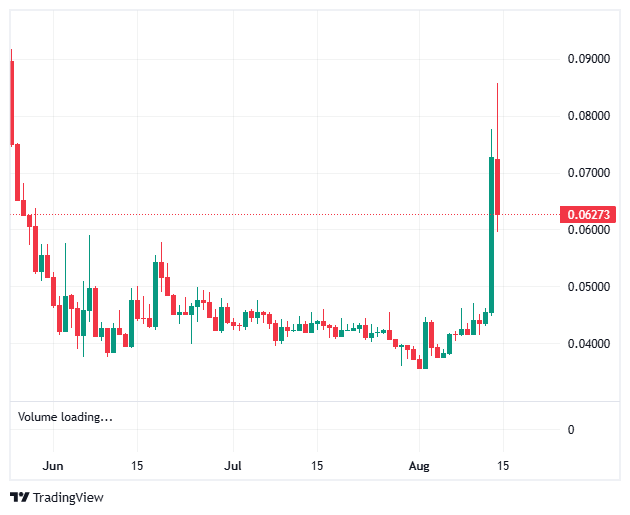
OpenEden has recently posted strong gains and appeared among the top performers on major market trackers.
Traders now wonder whether the project can deliver outsized returns.
This article examines the most common questions about OpenEden and evaluates the realistic potential behind the “millionaire maker” narrative.
What is OpenEden (EDEN)?
OpenEden is a regulated real-world asset (RWA) tokenisation platform that brings U.S. Treasury securities on-chain. EDEN is its native utility and governance token.
Moreover, the project focuses on institutional-grade infrastructure rather than pure speculation. Thus, OpenEden attempts to connect traditional fixed-income yields with blockchain accessibility.
Therefore, its value proposition differs from many high-volatility crypto assets that lack underlying cash-flow fundamentals.

How Does OpenEden Work?
Users (typically after KYC) can access products like TBILL (tokenized short-term U.S. T-Bills) and USDO (a yield-bearing stablecoin backed by Treasuries), enabling on-chain exposure to traditional fixed-income yields.
Furthermore, the platform emphasises transparency through regulated structures and third-party custody.
In addition, these products aim to offer relatively stable yields compared with pure crypto-native assets.
As a result, OpenEden targets both DeFi participants seeking lower-risk collateral and institutional treasuries looking for compliant on-chain options.
Ultimately, the success of the model depends on sustained adoption of these RWA products.
What is the Utility of the EDEN Token?
EDEN provides fee discounts, early access to new tokenized products, staking rewards, and governance rights when staked.
Moreover, the token is designed to align holders with protocol growth rather than rely solely on emissions.
In addition, preferential fee structures can reduce costs for frequent users of TBILL or USDO products.
As a result, utility increases if the underlying RWA platform attracts meaningful volume.
Therefore, EDEN’s long-term demand is closely tied to real economic activity on the OpenEden platform.
What Is xEDEN And How Does Staking Work?
Staking EDEN converts it into xEDEN, a value-accruing governance token that enables voting on key decisions (e.g., reserve strategy, product roadmap) and compounds rewards automatically.
Furthermore, xEDEN holders participate in decisions that affect the ecosystem’s direction.
In addition, the auto-compounding design removes the need for manual reward claims.
As a result, staking creates a longer-term alignment mechanism between token holders and protocol performance.
The attractiveness of xEDEN depends on the quality of governance outcomes and the sustainability of rewards.

What Are the Tokenomics of EDEN?
Total supply is fixed at 1 billion EDEN. Allocations include Ecosystem & Community (~41%), Team & Advisers (20%), Investors (~15%), Foundation (10%), plus airdrop and early adopter portions, with various vesting schedules.
Moreover, significant portions remain subject to future unlocks, which can create supply pressure.
In addition, the distribution attempts to balance community incentives with team and investor alignment.
Consequently, investors must monitor unlock schedules closely. Therefore, tokenomics alone do not guarantee price appreciation; actual platform revenue and demand matter far more.
Is OpenEden Regulated / Compliant?
Yes — it operates through licensed entities (e.g., in Bermuda and BVI), has received investment-grade ratings (such as Moody’s “A-bf” for its fund), and emphasises institutional-grade compliance and KYC/AML.
Furthermore, this regulatory focus distinguishes OpenEden from many unregulated DeFi protocols.
In addition, institutional-grade ratings and custody arrangements aim to build trust with professional capital.
As a result, the compliance layer may support broader adoption over time.
The, regulatory alignment can be both a strength and a constraint, depending on evolving rules across jurisdictions.

Who Can Invest in OpenEden’s RWA Products?
Products like TBILL are generally permissioned and require KYC screening; many are limited to accredited or professional investors.
Moreover, this restriction reduces accessibility for average retail users compared with fully permissionless protocols.
In addition, the permissioned nature supports regulatory compliance but limits the total addressable user base in the short term.
Thus, growth may depend more on institutional and professional capital than on broad retail speculation.
Therefore, the investor base for the core RWA products differs from the broader secondary market for the EDEN token itself.
What Are the Main Risks of Holding EDEN or Using OpenEden?
Risks include smart-contract risk, regulatory changes, token unlock/selling pressure, custody of underlying assets, and the fact that EDEN’s value depends on protocol adoption and revenue.
Furthermore, even regulated structures cannot eliminate all operational or market risks.
In addition, large future unlocks can suppress price appreciation if demand does not absorb new supply.
As a result, EDEN remains a high-risk asset despite its RWA foundation. Overall, no token offers guaranteed wealth creation, and capital loss remains possible.
When Did the EDEN Token Launch?
The Token Generation Event (TGE) occurred around September 30, 2025, with listings on major exchanges following.
Moreover, the relatively recent launch means the project is still in an early growth phase.
In addition, early price discovery and liquidity building continue to shape market behaviour. Consequently, volatility remains elevated compared with more mature assets.
Therefore, recent strong performance should be viewed in the context of a still-young token.
How Can I Buy or Stake EDEN?
EDEN trades on major centralised exchanges like Toolbit, Bithumb, MEXC, Bitvavo, and Bitrue with its largest market on Binance.
The token can also be traded on decentralised exchanges such as Uniswap and PancakeSwap.
EDEN can be staked on the OpenEden platform to receive xEDEN for governance and rewards.
Furthermore, users should verify official contract addresses and platform links to avoid scams.
In addition, staking requires interacting with the protocol’s smart contracts or interface.
As a result, participants must practice standard security hygiene. Accessibility is relatively straightforward for those already active in crypto markets.
OpenEden combines a regulated RWA foundation with a native token designed for utility and governance.
While the recent price surge and institutional positioning have generated excitement, turning EDEN into a “millionaire maker” would require sustained platform growth, meaningful revenue capture, and favourable market conditions over an extended period.
Most tokens that deliver extreme returns do so under rare combinations of timing, adoption, and narrative strength.
Investors who focus on the underlying business fundamentals, monitor unlock schedules, and size positions responsibly stand in a better position than those chasing short-term momentum alone.
Careful research and realistic expectations remain essential.
