

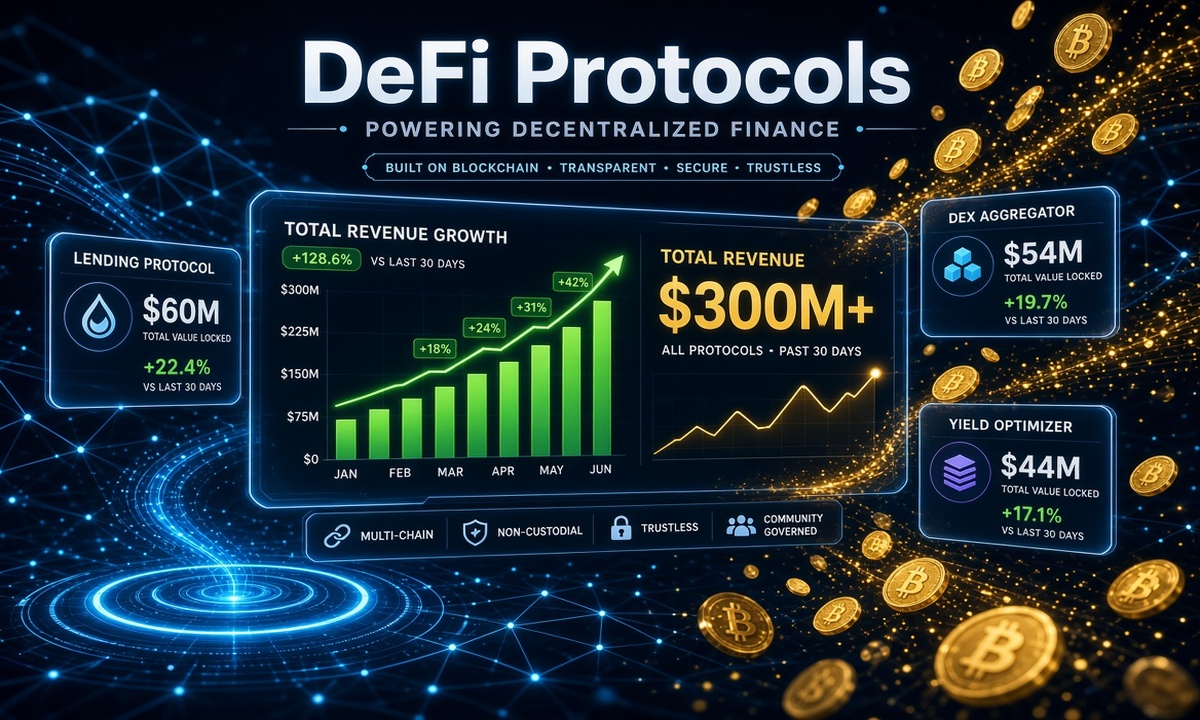
Fresh data from DefiLlama reveals a striking reality in DeFi protocols revenue.
The leading DeFi protocols generated more than $300 million in combined revenue across the past 30 days.
This figure shows how real economic activity continues to thrive even amid shifting market narratives.
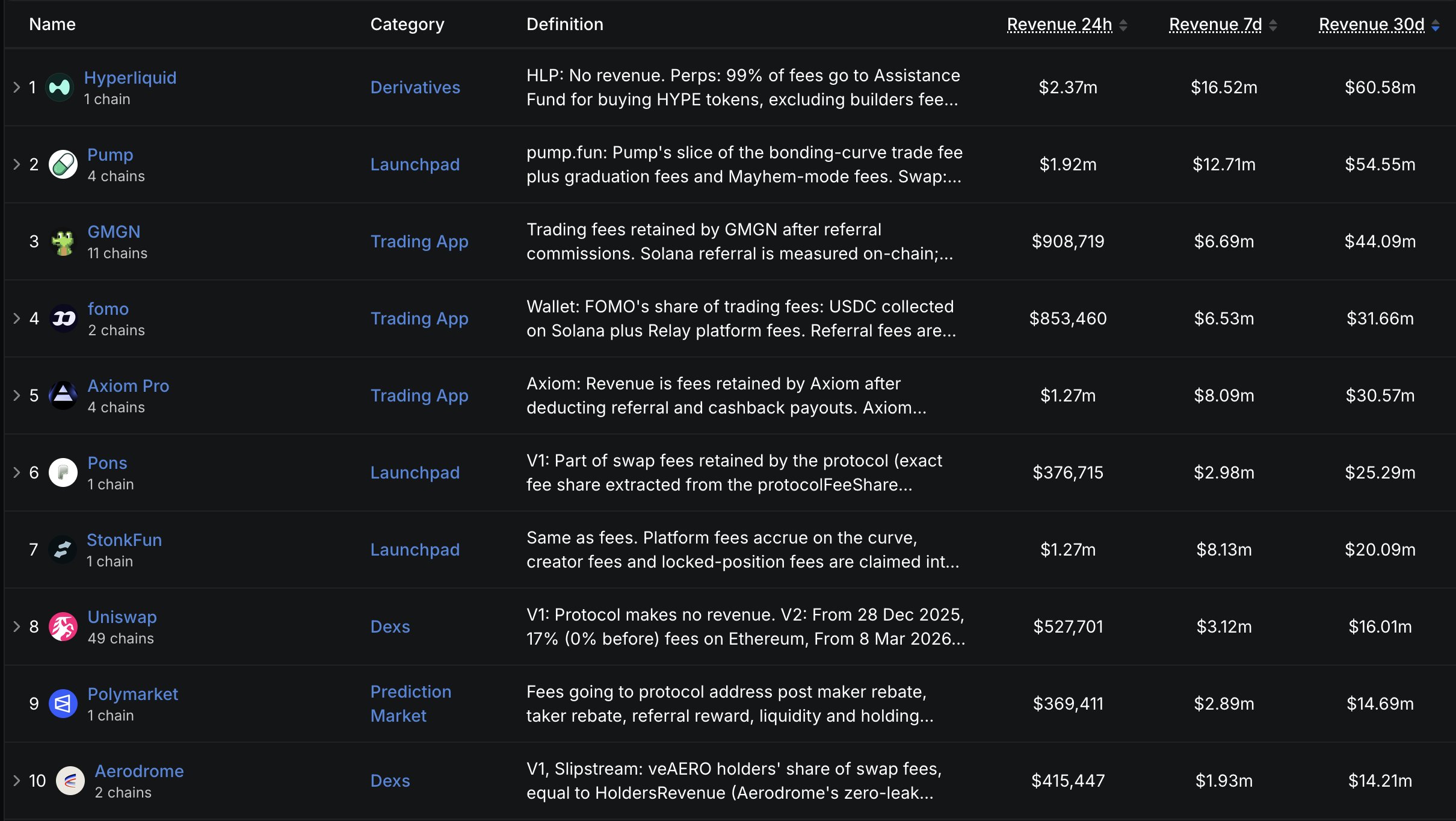
Hyperliquid sits at the top with $60.58 million. Pump follows closely at $54.55 million. GMGN secured third place with $44.09 million. Then come Fomo at $31.66 million, Axiom Pro at $30.57 million, Pons at $25.29 million, StonkFun at $20.09 million, Uniswap at $16.01 million, Polymarket at $14.69 million, and Aerodrome at $14.21 million.
Together these ten DeFi protocols cleared the $300 million mark.

Why Launchpads and Trading Apps Dominate Current DeFi Protocols Revenue
A clear pattern emerges when you examine the categories. Launchpads and trading applications occupy most of the top spots.
Hyperliquid operates as a derivatives platform. Pump, Pons, and StonkFun function primarily as token launchpads.
GMGN, Fomo, and Axiom Pro serve as trading apps or wallets that capture fees from high-velocity activity.
Meanwhile, traditional decentralised exchanges still appear, yet they trail the newer players. Uniswap and Aerodrome round out the list.
This shift reflects how user behaviour has evolved. Traders chase rapid token launches and quick swaps far more aggressively than classic liquidity provision in many cases.
Thus, fee capture concentrates where volume spikes hardest.
DefiLlama tracks revenue as the portion of fees retained by the protocol after any necessary distributions.
For Hyperliquid, the majority of perpetual and spot fees flow into its Assistance Fund for HYPE buybacks.
Pump retains a slice of bonding-curve fees plus graduation and terminal charges. Similar mechanics power the others. These models convert user activity directly into protocol cash flow.
How These Numbers Compare Across DeFi Protocols
The concentration feels notable. These ten DeFi protocols account for a meaningful share of recent retained revenue once stablecoin issuers and pure chain fee burns are set aside.
Hyperliquid and Pump alone delivered over $115 million. Adding GMGN pushes the trio past $159 million.
Such scale demonstrates that certain DeFi protocols have built durable businesses rather than relying solely on token incentives.
At the same time, the presence of newer names such as Pons on Robinhood Chain and StonkFun on Solana highlights geographic and chain diversification.
Activity no longer clusters exclusively on Ethereum. Solana-based and specialised layer-2 launchpads now compete effectively for attention and fees.
What This Means for the Broader DeFi Landscape
Revenue figures offer one of the cleanest signals available. Protocols that generate consistent cash flow can fund development, buybacks, or treasury operations without constant token emissions.
Hyperliquid’s model of routing nearly all fees into token support exemplifies this approach.
Pump and several launchpads follow comparable paths by recycling a portion of fees into their ecosystems.
Still, sustainability questions remain. High revenue often ties to speculative trading waves. Launchpad volume can cool quickly if new-token demand softens.
Trading apps depend on continued user preference for their interfaces over direct DEX interaction.
Uniswap’s inclusion shows that established infrastructure retains relevance once fee switches activate more fully.
Investors and builders watching DeFi protocols increasingly track these retained-revenue metrics alongside total value locked.
A protocol that earns tens of millions monthly while maintaining reasonable margins demonstrates product-market fit more convincingly than total value locked (TVL) alone.
Frequently Asked Questions About Top-Performing DeFi Protocols
Which DeFi protocols currently lead in 30-day revenue?
Hyperliquid, Pump, and GMGN currently occupy the first three positions according to the latest DefiLlama snapshot. Their combined contribution exceeds $159 million for the period.
Why do launchpads generate so much revenue among DeFi protocols?
Launchpads monetise the entire lifecycle of new tokens. They collect fees during the bonding-curve phase, at graduation, and sometimes through related trading terminals. High launch volume translates quickly into protocol income.
How does DefiLlama define revenue for these DAPPs?
DefiLlama measures the fees the protocol itself retains after subtracting referral payouts, cashbacks, or other distributions. The metric focuses on what stays with the protocol rather than total fees paid by users.
Do traditional DEXs still matter in the current DAPPs ranking?
Yes. Uniswap and Aerodrome both appear in the top ten. Their presence confirms that deep liquidity venues continue generating meaningful revenue once fee-switch mechanisms take effect.
What risks accompany high revenue concentration in DAPPs?
Heavy reliance on trading volume leaves protocols exposed to sentiment shifts. A prolonged quiet period in meme or new-token activity could reduce fee intake for several of the current leaders.
How can users verify these DAPPs revenue figures?
The most direct method involves visiting DefiLlama’s revenue dashboard. The site updates continuously and provides category breakdowns, definitions, and historical charts for each protocol.
These results arrive at a moment when many market participants debate the long-term viability of decentralised applications (dApps).
The numbers supply concrete evidence that a subset of DeFi protocols has already built businesses capable of generating hundreds of millions in a single month.
Whether the current leaders maintain their positions will depend on their ability to adapt as user preferences evolve.
For now, the data from DefiLlama offers a clear snapshot of where real revenue currently flows.
