

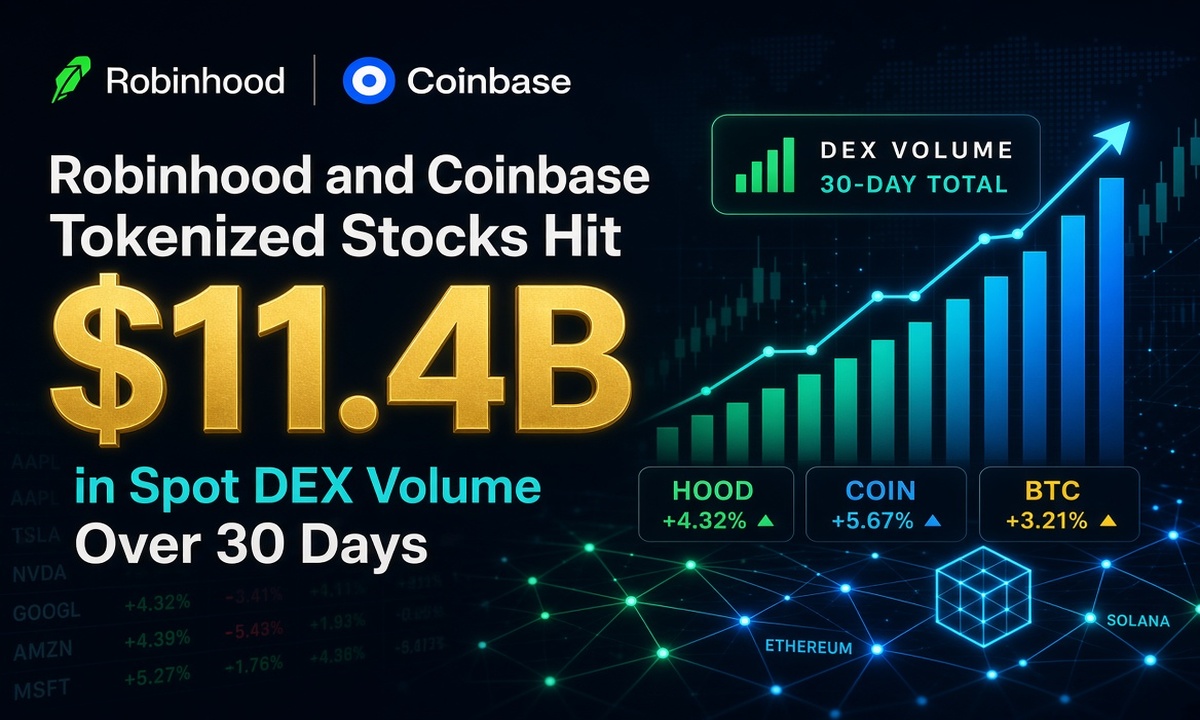
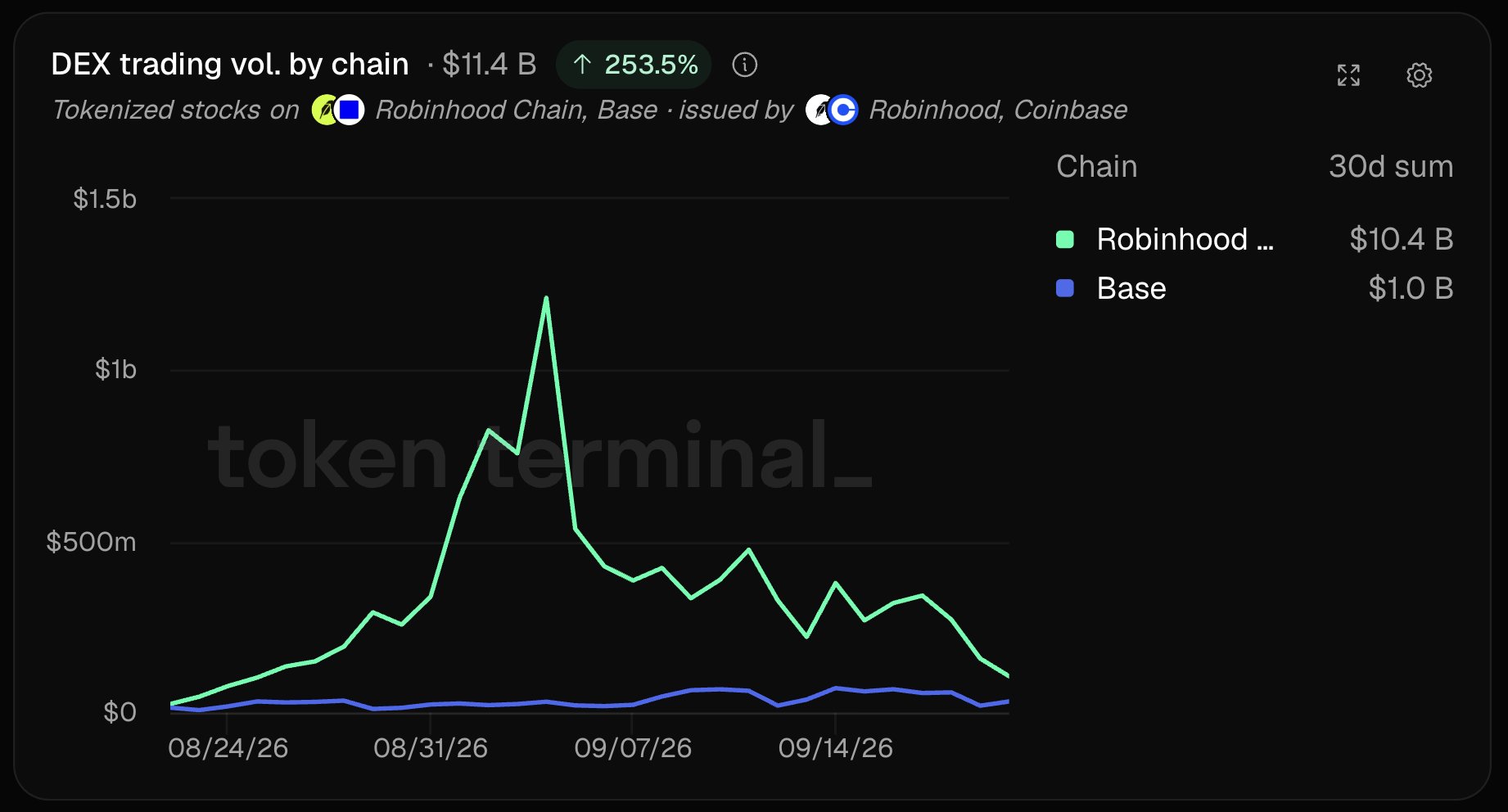
Tokenized stocks issued by Robinhood and Coinbase just cleared $11.4 billion in spot decentralised exchange (DEX) volume across the past thirty days.
Robinhood Chain alone accounted for $10.4 billion of that total while Base contributed the remaining $1.0 billion.
Token Terminal’s latest tracker captured the split and confirmed Robinhood’s clear lead during the period.
The figure marks a rapid acceleration for on-chain equity trading.
Traditional stock markets still close on weekends and holidays, yet these tokenized versions keep moving around the clock on decentralised exchanges.
Traders now treat major U.S. names such as Nvidia, Apple, Meta and GameStop as programmable assets that settle in seconds.
How Robinhood and Coinbase Tokenized Stocks Reached $11.4 Billion
Robinhood launched its dedicated Layer-2 chain in early July 2026 specifically to host stock tokens.
Those tokens quickly found liquidity on Uniswap v3 and v4 deployments native to the network.
Daily volumes climbed from modest early levels into the tens of millions and occasionally higher as memecoin pairs collateralised by the equities added further activity.
Meanwhile, Coinbase introduced its own B20-standard tokenized stocks on Base in late August.
Each token represents a beneficial claim on a real share held in regulated, bankruptcy-remote custody.
Aerodrome emerged as the primary venue, handling the bulk of Base volume for names such as NVDAc, AAPLc, METAc and GOOGLc.
The combined thirty-day total across both ecosystems reached the $11.4 billion mark reported by Token Terminal.
Why Tokenized Stocks Are Attracting Serious DEX Flow
Traditional brokerage accounts lock capital inside closed systems. Tokenized versions live as standard tokens that wallets, lending protocols and automated strategies can interact with freely.
Users can hold fractional exposure, post the tokens as collateral, or trade them at any hour without waiting for the New York open.
In particular, the 24/7 nature of DEX markets has proved sticky. Earnings releases, macro data and weekend news no longer leave positions stranded until Monday.
Liquidity providers earn fees on pairs that would otherwise sit idle, and arbitrageurs keep prices aligned with the underlying cash markets during regular hours.
What Separates Robinhood Chain Volume from Base Volume
Robinhood Chain currently hosts a broader catalogue of tickers and benefits from deeper early liquidity plus memecoin-driven secondary activity.
Uniswap processes nearly all of its stock-token flow. Base, by contrast, concentrates volume on a smaller set of high-profile names and routes most trades through Aerodrome.
At the same time, both platforms share a common design goal: bringing real economic exposure to U.S. equities on-chain for eligible non-U.S. users.
Robinhood’s tokens are structured as debt securities that deliver economic exposure without granting legal ownership or voting rights.
Coinbase’s tokens confer a direct beneficial claim on the underlying shares.
Those structural differences influence custody, regulatory treatment and the precise rights each holder receives.
How Tokenized Stocks Fit into Broader On-Chain Finance
Once an equity lives as a token, it can serve as collateral on lending markets, sit inside automated vaults, or form the basis for structured products.
Protocols already accept several of the leading names.
Builders can create baskets, yield strategies or perpetual-style exposure without leaving the blockchain environment.
Looking ahead, the competitive dynamic between Robinhood Chain and Base remains fluid.
Coinbase’s deeper distribution and institutional relationships could narrow the volume gap if more tickers migrate to Base and liquidity deepens.
Robinhood’s first-mover advantage and integrated brokerage traffic currently keep it ahead.
Frequently Asked Questions About Tokenized Stocks and the $11.4 Billion Volume
Do tokenized stocks give holders the same rights as traditional shares?
Robinhood stock tokens provide economic exposure without voting rights or legal ownership of the underlying shares.
Coinbase tokenized stocks confer a beneficial claim on real shares held in custody.
Neither product is currently available to U.S. persons.
Which DEXes process most of the volume?
Uniswap dominates Robinhood Chain activity.
Aerodrome handles the large majority of Base volume for Coinbase-issued tokens.
Can these tokens trade when traditional markets are closed?
Yes, DEX pools operate continuously, so price discovery continues through weekends, holidays and overnight sessions.
How are the underlying shares safeguarded?
Both issuers use regulated custodians.
Coinbase emphasises bankruptcy-remote custody separate from its own balance sheet.
Robinhood uses a Jersey-based issuer entity for its stock tokens.
Is the $11.4 billion figure pure equity volume or inflated by related pairs?
Token Terminal tracks the stock tokens themselves.
Memecoin pairs collateralised by the tokens contribute additional secondary volume on Robinhood Chain, yet the reported figure focuses on the equity tokens.
Will more brokers enter the tokenized stock race?
Several platforms already compete across Solana, BNB Chain and other networks.
The speed at which Robinhood and Coinbase have scaled suggests further entrants are likely as regulatory clarity improves.
The $11.4 billion 30-day total demonstrates that tokenized stocks have moved beyond experimental status.
Robinhood Chain currently leads the charge while Base builds a complementary base of activity.
As more capital treats these instruments as everyday trading and collateral assets, the gap between traditional equity markets and on-chain markets will keep narrowing.
