

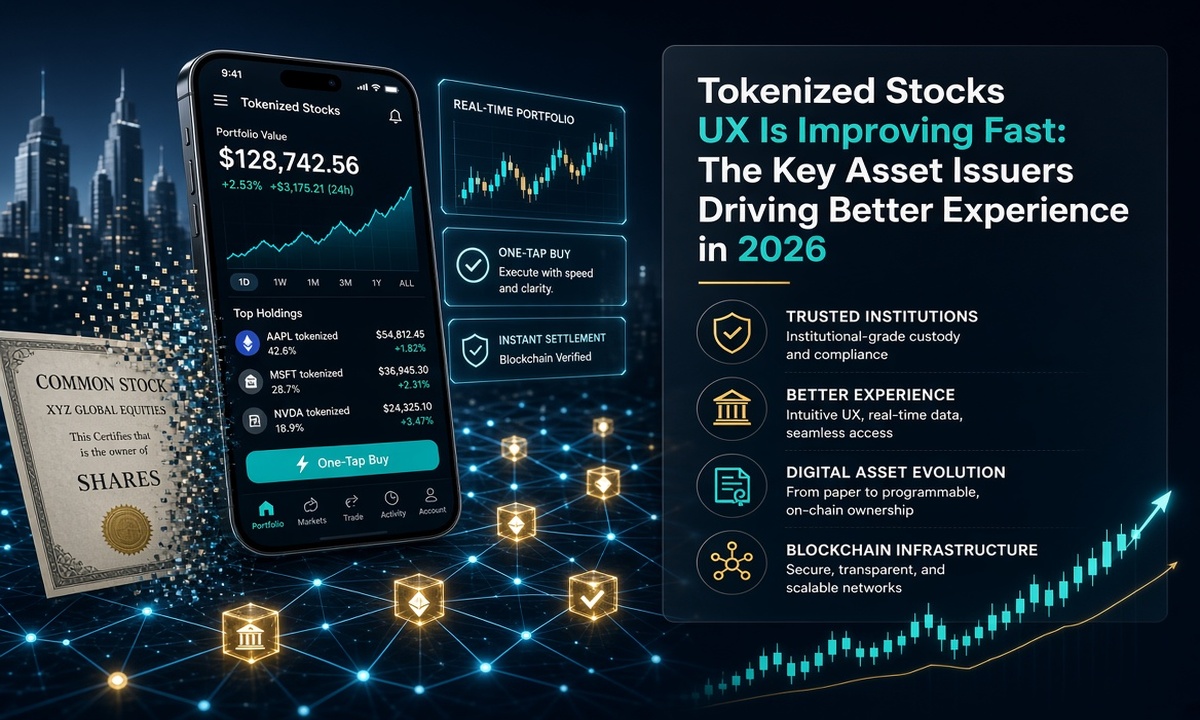
Token Terminal has pointed out a simple truth about tokenized stocks UX (user experience) as of September 2026.
The current user experience ranks as the worst it will ever be.
Yet 4.4 million holders already interact with these assets.
That combination of early traction and clear room for improvement creates unusual opportunity.
Why is tokenized stocks UX still limited right now?
Users face constrained stock selection, uneven liquidity, and interfaces that often feel unfinished.
Legal and economic rights can remain unclear, while seamless ways to lend, borrow, or use the assets as collateral stay underdeveloped.
In addition, the entire category still represents only a tiny slice of the $150 trillion global public equity market.
Nevertheless, the technology and distribution channels keep advancing, so the friction users feel today is temporary.
Tokenized Stock UX: Which asset issuers are actively improving the experience?
A growing group of specialised platforms leads the effort.
Securitize focuses on regulated issuance and clearer ownership structures.
xStocks and Superstate expand available symbols and refine redemption paths.
Robinhood Crypto and Backpack push consumer-friendly interfaces and broader distribution.
Ondo continues scaling its global markets offering, while Centrifuge brings additional infrastructure for onchain usability.
Moreover, each issuer competes on different pieces of the stack—issuance quality, liquidity depth, legal clarity, and interface design—so progress compounds across the sector.
How will better UX change adoption?
Smoother interfaces and deeper markets lower the barrier for both retail and institutional participants.
Beyond that, clearer economic rights and expanded decentralised finance (DeFi) composability turn tokenized stocks from static holdings into active financial tools.
Specifically, when users can trade, lend, and collateralise these assets with less friction, daily activity rises and the value proposition strengthens.
At the same time, more listed stocks give investors genuine choice rather than a narrow set of popular names.

What does this mean for onchain finance in 2026?
Projects that integrate these improving assets stand to capture new volume and users.
Meanwhile, the issuers themselves race to deliver the features that matter most: wider selection, reliable liquidity, transparent structures, and intuitive design.
Ultimately, the gap between current clunky experiences and future polished ones creates a clear runway for growth.
Tokenized stocks already attract millions of holders; better UX simply accelerates the next wave.
The direction is already visible. Leading issuers treat user experience as a competitive priority rather than an afterthought, and that shift is reshaping how real-world equities live onchain.
