


Arkham Intelligence flagged a striking on-chain reality this week with Mt. Gox.
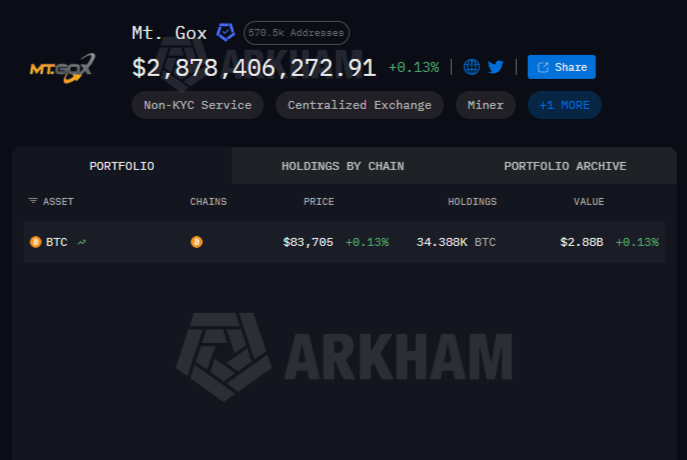
Wallets labelled to the Mt. Gox estate still control 34,387.51 Bitcoin, valued at roughly $2.88 billion.
The figure sits more than twelve years after the exchange collapsed in 2014.
These coins remain visible and trackable on the blockchain even as the rehabilitation process nears its final stretch.

How Much Bitcoin Does the Mt. Gox Estate Still Hold in 2026?
Arkham’s latest snapshot places the labelled addresses at 34,387.51 BTC.
Other recent tallies hover between 34,000 and 34,500 BTC, confirming the stack has stayed remarkably steady in recent months.
After the 2014 failure, the estate recovered close to 200,000 BTC in total. The current balance represents the final portion still awaiting distribution to remaining creditors.
In June 2026, the wallets moved more than 10,400 BTC internally between estate-linked addresses, yet the overall holdings barely shifted.
Market observers continue watching these addresses closely because any large transfer toward exchanges often signals upcoming repayments.
Why Has the Mt. Gox Repayment Process Taken More Than a Decade?
Trustee Nobuaki Kobayashi has guided the rehabilitation since the early days. Distributions finally began in mid-2024.
By late 2026, roughly 19,500 of an estimated 24,000 creditors had already received payouts.
The trustee set October 31, 2026 as the final repayment deadline after several earlier extensions.
Legal complexity, the need to verify claims across jurisdictions, and careful coordination with exchanges such as Kraken slowed the process.
Each remaining coin must eventually leave the estate wallets, which keeps the addresses under constant public scrutiny.

What Could Happen When the Remaining Mt. Gox Bitcoin Moves?
Creditors who still await their share may sell portions of their recovered Bitcoin once they receive it.
That possibility has long fuelled market speculation about potential selling pressure.
At the same time, many long-term holders have treated earlier distributions as long-held assets rather than immediate sale candidates.
The final deadline creates a clear timeline. Any large outflows from the labelled wallets toward known exchange deposit addresses will likely draw rapid attention from traders and analysts.
Until those transfers occur, the 34,387 BTC continue to sit as one of the most watched dormant stacks in the Bitcoin ecosystem.

How Do These Holdings Compare With Earlier Recoveries?
The original Mt. Gox loss involved roughly 850,000 BTC. Recovery efforts later located and secured a substantial portion of those coins.
The estate then methodically distributed the bulk of the recovered Bitcoin over the past two years.
The remaining 34,387 BTC therefore represent the tail end of a long recovery rather than a new discovery.
This lingering balance shows both the transparency of public blockchains and the slow pace of complex bankruptcy proceedings in the crypto space.
Anyone can still view the addresses and balances on platforms such as Arkham.
The Mt. Gox Bitcoin Holdings 2026 story remains unfinished. The estate’s 34,387 BTC, now worth $2.88 billion, stand as a living reminder of early exchange risks and the long path toward resolution.
With the October 31 deadline approaching, the next major wallet movements could close one of crypto’s longest-running chapters.
