

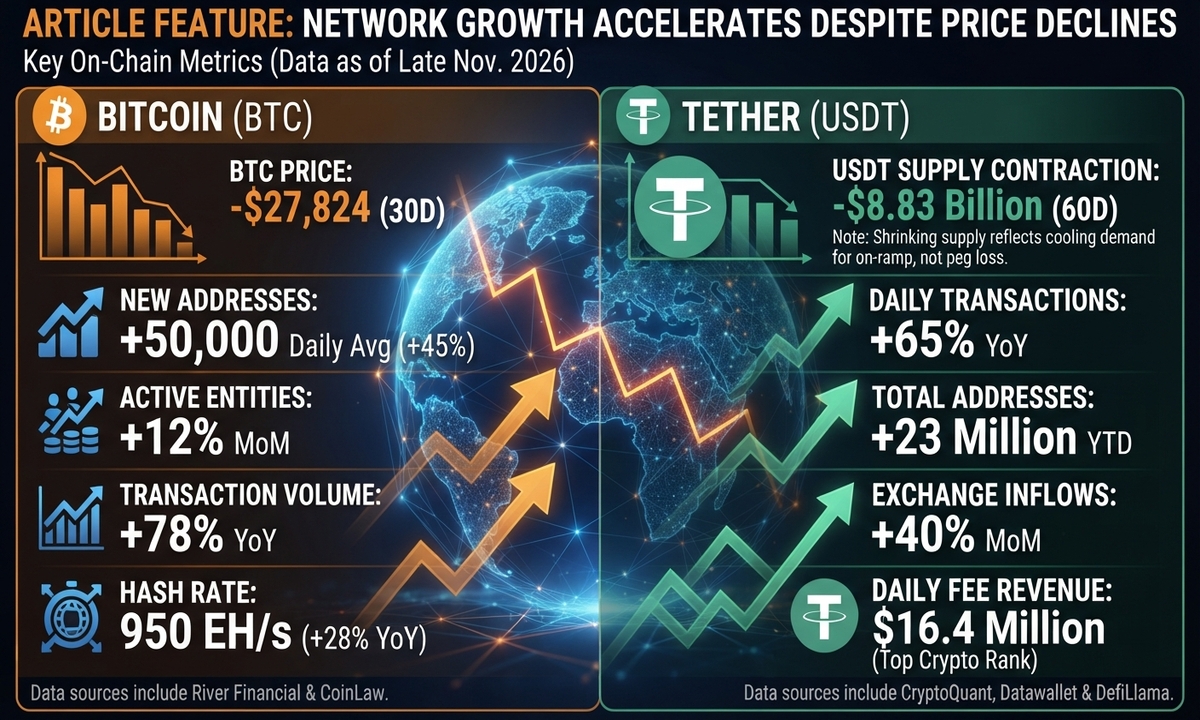
Bitcoin continues to attract fresh participants even while its price struggles.
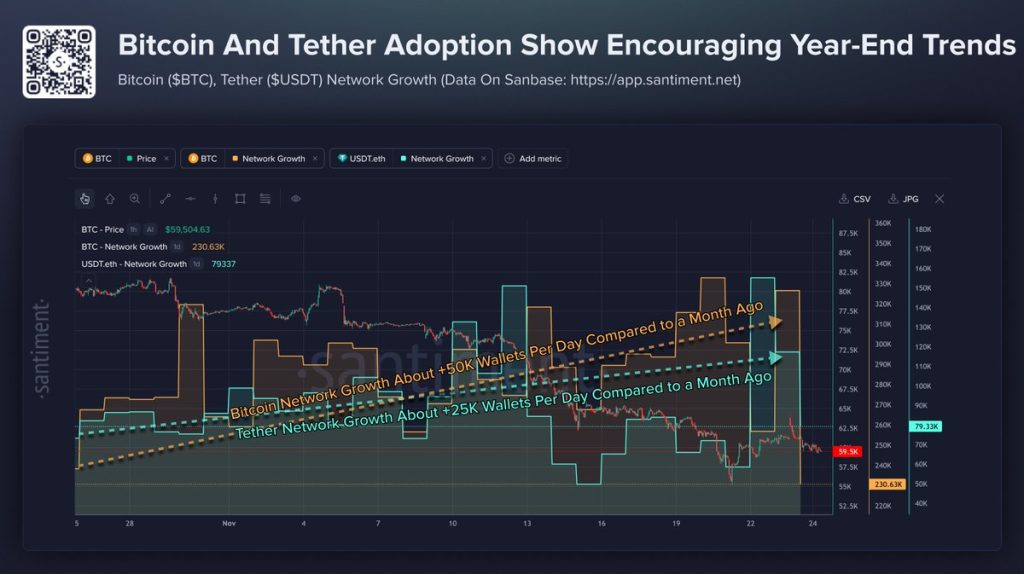
Over the past month, the daily flow of brand-new Bitcoin addresses has climbed by roughly 50,000 compared with levels seen a month earlier.
At the same time, Tether on Ethereum has added about 25,000 new addresses each day.
These figures come straight from Santiment’s on-chain tracking and stand out against the soft price action that has kept Bitcoin near the $59,000 area.
Fresh wallet creation rarely moves in lockstep with short-term price swings.
Right now, the two largest pillars of the crypto ecosystem—Bitcoin itself and the dominant stablecoin—are expanding their user bases while speculative interest cools.
That divergence often signals quieter accumulation rather than outright abandonment.
Why Does Bitcoin Network Growth Matter When Prices Fall?
Network growth tracks first-time addresses that receive coins.
A sustained rise shows new people or new capital still entering the system.
Bitcoin’s jump of roughly 50,000 extra daily addresses points to broader participation, not just existing holders reshuffling coins.
Historical patterns link periods of rising new-address activity with later recoveries once selling pressure eases.
The current uptrend therefore supplies an early, measurable sign of underlying demand.
Tether’s parallel increase adds another layer. Stablecoins serve as the primary on-ramp and settlement layer for trading, payments, and capital movement across the market.
When both Bitcoin and Tether wallets expand together, liquidity and participation tend to reinforce each other.

How Does Rising Tether Activity Support Bitcoin?
Tether remains the most widely used stablecoin for moving value in and out of crypto markets.
Its network growth on Ethereum reflects continued transactional demand even as overall market sentiment stays cautious.
Traders and businesses still need a reliable dollar proxy; fresh USDT addresses indicate that need has not disappeared.
In practice, this keeps capital circulating and ready to rotate back into Bitcoin once confidence returns.
Santiment notes that simultaneous expansion of the largest asset and the largest stablecoin ranks among the more constructive signals available today.
The data does not guarantee an immediate rebound, yet it strengthens the case that participation is building beneath the surface.

What Could Sustained Growth Mean for 2027?
If the current pace of new-wallet creation holds through the final weeks of 2026, the foundation for a more durable recovery into 2027 grows firmer.
Markets often bottom when price declines outpace the loss of network interest.
The opposite pattern—price weakness paired with rising addresses—has preceded several previous recoveries.
Continued growth would suggest that new participants view current levels as attractive entry points rather than reasons to exit.
Bitcoin’s price has retreated sharply from earlier highs, yet the on-chain metrics refuse to confirm a broad retreat of interest.
Active addresses and funded wallets have also held up better than many expected during the drawdown.
These quieter indicators rarely grab headlines the way price charts do, but they frequently offer clearer insight into the health of the network.
Looking ahead into the future, the decisive test will be whether the elevated new-address rates persist.
A prolonged rise would imply that Bitcoin’s base of users and capital is still expanding, independent of short-term price noise.
That kind of quiet strength has historically rewarded patient observers once sentiment eventually shifts.
