

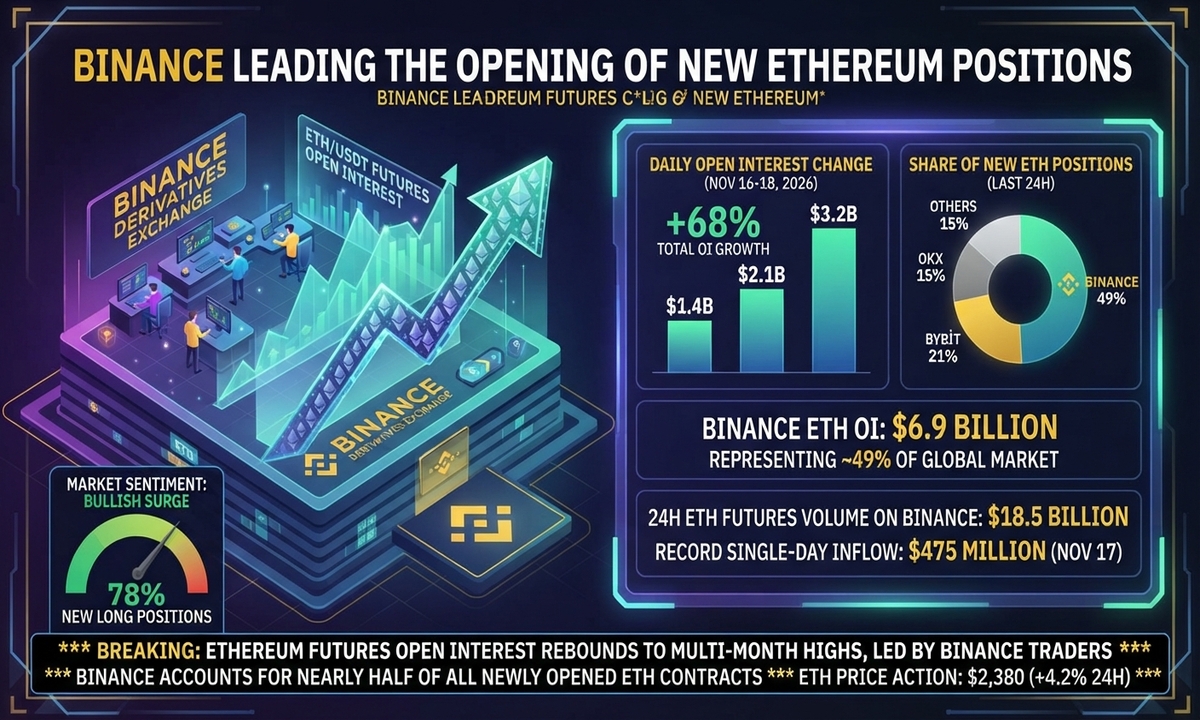
Binance currently stands at the forefront of fresh Ethereum futures activity.
CryptoQuant data shows open interest in ETH futures climbing since mid-November 2026, and Binance accounts for the bulk of those new contracts.
Traders have largely finished unwinding older leveraged bets. Fresh positions now take their place.
This development arrives after a clear period of deleveraging across the ETH derivatives market.
Open interest had fallen to multi-year lows earlier in November.
Binance’s share of total ETH futures open interest has hovered near 49% in recent months, giving the exchange outsized influence whenever positioning turns.

What Does the Rise in Binance Ethereum Open Interest Actually Mean?
Rising open interest paired with new position formation often signals that participants are expressing directional views again rather than simply closing existing ones.
In this case, Binance is the primary venue where that shift is visible.
The exchange’s deep liquidity and large trader base make it the natural place for the market to rebuild exposure.
Meanwhile, other platforms show more muted changes in the same 24-hour window.

Why Is Binance Capturing Most of the New Ethereum Positions?
Binance maintains the largest ETH futures market by a wide margin.
Recent snapshots place its open interest near $7 billion, representing roughly half of tracked venue totals on some aggregators.
High trading volume, competitive fees, and broad product availability keep both retail and professional flow concentrated there.
When the market transitions from liquidation-driven activity to new risk-taking, Binance naturally absorbs the largest share.

How Does This Change Market Structure for Ethereum Traders?
The end of the position-clearing phase removes one source of forced selling pressure.
New open interest introduces the possibility of either supportive long building or renewed short pressure, depending on how the contracts lean.
Binance’s dominance means price discovery and funding-rate dynamics on that platform will matter more than activity on smaller venues in the near term.
Traders watching ETH therefore gain clearer signals by focusing on Binance-specific metrics such as open-interest change, funding rates, and liquidations.

What Indicators Confirm the Shift Away from Deleveraging?
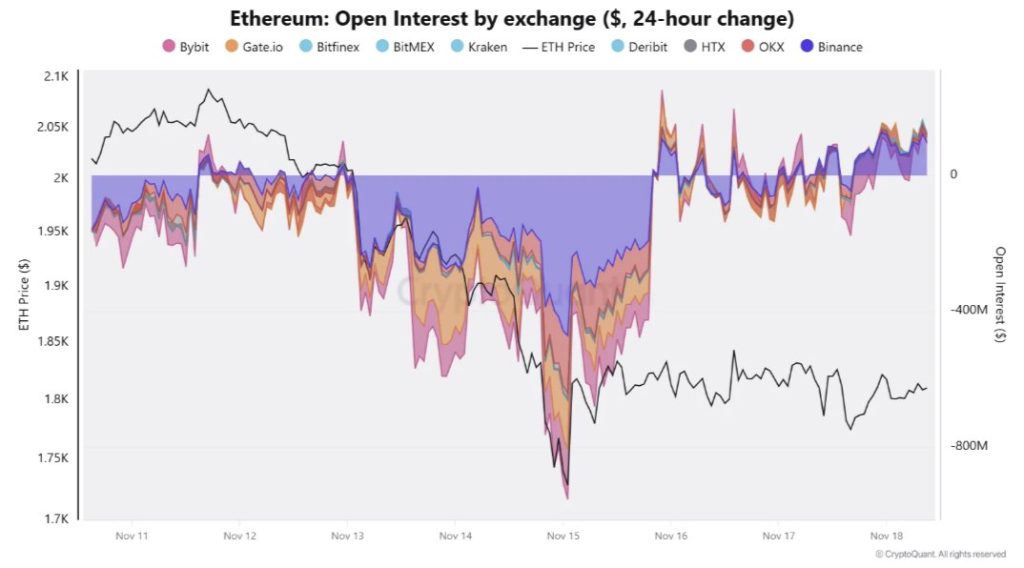
CryptoQuant analysts note that the process of clearing existing positions is nearing completion.
Charts of 24-hour open-interest change by exchange show Binance contributing the clearest positive readings in the latest sessions.
Price has stabilised in the $1,700–$1,850 range during the same period, consistent with a market that is no longer dominated by forced closures.
Concurrently, exchange ETH reserves on Binance have declined to multi-year lows, suggesting some investors prefer self-custody or decentralised finance (DeFi) deployment rather than keeping coins ready for immediate sale.
What Should Market Participants Monitor Going Forward?
Watch whether the open-interest increase on Binance continues and whether it arrives alongside rising long/short ratios or positive funding.
Persistent growth in new positions without a corresponding price breakout could still leave the market vulnerable to another flush.
Conversely, sustained building of exposure on the largest venue often precedes clearer trend development.
Cross-checking Binance data against overall ETH futures totals and spot-exchange flows will help separate genuine accumulation from short-term speculation.
Binance’s current leadership in opening new Ethereum positions marks a tangible change in derivatives market behaviour.
After weeks of position reduction, the largest exchange is once again the main stage for fresh risk.
Data from CryptoQuant and supporting market trackers supply the clearest evidence of this transition.
Participants who track these shifts in real time hold a practical edge as the next phase of ETH positioning unfolds.
