
Anthropic began trading on Nasdaq under the ticker ANT on November 19, 2026.
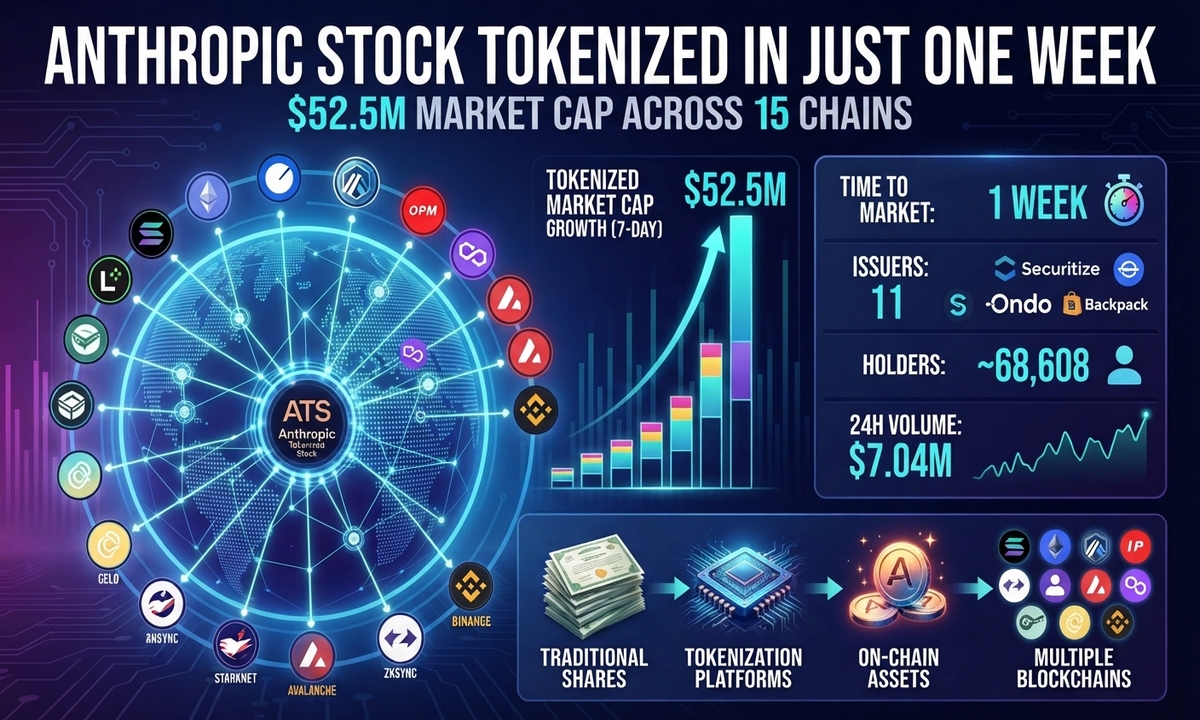
Within seven days, 11 asset issuers had already launched tokenized versions of that same stock across 15 different blockchains.
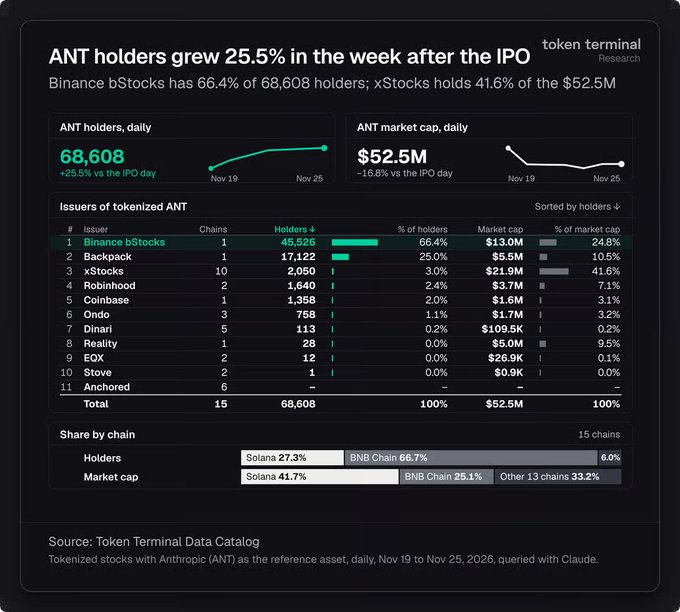
Those products together reached a $52.5 million market capitalisation and attracted 68,608 holders, according to Token Terminal data released on November 27.
This rapid rollout highlights how quickly the market now responds to major public listings.
What Exactly Happened With Anthropic Tokenized Stock After the IPO?
Anthropic priced its shares at $83 and raised roughly $81.3 billion in what became the largest IPO on record.
The stock opened at $111.50 and closed its first day at $97.17. While traditional markets handled the primary listing, multiple platforms simultaneously introduced on-chain versions tracking the ANT reference asset.
Issuers moved fast. Products appeared on Solana, BNB Chain, Ethereum, Base and others within hours or days.
Early volume on Solana alone exceeded $29 million in the first 90 minutes after the Nasdaq open.
Backpack Securities captured the largest share of that initial activity. Token Terminal later aggregated the broader picture across all 15 chains.
Why Did So Many Issuers Race to Tokenize Anthropic Stock?
Demand for AI-related exposure remains strong among crypto-native users who want continuous trading and DeFi compatibility.
At the same time, issuers compete to capture early liquidity and holder mindshare whenever a high-profile company goes public.
In parallel, platforms such as Ondo (ANTon), xStocks (ANTx), Securitize and Backpack each offered their own structures.
Some provide redeemable claims backed by actual shares; others deliver pure price exposure without voting rights or direct ownership.
This variety lets different investor groups participate under the rules that suit them.
Interestingly, the combined market cap of $52.5 million remains tiny beside Anthropic’s multi-trillion-dollar traditional valuation, yet the holder count already exceeds 68,000 wallets.
How Do These Anthropic Tokenized Stock Products Differ From Real Shares?
Most of the tokens give economic exposure rather than full shareholder rights.
Holders typically cannot vote or receive dividends in the traditional sense.
Certain regulated offerings, such as those from Securitize, aim to preserve more of the underlying rights for eligible investors in permitted jurisdictions.
Meanwhile, trading occurs around the clock on decentralised venues, something Nasdaq cannot match.
Liquidity concentrates heavily on Solana in the early days, though activity has spread across the other listed chains.
Users should always check the specific terms of each issuer because legal structure, custody arrangements and redemption options vary widely.
What Does the Speed of This Tokenization Tell Us About the Broader Market?
The fact that 11 issuers covered 15 chains in a single week shows tokenization infrastructure has matured.
Major IPOs no longer wait weeks or months before on-chain versions appear. Instead, the response now happens almost in real time.
Looking further, the $52.5 million market cap and 68,608 holders demonstrate genuine retail interest even when the products represent only fractional exposure relative to the traditional market.
This pattern may repeat with future high-profile listings.
At the same time, the gap between on-chain volume and Nasdaq turnover remains enormous, reminding everyone that traditional markets still dominate liquidity.
Overall, Anthropic’s first week as a public company delivered a clear case study in how tokenized stocks now form an immediate parallel market.
The numbers from Token Terminal give the clearest snapshot so far of that parallel activity.
