

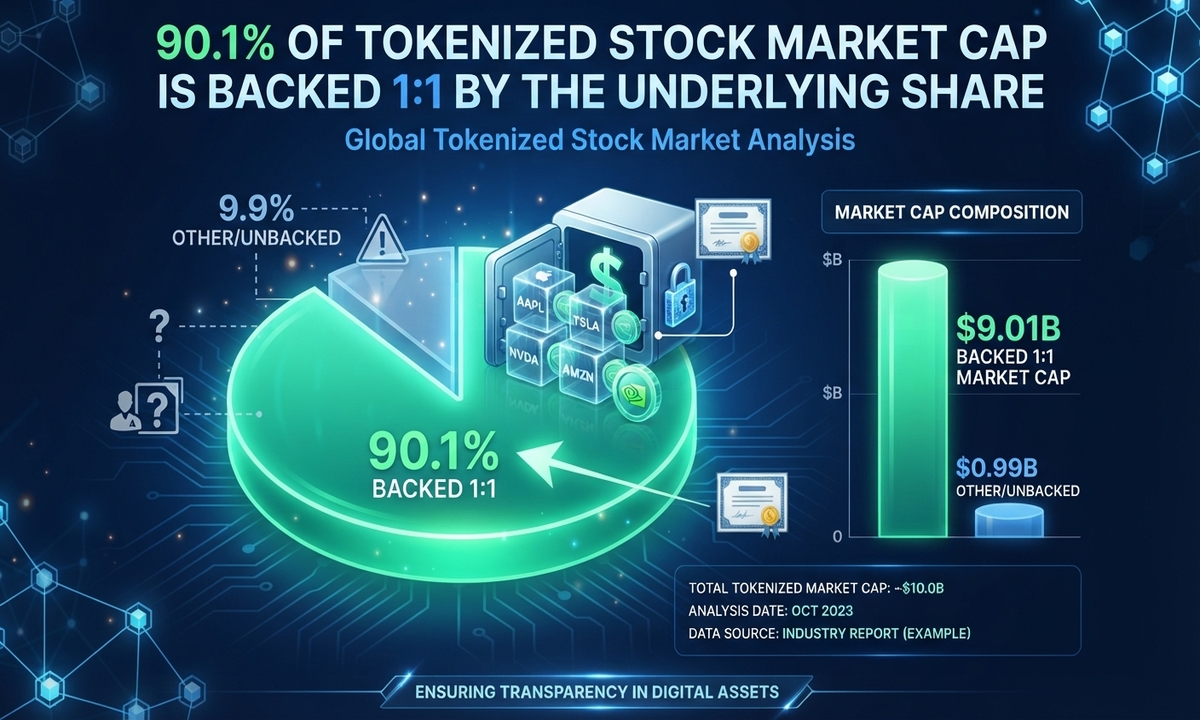
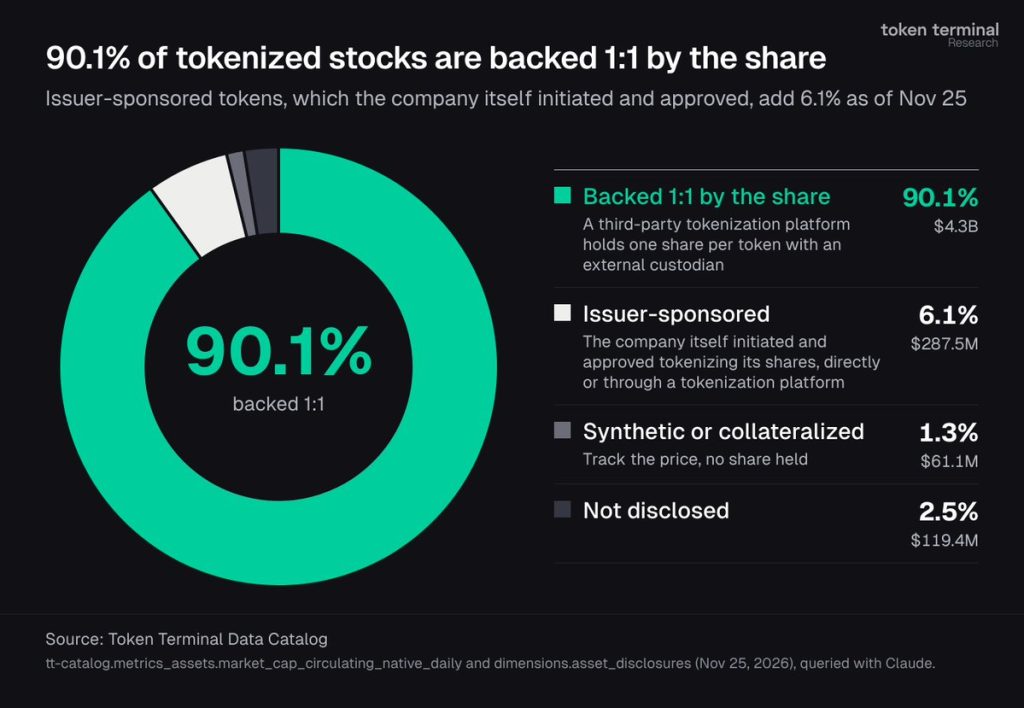
Token Terminal’s latest breakdown shows that 90.1% of the entire tokenized stock market cap sits on tokens backed one-to-one by actual shares held in custody.
Issuer-sponsored tokens, the ones a company itself initiates and approves, contribute another 6.1%.
The remaining slice covers synthetic or less tightly collateralised products.
This structure closely mirrors how the largest stablecoins operate today.
What Does 1:1 Backing Actually Mean for Tokenized Stock Market Cap?
When an issuer creates a new token under the 1:1 model, it must place a corresponding real share with a regulated custodian.
That share stays locked while the token circulates on-chain.
Holders therefore gain price exposure that is directly supported by physical equity rather than a pure synthetic claim.
Alpaca Securities currently serves as the primary custodian for the large majority of these shares, often covering 83% to 94% of the backed portion depending on the measurement window.
The arrangement creates a clear link between on-chain demand and traditional market activity.
Why Does the 1:1 Model Dominate Tokenized Stock Market Cap?
Investors and platforms favour collateralised products because they reduce counterparty risk.
In parallel, the model allows issuers to scale supply only when they can source and custody additional shares.
This discipline prevents unlimited minting and aligns token growth with real-world equity demand.
Issuer-sponsored tokens add a complementary layer. In those cases, the company itself participates, and the token often represents a direct entry on the company’s register.
Together, the two categories account for more than 96% of current tokenized stock market cap, leaving synthetic products as a small minority.
Interestingly, this composition echoes the path stablecoins took after algorithmic experiments failed and fully reserved designs prevailed.
How Does This Backing Structure Affect Demand for Underlying Shares?
Every new 1:1 token requires the purchase or allocation of an actual share.
Non-U.S. investors drive most of the activity, since many products exclude U.S. persons.
As a result, foreign demand for tokenized exposure translates into additional buying pressure in the traditional equity market.
The overall tokenized stock market now sits near $4.5 billion to $4.7 billion.
U.S. stocks and ETFs make up the overwhelming majority of the reference assets.
Building on this foundation, the 1:1 model turns global crypto wallets into a distribution channel for American equities.
What Risks Still Exist Despite Strong Backing?
Custody concentration remains the clearest structural point of attention.
When one broker-dealer holds the bulk of the underlying shares, operational or regulatory issues at that firm could affect a large share of the market.
At the same time, legal rights vary by issuer. Many tokens deliver economic exposure without voting power or automatic dividend pass-through.
Users therefore need to examine each product’s documentation carefully.
The high percentage of 1:1 backing improves transparency and trust, yet it does not eliminate all differences between on-chain tokens and ordinary brokerage shares.
In short, the data confirms that tokenized stock market cap rests on a foundation very similar to today’s leading stablecoins.
Real shares sit behind most of the value, and that design choice continues to shape how the sector grows.
