

Securitize continues to sit at the centre of the real-world asset (RWA) shift.
Its latest Q2 2026 results show clear platform expansion even while certain revenue lines softened.
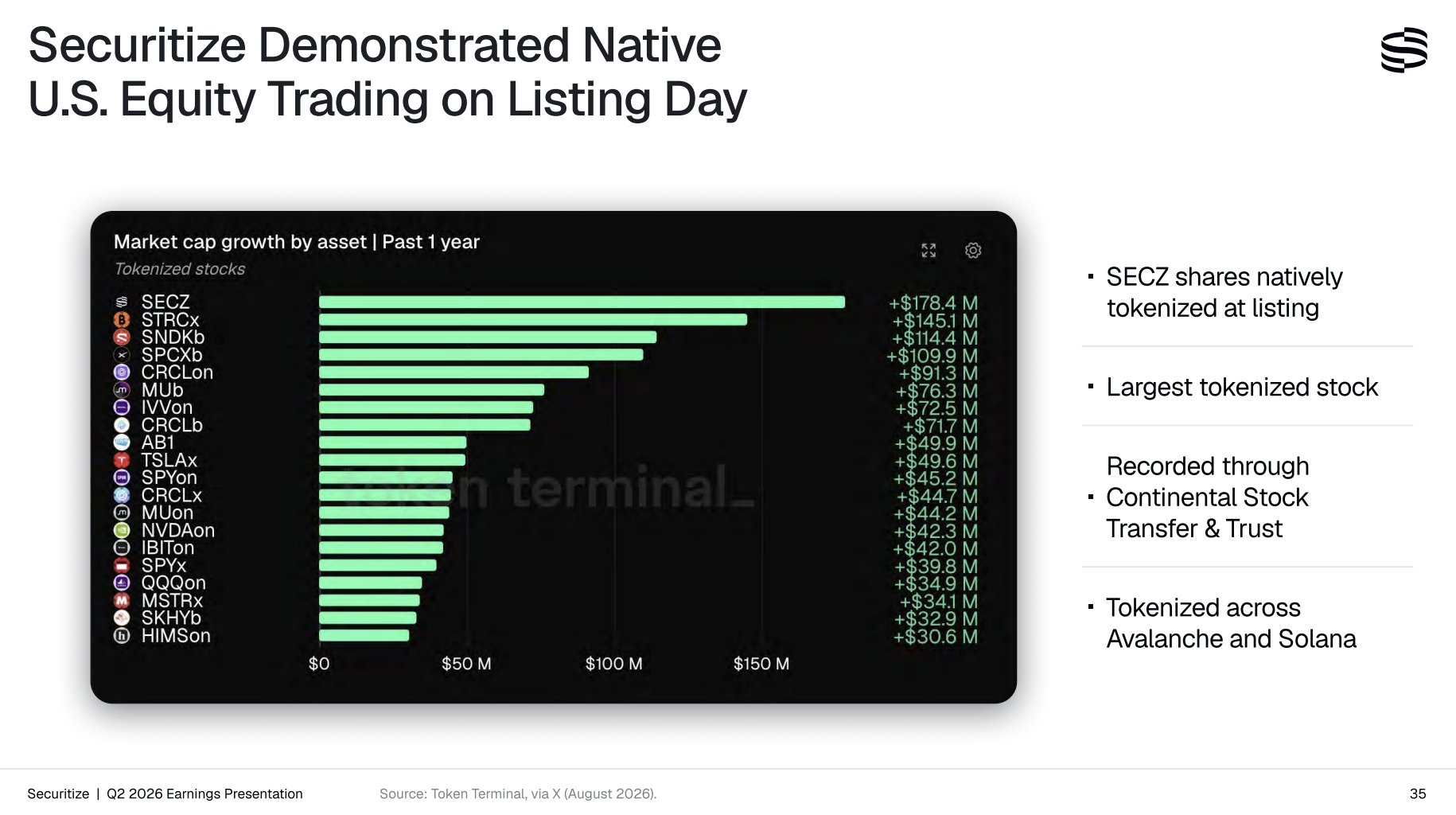
Token Terminal recently pointed to the earnings presentation as a useful window into where capital markets are heading.
What Do Securitize’s Latest Numbers Actually Show?
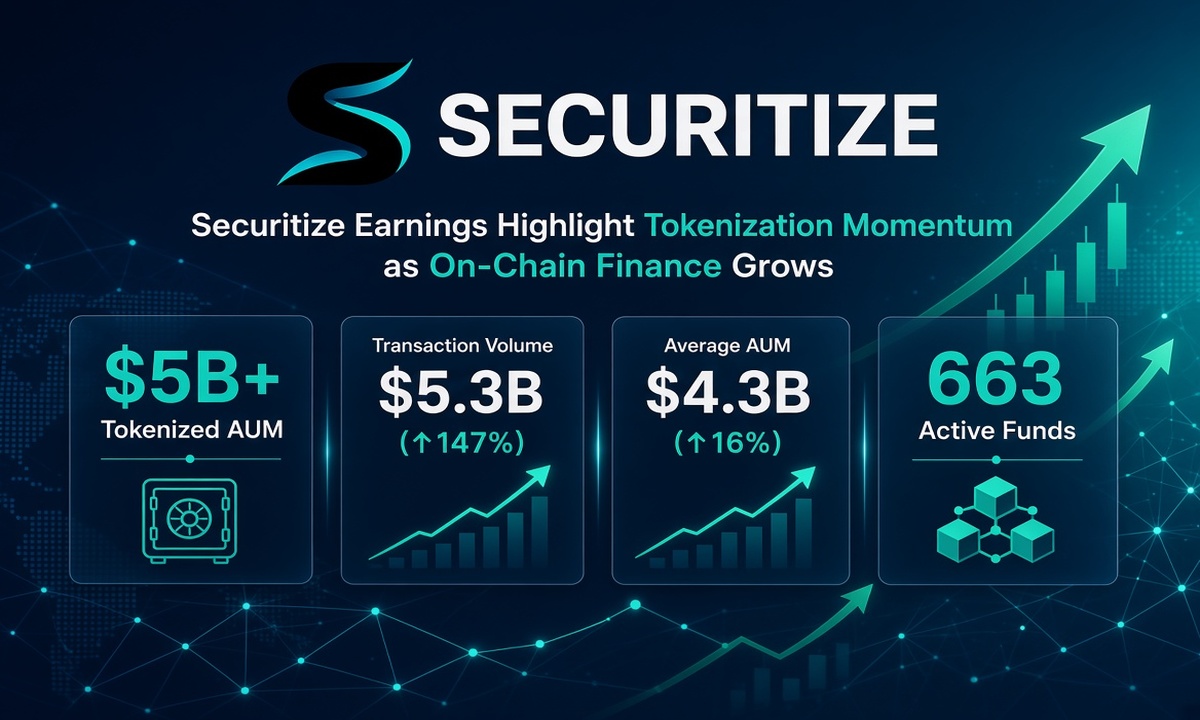
Average tokenized assets under management (AUM) climbed 16% to roughly $4.26 billion.
At the same time, aggregate transaction volume jumped 147% to $5.3 billion.
These figures include subscriptions, redemptions, dividends and cross-chain movements.
BlackRock’s BUIDL products and a $250 million subscription into the Securitize Tokenized AAA CLO Fund drove a large share of the activity.
Total revenue came in at $14.4 million, down 5% year over year (YoY).
Tokenization revenue itself declined 12% to about $7.8–7.9 million. Management linked the drop mainly to fewer new on-chain integrations compared with the prior-year period.
Asset-servicing revenue, by contrast, edged higher and helped limit the overall decline.
First-half total revenue still rose 16% to $33.9 million, marking a company record for the half.
How Is Platform Activity Expanding While Revenue Softens?
Securitize now services more than 660 active funds. Tokenized Treasuries remain a standout category, with the broader market exceeding $16 billion across dozens of products.
Securitize-supported offerings account for roughly one-fifth of that segment.
Early in the third quarter the company already crossed $5 billion in tokenized assets under management.
These metrics matter because they measure real usage of blockchain rails rather than just announced partnerships.
Meanwhile, Token Terminal tracks those same blockchain rails in real time. The firm notes that as more traditional assets move on-chain, a growing share of global financial flows appears first in its data sets.
Securitize’s volume surge therefore serves as an early indicator rather than a lagging one.
Securitize: Why Does Monetisation Remain the Key Question?
Fewer completed integrations reduced one-time and related fees in the quarter.
Higher operating costs tied to public-company readiness and headcount growth also widened the adjusted EBITDA loss to $5.5 million and the GAAP net loss to $21.7 million.
Full-year revenue guidance was trimmed to a $70–80 million range. These pressures are real.
Still, the underlying demand signal looks constructive. Institutional managers continue to choose regulated platforms for issuance, transfer-agency services and compliance.
Securitize’s ability to host large individual products above $100 million in AUM reinforces that positioning.
Looking ahead, the company is expanding blockchain support, including planned integration with Stellar, which should broaden options for asset managers.
In short, Securitize’s Q2 results illustrate the classic early-stage tension of a new market infrastructure business: usage is accelerating faster than near-term monetisation.
The earnings presentation therefore offers more than a quarterly scorecard.
It supplies a live reading on how quickly capital markets are adopting on-chain settlement and servicing.
Investors and builders watching the tokenization thesis will find the activity metrics more revealing than the temporary revenue dip.
