

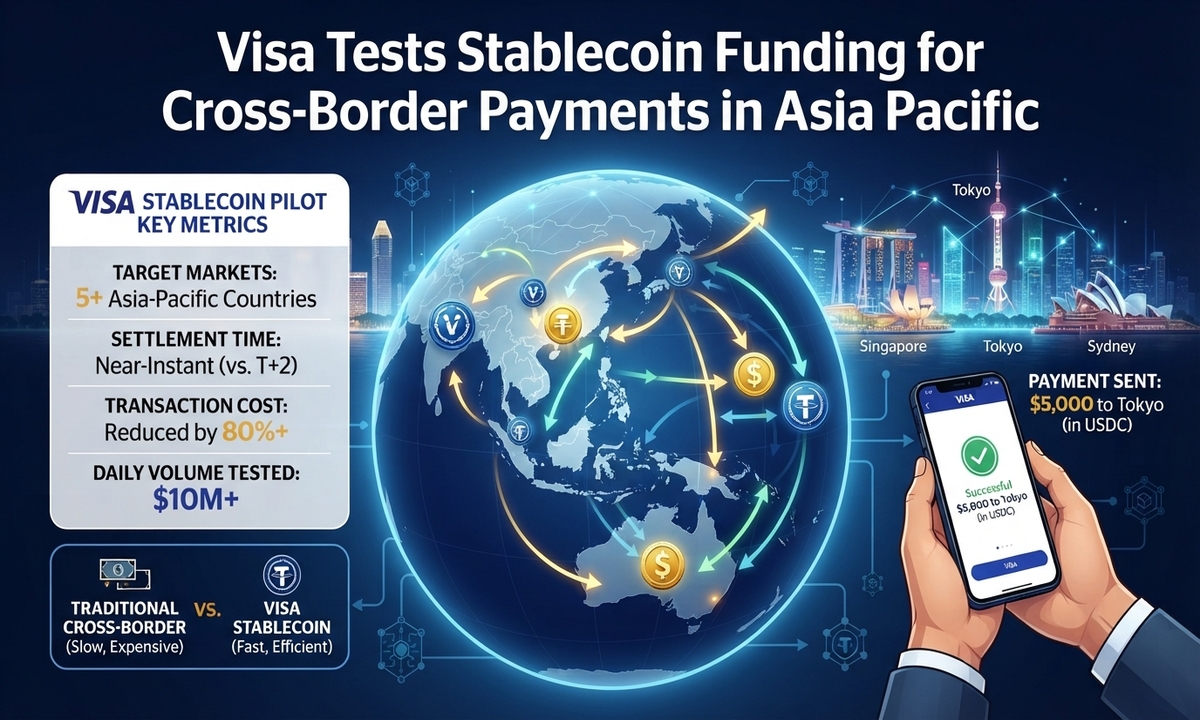
Visa has partnered with Singapore-based digital payments provider dtcpay to test stablecoin funding for international transfers across Asia Pacific. The pilot will allow eligible Visa Direct clients to use stablecoins to fund cross-border payouts.
However, recipients will continue receiving money in traditional currencies. The arrangement aims to give businesses more flexibility when funding international payments.
Currently, businesses often deposit money in advance to cover international transfers. This practice ties up funds and creates challenges when banks operate across different time zones.
Stablecoin funding could help payment providers manage their funds more efficiently. It could also allow them to finance payouts outside conventional banking hours.
Meanwhile, stablecoin infrastructure provider Triple-A will support the pilot. The company will handle stablecoin processing, currency conversion, settlement, and compliance checks.
Vira Platonova, Visa Direct’s global head, said,
“Stablecoins are becoming an increasingly important part of the infrastructure supporting global money movement. Their long-term value lies in how effectively they connect with the financial systems businesses already use.”
Visa will not provide regulated digital asset services through the arrangement. Licensed partners will handle those activities.
Singapore’s Monetary Authority financial institutions directory lists dtcpay as a major payment institution. Its licence covers cross-border money transfers, digital payment token services and electronic money issuance.
Visa has not named the stablecoins that dtcpay will support. It has also not announced a commercial rollout schedule for individual Asia Pacific markets.

Visa Expands AI Payments Programme With More Than 50 Companies
Visa is also expanding its Agentic Ready programme across Asia Pacific. The initiative helps merchants and payment providers prepare for purchases initiated by artificial intelligence (AI) agents.
Visa launched the programme in April 2026, initially focusing on financial institutions that issue Visa payment credentials. More than 100 issuers across 10 regional markets have since joined.
The latest phase brings in more than 50 companies involved in processing and accepting merchant payments. Participants include DBS Bank, Airwallex, Stripe, Adyen, Maybank and Bank of China (Hong Kong). Razorpay and Commonwealth Bank of Australia have also joined the programme.
Participants will test how businesses identify authorised AI agents and verify payment credentials. They will also examine how their systems handle purchases made on customers’ behalf.
The tests will cover customer interactions after purchases, including payment disputes. These checks will help businesses manage transactions initiated by AI agents.
Visa’s research across Singapore, Australia, and Japan found high generative AI usage. Adoption ranged from 67% in Japan to 90% in Singapore. However, only 20% to 30% of respondents trusted AI to purchase everyday household products.

Stablecoin Settlement Activity Surpasses $25 Billion
Visa reported an annualised stablecoin settlement run rate above $25 billion during its October earnings call. This represented approximately ten times the previous year’s level.
The company also reported more than 225 stablecoin-linked card programmes across over 50 countries. These programmes cover approximately five million cards. Earlier in November, Visa added Western Union’s USDPT stablecoin to its settlement network.
