

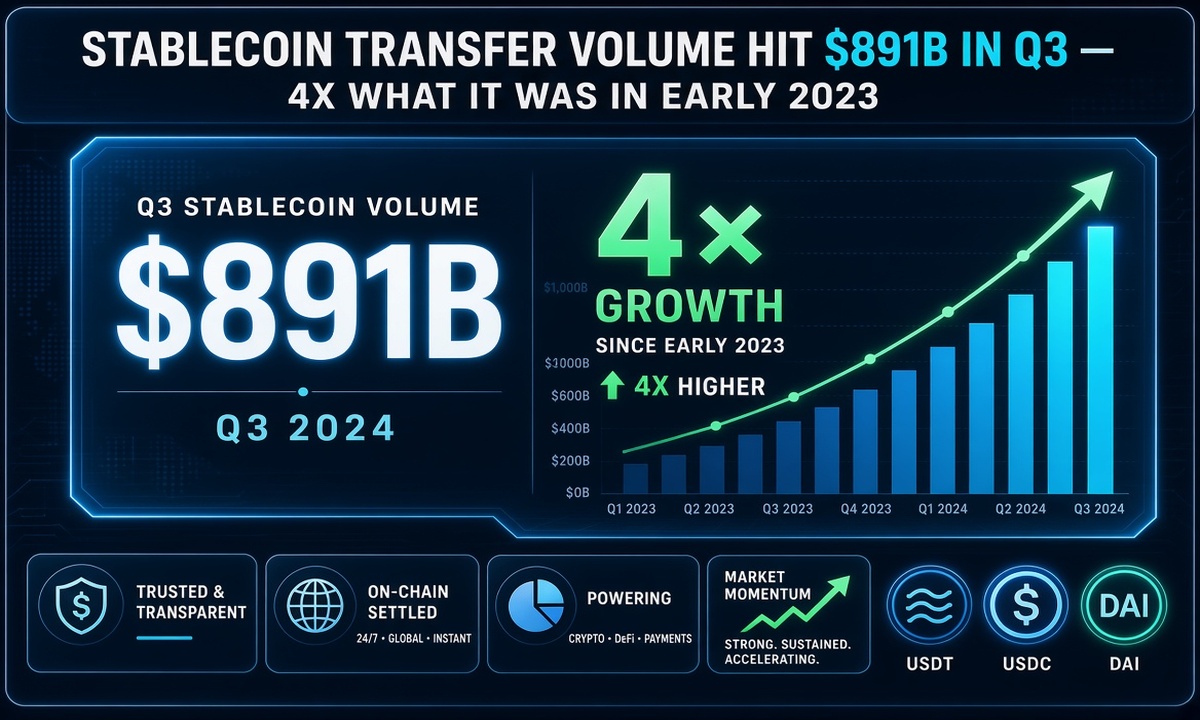
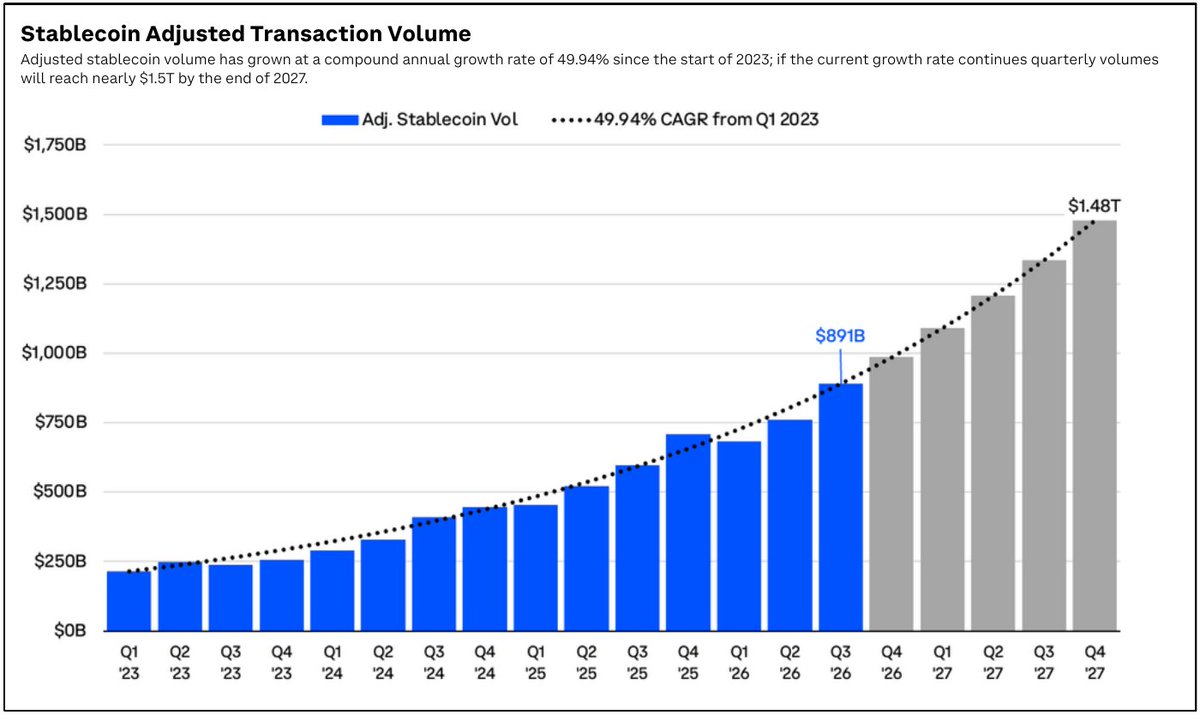
Stablecoin transfer volume reached $891 billion in the third quarter (Q3) of 2026.
That figure marks more than a fourfold increase from the roughly $216 billion recorded in early 2023, according to a joint report from Coinbase and The Block Pro Research.
Adjusted organic volume—excluding exchange trades, decentralised finance (DeFi) activity, bridges, bots, and mint-and-burn events—averaged more than $400 million every hour throughout the quarter.
Meanwhile, overall stablecoin supply barely budged, rising just 0.4% year-to-date (YTD) and hovering near $305 billion.
The same pool of dollars now moves far faster. Velocity has become the clearer signal of real utility.
In parallel, about 73% of screened stablecoin transfer volume over the 12 months ending July 2026 occurred outside U.S. banking hours—nights, weekends, and holidays.
Traditional rails shut down; stablecoin rails stay open.
Why Does Rising Stablecoin Transfer Volume Matter More Than Supply Growth?
Supply growth tells us how much capital sits on-chain. Velocity shows how actively people use that capital.
When volume multiplies while supply stays flat, existing tokens turn over more frequently for actual settlement and payments rather than speculation.
Furthermore, a $200 USDC remittance on Base costs roughly 86% less than a comparable traditional transfer, delivering tangible savings for everyday users and migrant workers.

How Are Banks and Businesses Driving This Stablecoin Transfer Volume?
Seven of the 10 largest U.S. banks have already tested stablecoins or tokenized deposits for settlement purposes.
At the same time, 30% of mid-market companies engaged in cross-border commerce now use or pilot stablecoins—up from only 10% in 2024.
Business-to-business payment volume itself rose 36% year-over-year (YoY). These institutional experiments add steady, recurring flow and help explain why organic transfer activity continues to climb.

What Could Sustained Growth Mean Going Forward?
If the current pace holds, quarterly adjusted volume could approach $1.5 trillion by the end of 2027.
Interestingly, researchers estimate that shifting 80% of international transactions onto stablecoin networks might add $155 billion annually to global GDP and unlock roughly $3 trillion in liquidity currently tied up in traditional banking channels.
Those projections remain hypothetical, yet they illustrate the scale of potential efficiency gains.
Currently, more than 293 million blockchain addresses already hold stablecoins—exceeding the combined card base of American Express and Discover.
In short, the $891 billion stablecoin transfer volume figure highlights a quiet but powerful shift: the same dollars are circulating more efficiently, around the clock, and across borders.
The data points to maturing payment infrastructure rather than mere speculation.
