

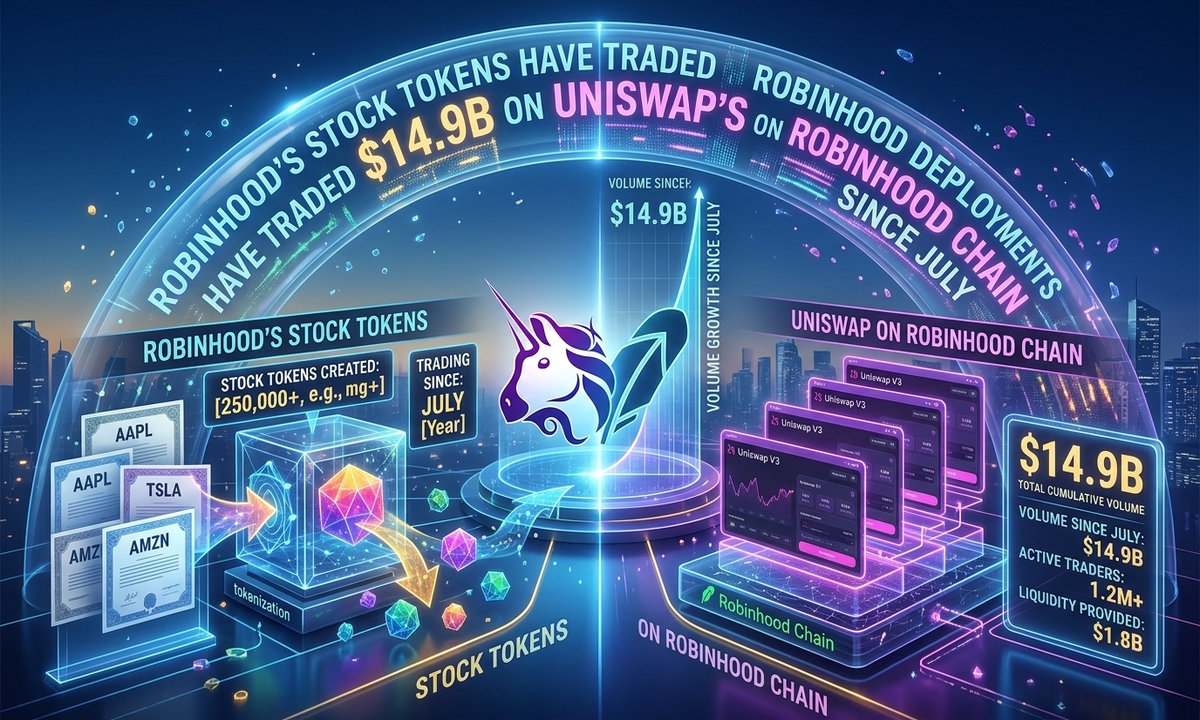
Robinhood stock tokens have generated $14.9 billion in trading volume across Uniswap’s v2, v3, and v4 deployments on Robinhood Chain since the network went live in early July 2026.
Token Terminal data shows the activity spanned 49,060 pools. Volume peaked at $1.15 billion on a single day in early September, yet the trailing seven-day figure has since dropped 86%.
The largest single pool, USDG-NVDA on Uniswap v3, alone accounts for $1.36 billion, or roughly 9.1% of the entire total.
What Exactly Are Robinhood Stock Tokens?
Robinhood issues these tokens as ERC-20 debt securities that deliver economic exposure to underlying U.S. equities and exchange-traded funds (ETFs).
Holders receive the performance of names such as NVIDIA, Apple, GameStop, or SPY without owning the shares themselves.
The tokens trade 24/7 on Robinhood Chain, an Ethereum Layer 2 built for real-world assets (RWA).
Uniswap serves as the primary public automated market maker on the network, giving anyone with a wallet the ability to swap, provide liquidity, or route orders through UniswapX.

Why Did Trading Volume Climb So Quickly After Launch?
Robinhood Chain launched on July 1 with Uniswap already live across multiple versions.
Early momentum came from continuous access outside traditional market hours.
Traders could move in and out of stock tokens during weekends and overnight sessions when conventional exchanges stayed closed.
At the same time, the presence of stablecoin pairs such as USDG created tight markets for high-demand names.
NVIDIA, SpaceX, and meme-adjacent equities attracted the heaviest flow. Looking closer at the data, the September peak coincided with a broader wave of activity across the chain before volumes cooled.

How Concentrated Is the Liquidity Across These Pools?
Although more than 49,000 pools exist, a relatively small set of pairs drives most of the volume.
The USDG-NVDA pool stands far ahead of the rest.
Other frequently traded pairs include various combinations of AMC, GameStop, Alphabet, Apple, and SPY.
In parallel, some pools mix stock tokens with memecoins, creating novel pricing relationships that traditional markets never offered.
This concentration means a handful of assets shape the daily experience for most users while thousands of smaller pools remain lightly used.
What Does the Recent Volume Decline Signal for Robinhood Chain?
Seven-day volume has fallen sharply from its September high. The drop does not erase the cumulative $14.9 billion already recorded.
Instead, it reflects the natural cooling that often follows an intense launch period.
Gas subsidies that once encouraged experimentation have largely ended, and speculative interest has shifted.
Still, the infrastructure remains intact.
Liquidity providers continue to maintain positions in the larger pools, and new tokenized assets from partners such as Ondo have expanded the menu of available names.

Can Everyday Users Actually Access These Markets?
Anyone with a compatible wallet can interact with the Uniswap deployments on Robinhood Chain.
Users outside restricted jurisdictions can hold, transfer, or trade the tokens freely. Liquidity providers earn fees from the same pools that generated the $14.9 billion figure.
Beyond simple swaps, the tokens can serve as collateral in lending protocols that have launched on the chain.
The combination of continuous trading hours and composability with other DeFi tools remains the clearest practical advantage over traditional brokerage accounts.
Robinhood’s stock tokens have moved from experimental product to measurable on-chain market in just four months.
The $14.9 billion figure demonstrates real demand for tokenized equities that trade around the clock.
Whether volume stabilises or rebounds will depend on sustained liquidity, regulatory clarity, and the continued willingness of traders to treat these tokens as everyday instruments rather than short-term novelties.
