

ETFs (exchange-traded funds) keep gaining ground on mutual funds at a pace few expected a decade ago.
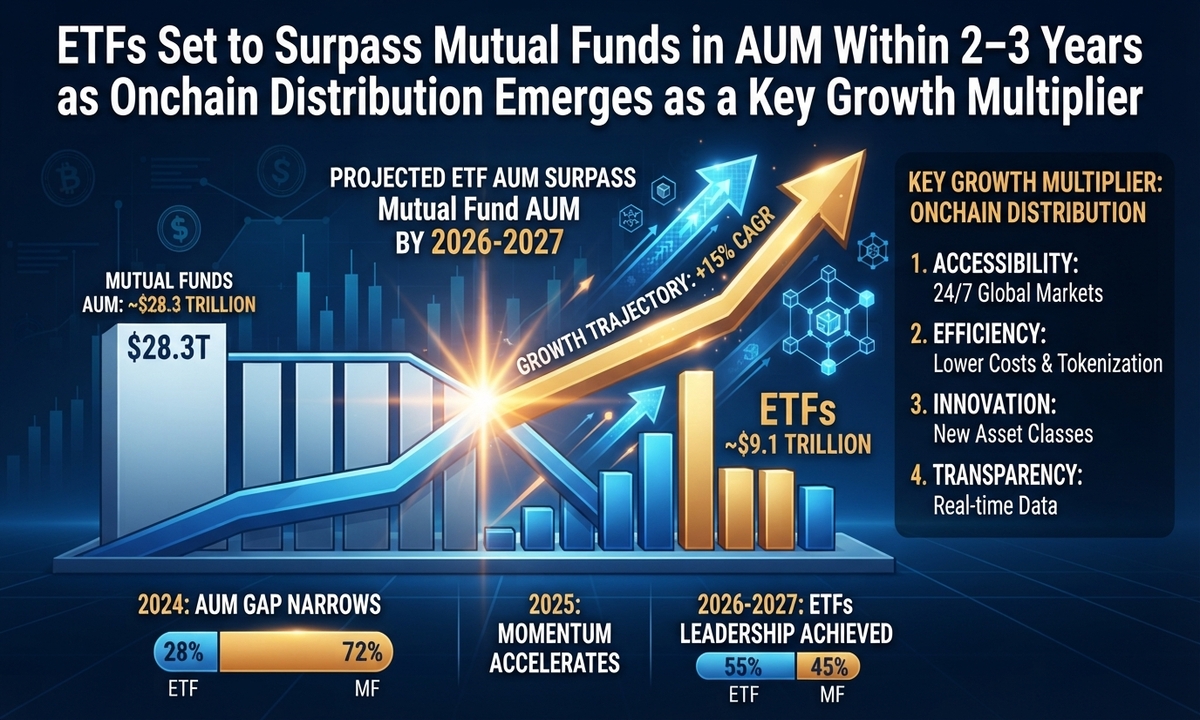
Bloomberg analyst James Seyffart now projects that ETFs will overtake mutual funds in total assets under management within the next two to three years.
If the growth rate seen since summer holds steady, the crossover could arrive in roughly two years.
Global ETF assets already sit near $24 trillion after strong 2026 inflows that topped $2.2 trillion year-to-date (YTD) through September 2026.
U.S. long-term fund data from the Investment Company Institute still show mutual funds holding a large share. Yet, index products and ETFs continue to pull ahead in net flows while active mutual funds face persistent outflows.

ETFs: Why the Shift Keeps Accelerating
Investors favour the ETF structure for several practical reasons. Intraday trading, greater tax efficiency in taxable accounts, and generally lower expense ratios give ETFs an edge.
Advisors and institutions have steadily moved assets into the wrapper, and the number of ETF launches, conversions, and share-class versions of existing strategies keeps rising.
Rolling twelve-month growth rates for ETFs have trended higher for years, and recent data show the upward slope steepening.
Passive equity and fixed-income ETFs drive most of the volume, yet active ETFs have also expanded rapidly and now claim a meaningful slice of the U.S. market.
The result is a broader product set that appeals to both cost-conscious index investors and those seeking more specialized strategies.
Onchain Distribution as the Next Multiplier
Token Terminal recently pointed to another force that could speed the transition: onchain distribution.
Tokenized versions of stocks and ETFs already trade across multiple blockchains, giving investors 24/7 access, near-instant settlement, and the ability to move assets into decentralised finance (DeFi) protocols without traditional intermediaries.
While the tokenized ETF segment remains small relative to the overall industry, its growth rate has been sharp.
Holder counts and market values for tokenized equity and ETF products have multiplied several times over in the past year alone.
Platforms that package baskets of tokenized assets create new distribution channels that reach users outside conventional brokerage systems.
In that sense, onchain rails function as an additional growth layer rather than a replacement for traditional ETF infrastructure.
Issuers that can operate in both environments stand to capture flows from both institutional and crypto-native audiences.

Frequently Asked Questions About the ETF–Mutual Fund Crossover
When exactly might ETFs overtake mutual funds?
Seyffart’s base case is two to three years. Sustained momentum at the pace observed since summer could compress the timeline to about two years.
Market returns, interest-rate moves, and regulatory changes will influence the exact date.
Do mutual funds still hold advantages?
Yes, many retirement plans and tax-deferred accounts still favour mutual funds, and some investors prefer the simplicity of end-of-day pricing.
Conversions and dual share-class structures are narrowing that gap, yet mutual funds retain a large installed base.
How significant is onchain distribution today?
Tokenized stocks and ETFs have grown from a few products worth tens of millions to hundreds of products valued in the low billions.
The absolute numbers remain modest beside the multi-trillion-dollar traditional ETF market, but the percentage growth and expanding holder base signal rising interest.
What risks could slow the trend?
A sharp equity-market decline would reduce AUM across both vehicles.
Regulatory hurdles around tokenization, changes in tax treatment, or a sudden preference shift back toward active mutual funds could also alter the path.
So far, none of those factors have reversed the multi-year flow advantage for ETFs.
Which products are driving the fastest growth?
Broad equity and fixed-income ETFs still dominate inflows.
Active ETFs and thematic strategies have gained share, while tokenized versions of popular index products are emerging as a new distribution avenue on chains such as Ethereum, BNB Chain, and Solana.
What Comes Next for ETFs
The combination of structural advantages, accelerating inflows, and new distribution channels positions ETFs for continued market-share gains.
Onchain rails add a further multiplier by opening 24/7 access and programmable settlement to a global user base.
Asset managers that adapt their product lines and distribution strategies to both traditional and onchain channels will likely capture the largest share of the next wave of assets.
The data already show ETFs closing the gap; the remaining question is simply how quickly the final crossover occurs.
