

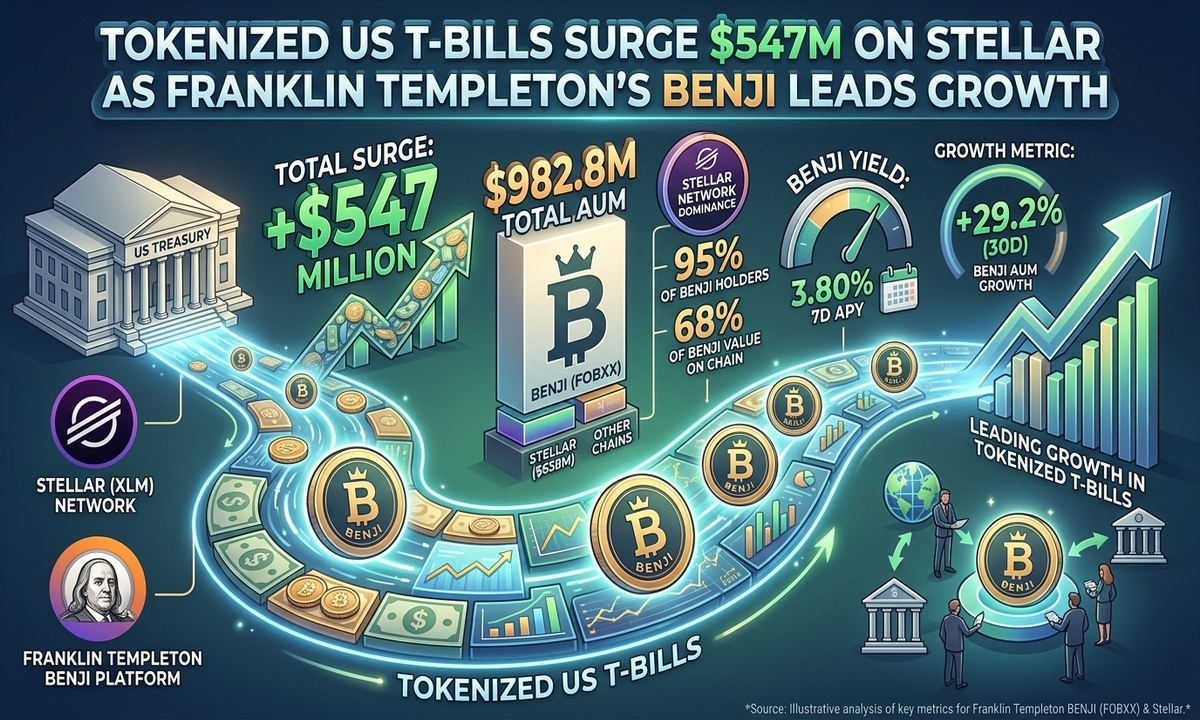
Tokenized US T-bills on Stellar just posted the strongest weekly expansion across all blockchains.
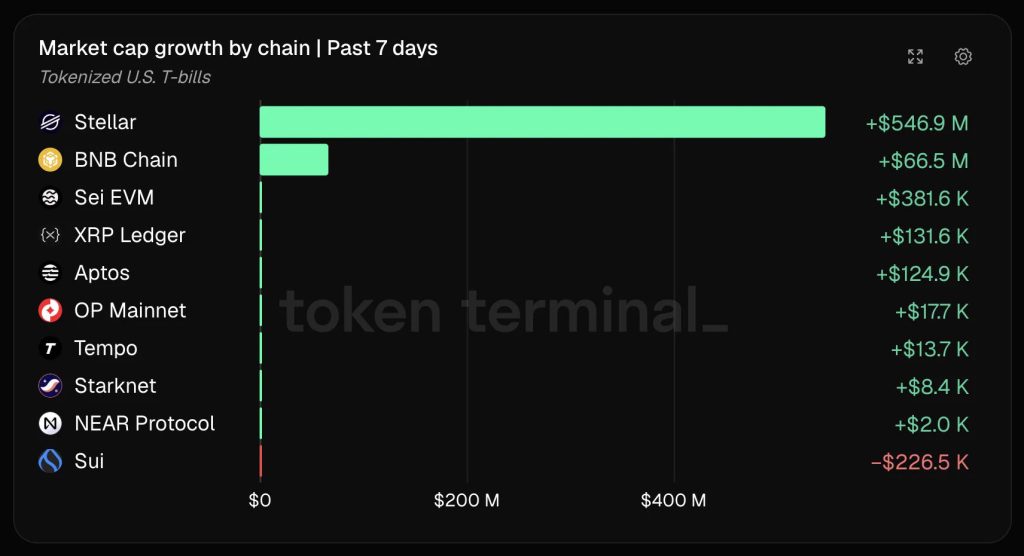
Market cap for these assets climbed $546.9 million over the past seven days, far outpacing every other network according to Token Terminal data.
BNB Chain followed with a more modest $66.5 million gain while most remaining chains registered only tiny increases.
Franklin Templeton’s BENJI fund supplied the bulk of that momentum. The regulated on-chain money market product has driven repeated large inflows onto Stellar in recent days, pushing the firm’s holdings on the network past the $1.1 billion mark.
What Are Tokenized US T-Bills and Why Do They Matter?
Tokenized US T-bills represent short-term U.S. government securities or funds that hold them as digital tokens on a public blockchain.
Holders gain exposure to the near-risk-free yield of treasury bills while enjoying the settlement speed and transferability of crypto rails.
In practice, the tokens trade near a $1 net asset value and distribute yield continuously rather than on a monthly schedule.
This structure appeals to both institutions seeking efficient cash management and retail investors looking for regulated yield on-chain.

Why Did Stellar Capture Nearly All the Recent Growth?
Stellar’s combination of low fees, fast finality, and long-standing support for regulated funds created the ideal environment.
Franklin Templeton first launched BENJI on the network in 2021, making it the earliest U.S.-registered mutual fund to use a public blockchain as its official share registry.
That early relationship continues to attract capital. Meanwhile, the network’s compliance features—whitelisting, freeze, and clawback capabilities—satisfy institutional requirements that many other chains still struggle to meet.
How Does Franklin Templeton’s BENJI Drive the Surge in Tokenized US T-Bills?
BENJI functions as the on-chain share of the Franklin OnChain U.S. Government Money Fund.
Each token equals one fund share and tracks short-term government securities, cash, and repurchase agreements.
Recent days saw multi-hundred-million-dollar subscriptions flow into the Stellar deployment, lifting total Franklin Templeton assets on the chain above $1.1 billion.
The fund remains open to retail investors at low minimums, a feature that distinguishes it from many institutional-only competitors.
What Does This Mean for Broader Adoption of Tokenized US T-Bills?
The concentration of growth on Stellar highlights how specific chains can become preferred venues once a trusted issuer establishes a presence.
At the same time, the overall tokenized U.S. Treasury market continues expanding, with total on-chain value now measured in the tens of billions.
Investors gain 24/7 transferability and the ability to use these assets as collateral in on-chain strategies, while still retaining the credit quality of U.S. government debt.
Will This Pace of Growth Continue?
Large weekly inflows of this magnitude rarely persist indefinitely, yet the structural demand remains solid.
Yield-seeking capital continues migrating toward regulated, transparent vehicles that settle instantly.
Looking ahead, further product expansion and potential regulatory clarity could sustain elevated activity.
For now, Stellar’s lead and BENJI’s contribution demonstrate that tokenized US T-bills have moved well beyond experimental status into meaningful scale.
