

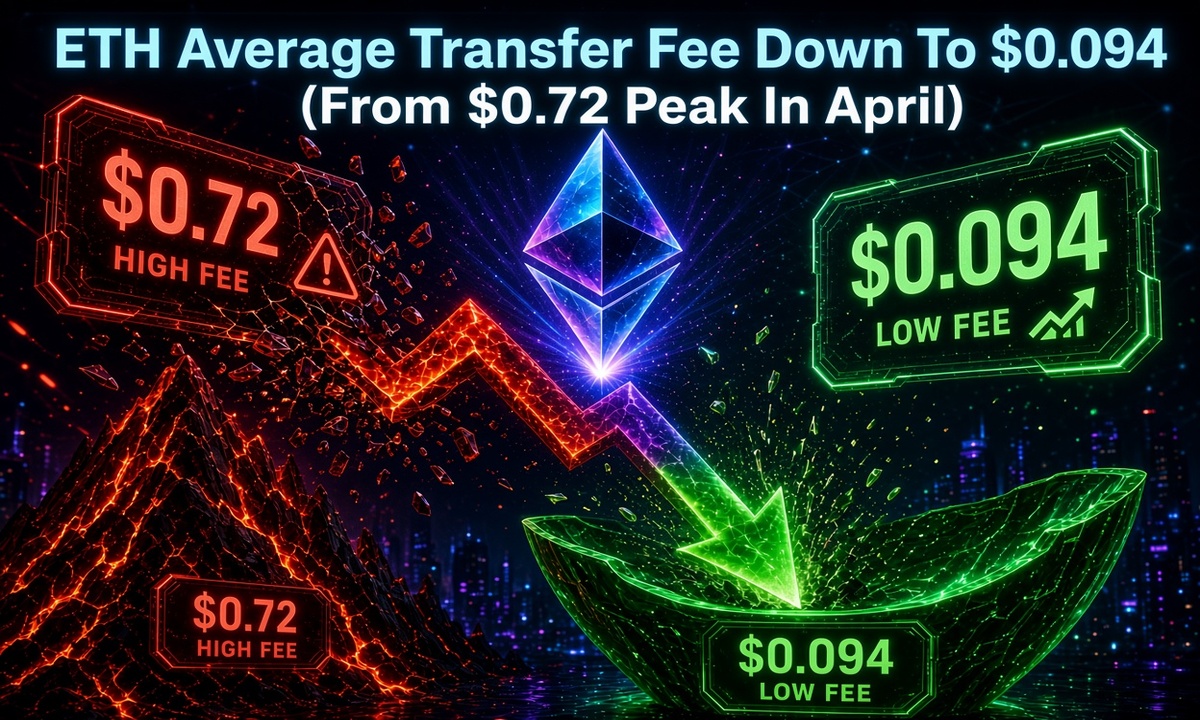
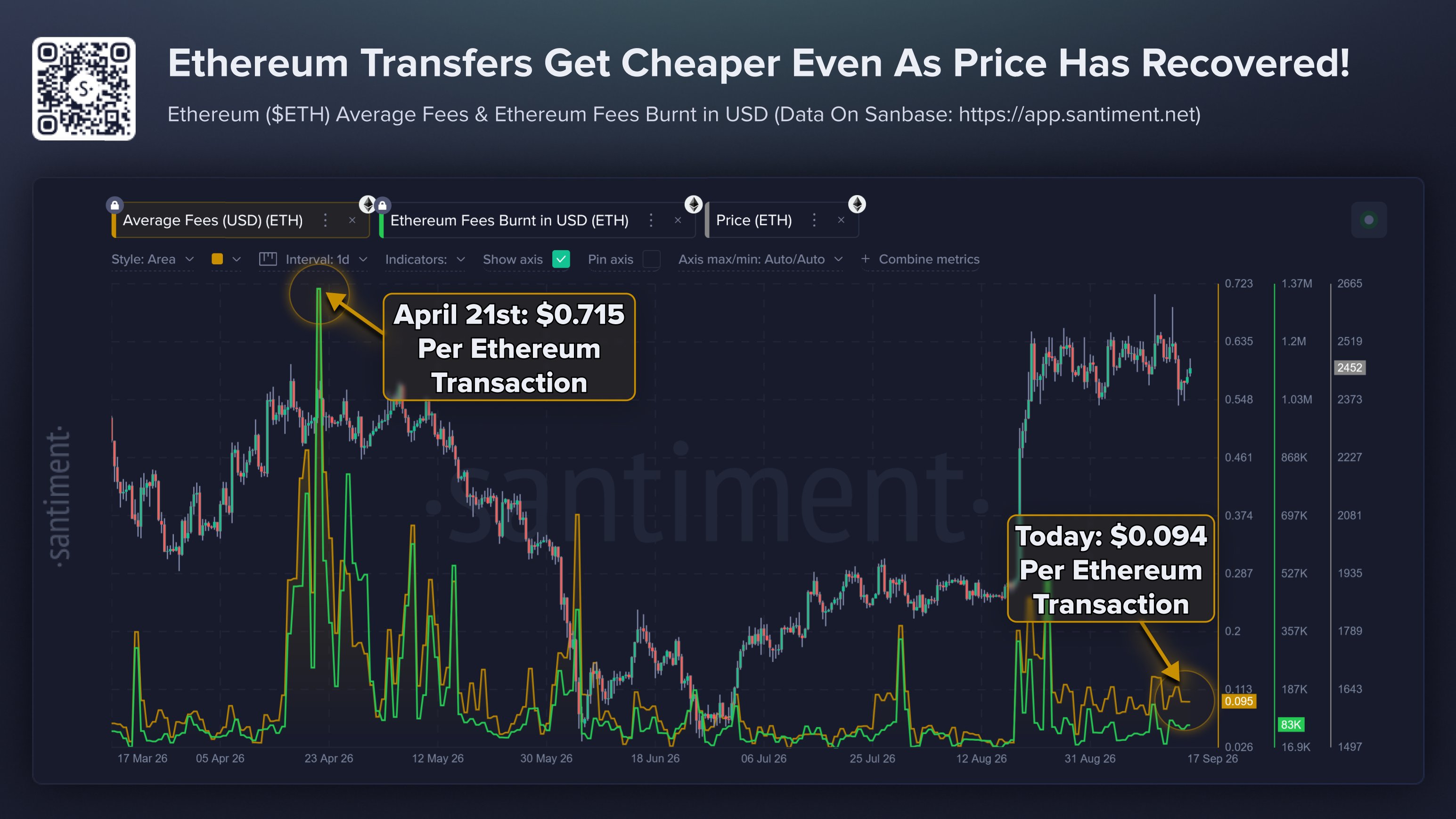
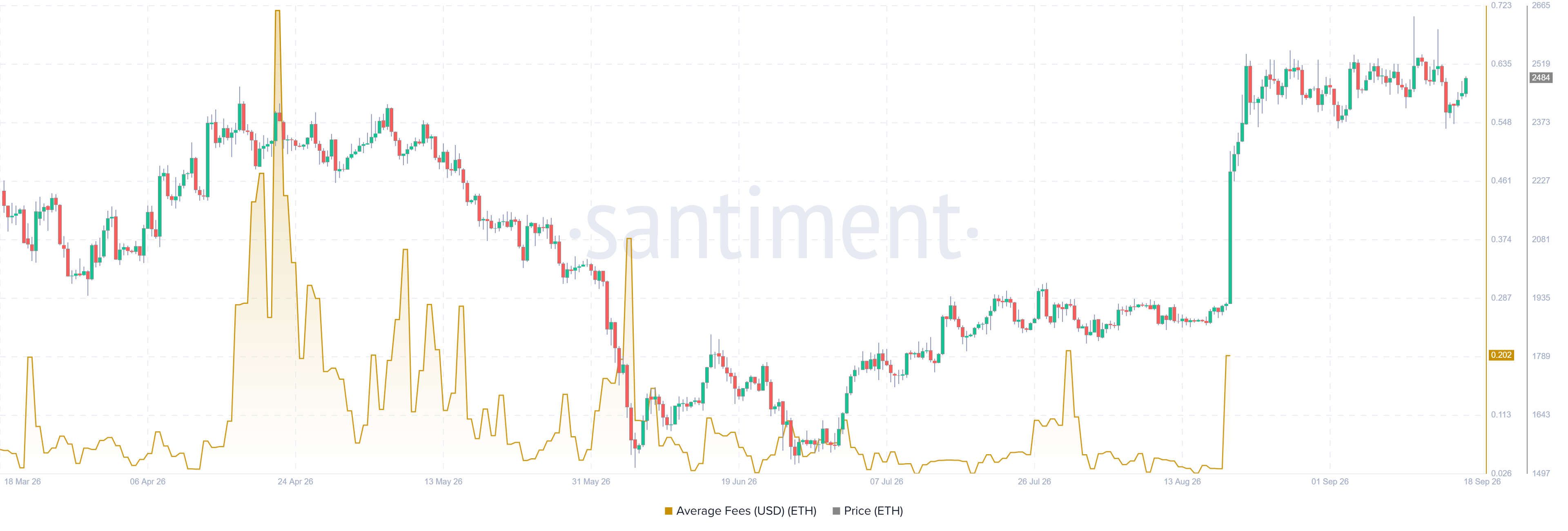
Ethereum users now pay far less to move value on the mainnet as ETH average transfer fee currently sits at roughly $0.094, down sharply from the $0.72 peak recorded on April 21.
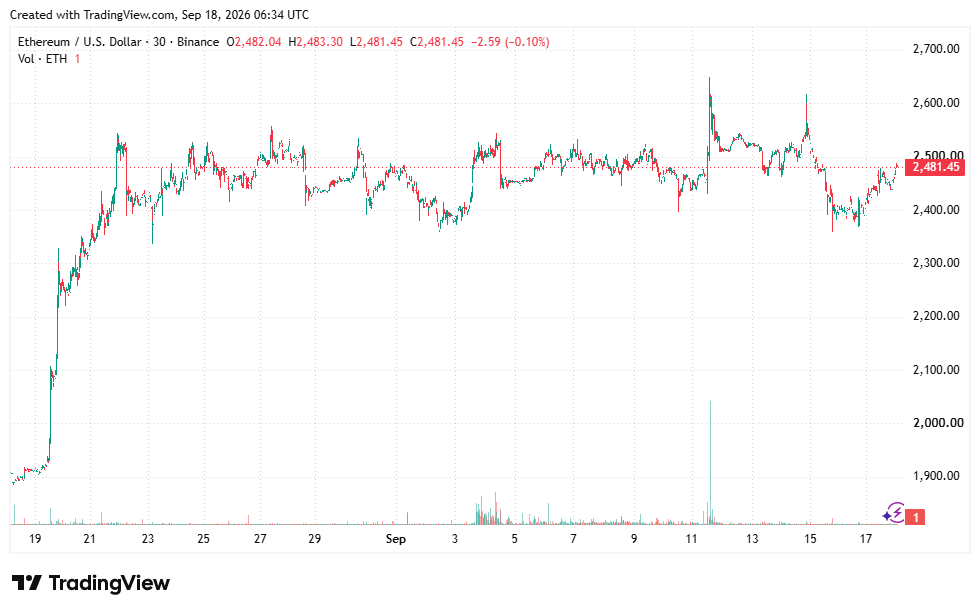
This decline arrives even while ETH trades at a higher market value than it did during that earlier high-fee window.
Santiment data captures the shift clearly and shows how softer summer demand combined with expanded network capacity produced the drop.
The change matters because transfer fees form the most visible cost most people encounter.
When those fees fall below a dollar and stay there, everyday actions—sending ETH, moving stablecoins, opening a decentralised finance (DeFi) position, or swapping tokens—become noticeably cheaper.
Projects that once hesitated to push users onto mainnet now face fewer complaints about cost.
In short, the barrier that once limited experimentation has loosened.
What Drove the ETH Average Transfer Fee Lower?
Ethereum transaction costs reached the lowest as a result of two forces working together.
First and foremost, mainnet demand cooled during the quieter summer months. Fewer users competed for block space, so the base fee and priority tips required to land a transaction eased.
Secondly, Ethereum itself grew more capable. The Fusaka upgrade delivered higher blob throughput, a 60 million gas limit, and better data-availability sampling. Layer-2 networks continued to pull the bulk of execution off the base layer.
Together, these factors raised the network’s effective capacity while demand stayed moderate.
Consider the gas-limit increase alone. Raising the default block gas limit to 60 million gives every block more room for computation.
Validators can include more transactions or more complex contracts without pushing fees upward as quickly.
Meanwhile, PeerDAS lets nodes store only a fraction of each blob instead of the full data set.
That change multiplies the amount of data the network can safely handle and directly benefits the rollups that post their batches to mainnet.
How Fusaka and Higher Blob Throughput Changed the Picture
Fusaka arrived as a practical scaling step rather than a flashy feature release. Its core contribution lies in data availability.
By letting validators sample rather than fully download every blob, the upgrade reduced the storage burden on individual nodes while increasing the total number of blobs the chain can process.
Later parameter adjustments further raised the target and maximum blob counts per block.
In parallel, the 60 million gas limit expanded pure execution capacity.
These technical moves do not eliminate fee spikes forever. Congestion can still appear during popular non-fungible token (NFT) mints or sudden market moves.
Yet, the baseline capacity is higher, so the same volume of activity produces lower average costs than it did in April.
The ETH average transfer fee reflects that new baseline.
The Growing Role of Layer-2 Networks
Layer-2 rollups now absorb the majority of user activity that once competed directly for mainnet blockspace.
Transfers, swaps, and DeFi interactions that once paid mainnet gas often settle on Arbitrum, Base, Optimism, or zk-rollups instead.
When those networks post their compressed data, they still use mainnet blobs, but the cost per user action drops dramatically.
The result is a quieter mainnet for simple transfers while the overall Ethereum ecosystem handles far more total volume.
This separation helps explain why the ETH average transfer fee can fall even as ecosystem-wide activity remains healthy.
Mainnet specialises more in settlement and data availability; the rollups handle the high-frequency work.

Why Lower Fees Matter Beyond Simple Transfers
Cheap blockspace changes behaviour. Developers can ship features that require frequent on-chain interaction without fear that users will abandon them over cost.
Stablecoin issuers and payment applications gain a more usable rail. Traders can rebalance positions or harvest yields without watching fees eat their edge.
In each case, the lower ETH average transfer fee removes friction that previously slowed adoption.
At the same time, low fees alone do not prove that demand has returned.
Santiment notes that the current environment simply removes one long-standing obstacle just as activity has room to recover.
If participation rises again, the expanded capacity should absorb more of that growth before fees climb back toward earlier peaks.
What Causes the ETH Average Transfer Fee to Drop?
The fee is the product of gas used and the prevailing gas price (base fee plus any tip).
When fewer transactions compete for limited blockspace, or when the network can process more gas and more blobs per block, the gas price falls.
Summer demand softness reduced competition. Fusaka and the 60 million gas limit increased supply of blockspace.
Layer-2 migration reduced the number of transactions that still need mainnet inclusion.
All three factors contributed.

How Does the Fusaka Upgrade Specifically Help Keep Fees Low?
Fusaka improves data availability through PeerDAS and raises the block gas limit. Higher blob capacity lets rollups post more data at lower cost.
The larger gas limit lets each block contain more computation. Both changes raise the threshold at which congestion appears, so average fees stay lower under ordinary load.
Is a Low ETH Average Transfer Fee a Sign of Weak Network Demand?
It can reflect quieter periods, yet it also reflects successful scaling.
Ethereum processed record transaction counts and throughput in earlier 2026 quarters even while monthly active addresses fluctuated.
The combination of higher capacity and selective migration to Layer 2s allows the network to handle more total activity without the high mainnet fees of prior cycles.

Will the ETH Average Transfer Fee Stay Near $0.095?
No one can guarantee a permanent level. Fees still respond to demand. A sudden surge in mainnet activity—new token launches, heavy DeFi usage, or market volatility—can push the average higher.
The expanded capacity simply means the network can absorb more volume before fees reach the levels seen in April.
How Do Layer-2 Networks Affect Mainnet Transfer Fees?
They reduce direct competition for mainnet blockspace. Users who once paid mainnet gas for every swap or transfer now do most of that work on cheaper rollups.
The remaining mainnet transactions face less congestion, so the ETH average transfer fee for those actions declines.
At the same time, the rollups still rely on mainnet for security and data availability, preserving Ethereum’s role as the settlement layer.
What Should Users and Builders Do While Fees Remain Low?
Users can move assets, open positions, or experiment with new applications at lower cost.
Builders can design experiences that assume frequent on-chain interaction rather than minimising every call.
Both groups benefit from testing and iterating while the cost environment stays favourable.
Monitoring live charts from sources such as Santiment remains useful because fees can still rise quickly when demand returns.
Looking ahead, the combination of Fusaka-era capacity, continued Layer-2 growth, and the current fee level creates a more usable Ethereum for both everyday transfers and more complex applications.
The ETH average transfer fee at $0.095 marks a practical improvement that removes friction without requiring users to abandon the mainnet entirely.
Projects and individuals who take advantage of the window may find the network easier to build on and interact with than it has been in many months.
