

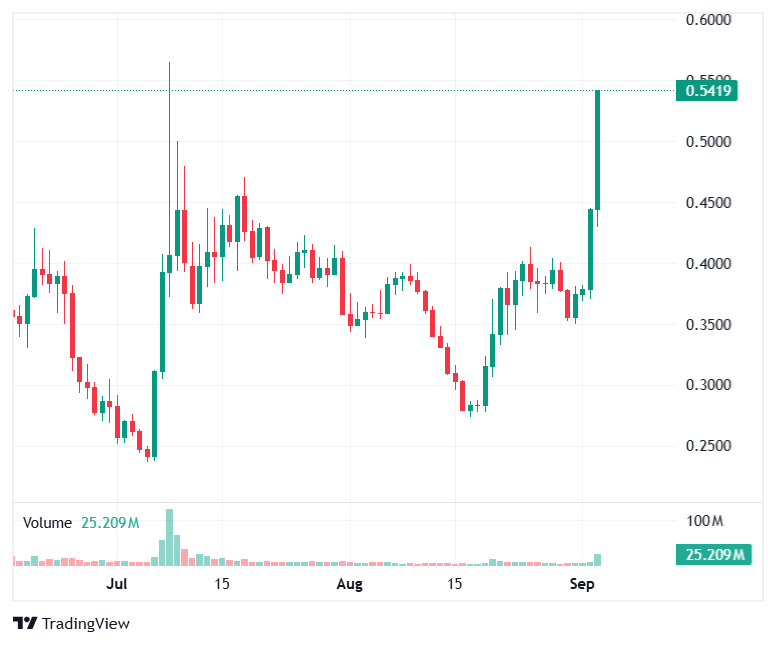
EDGE has delivered one of the sharper moves in the mid-cap decentralised finance (DeFi) space over the past day, climbing more than 40% and drawing fresh attention to the edgeX platform.
Traders who sat on the sidelines through the summer now face a practical question: does the rally rest on lasting progress, or does it simply reflect short-term momentum?
This piece examines the catalysts, the token’s actual role, the risks that still matter, and the practical steps for anyone considering an entry.
Why is EDGE pumping / Why is EDGE’s price up today?
EDGE’s latest climb arrives after a period of quieter price action.
Market participants point to renewed trading activity on the edgeX platform itself, where perpetual volume and open interest have picked up.
At the same time, the project continues to expand its offering beyond pure crypto perps into tokenised stocks, commodities, and other real-world assets.
That broader product set gives the narrative more room to run than a pure derivatives token typically enjoys.
Looking closer, edgeX positions itself as a high-performance orderbook venue rather than an automated market maker (AMM)-based exchange.
The platform advertises sub-10 millisecond matching latency and aims for
-like execution while keeping users in self-custody.
Strategic backing from Amber Group and earlier investment interest from Circle Ventures also help maintain visibility.
Volume on major exchanges has risen sharply alongside the price move, which often amplifies short-term gains when liquidity is thinner.
Is EDGE a good buy after the recent 40%+ rally?
Buying after a double-digit daily gain always requires caution.
The underlying platform has real usage metrics—hundreds of thousands of users and hundreds of billions in cumulative trading volume over time—and the shift toward multi-asset trading gives it a clearer growth story than many pure perpetual DEXs.
EDGE itself functions mainly as a governance and ecosystem token, so price strength still depends heavily on expectations around future platform success rather than automatic fee sharing.
Even so, the current levels sit well below the all-time high recorded earlier in 2026.
For traders who believe orderbook-based, low-latency decentralised derivatives will keep gaining share, the post-rally price may still offer an entry point with defined risk.
Longer-term holders will want evidence that the platform continues converting product improvements into sustained volume and that the token’s utility expands beyond governance.
Short-term momentum can fade quickly once the initial wave of buyers is exhausted.
What are the biggest risks of buying the digital asset right now (including past flash crashes and token unlocks)?
EDGE carries several concrete risks that deserve attention.
In early June 2026, the token experienced a severe flash crash, dropping roughly 70% within an hour before partial recovery.
The team attributed the move to deliberate market manipulation rather than a protocol exploit, and user funds on the exchange remained secure.
Still, the episode left a clear memory of how quickly liquidity can disappear and how vulnerable thinner markets remain to coordinated pressure.
Token unlocks form another ongoing concern. With a total supply of one billion EDGE and only around 350 million currently circulating, future releases from ecosystem, contributor, and foundation allocations can introduce fresh supply.
Monthly or scheduled unlocks have the potential to create selling pressure if recipients choose to liquidate.
Beyond that, EDGE faces the standard Layer-2 and derivatives risks: smart-contract vulnerabilities, oracle issues, and competition from both established perpetual venues and newer high-performance chains.
Position sizing that assumes the possibility of sharp drawdowns remains essential.

How do I buy the token and start trading on edgeX safely?
EDGE trades on several major centralised exchanges including OKX, Bybit, Bitget, KuCoin, and others, as well as on Coinbase in some regions.
After purchasing, most users withdraw the tokens to a self-custody wallet that supports the relevant network.
Always double-check contract addresses through official sources before interacting.
To trade on the edgeX platform itself, connect a compatible self-custodial wallet, deposit the required collateral (often USDC or similar stable assets), and begin placing orders through the orderbook interface.
Start with small size while learning the fee structure, margin modes, and withdrawal process.
Prefer hardware wallets for larger holdings and enable every available security feature on exchange accounts.
Avoid unverified third-party interfaces or newly launched contracts during periods of high excitement.
Is EDGE A Good Investment?
EDGE remains a higher-risk, higher-reward proposition rather than a core portfolio holding for most investors.
The platform’s focus on speed, orderbook liquidity, and expanding asset coverage gives it a differentiated position in the perpetual DEX landscape.
Strategic backers and measurable trading activity provide a foundation that pure meme tokens lack.
At the same time, the token’s value still relies more on narrative and governance influence than on automatic revenue share.
Past volatility, including the June flash crash, and the remaining unlock schedule mean that sharp corrections remain possible.
Investors who allocate only capital they can afford to lose entirely, who monitor platform metrics rather than price alone, and who treat EDGE as a speculative satellite position stand a better chance of navigating the next phase constructively.
Continuous due diligence and position reviews matter more than any single rally.
EDGE’s recent move reflects renewed interest in high-performance decentralised trading venues and the platform’s push into broader asset classes.
Whether the token can convert that interest into sustained value depends on execution, risk management by the team, and the market’s willingness to look past short-term volatility.
Careful position sizing and ongoing monitoring of both on-chain activity and unlock schedules remain the most practical ways to approach the opportunity.
