

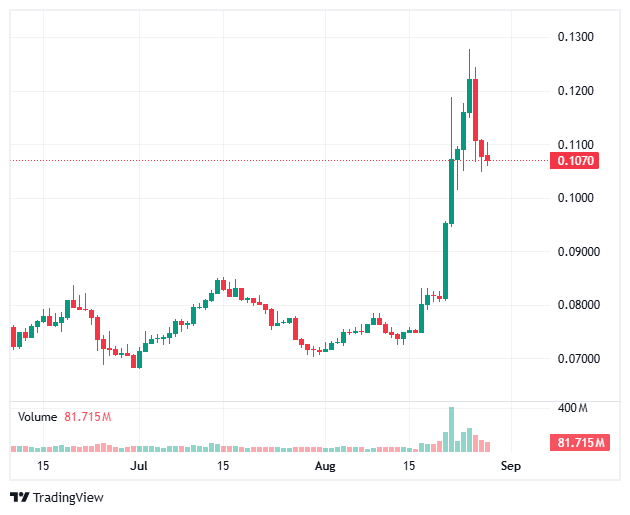
POL has delivered a sharp advance of more than 30% across the past week in late August 2026.
As a result, the cryptocurrency has climbed from the lower end of its recent range toward the $0.12 area and drawn renewed attention from traders and network participants.
Observers keep returning to one central question: what forces sit behind this move in POL?
Several interlocking developments appear to reinforce one another, spanning tokenomics proposals, on-chain capital flows, network usage metrics, technical structure, and payments-focused progress.
The sections below examine each factor in detail so readers can weigh the relative strength of every driver.
Did Sandeep Nailwal’s staking and tokenomics overhaul proposal spark the POL rally?
Polygon co-founder Sandeep Nailwal publicly shared details of a major staking and tokenomics reform in late August.
The proposal introduces native staking directly on Polygon PoS alongside existing Ethereum-based options and directs transaction priority fees toward POL stakers.
Early commentary suggests the changes could nearly double staking yields while funding those rewards primarily from real network fees rather than additional inflation.
Community demand for clearer value accrual helped push the discussion forward, and the announcement coincided with accelerated buying.
Market participants treated the update as a meaningful shift in how POL captures economic activity from the chain.
How much are massive exchange outflows and bridged netflows contributing to POL’s price rise?
Exchange outflows for POL surged dramatically, with some data sets showing a 690% jump in a single 24-hour window.
At the same time, bridged net inflows into Polygon PoS reached roughly 20 million dollars, ranking among the strongest across the broader market.
These flows signal that holders moved tokens off centralised venues while fresh capital entered the ecosystem.
Reduced liquid supply on exchanges often supports upward price pressure when demand appears, and the scale of the outflows added conviction to the accumulation narrative.
Multiple trackers highlighted the same pattern across consecutive days.
Is rising on-chain activity (transactions, active addresses, DEX volume, and Real Economic Value) the main fundamental driver?
Network metrics strengthened in parallel with the price advance.
Weekly transaction counts moved higher, active addresses expanded, and both decentralised exchange (DEX) and perpetual-futures volumes recorded multi-fold increases.
Real Economic Value, which combines base fees and priority tips, held above 5 million POL for successive weeks and edged higher still.
These figures point to genuine usage rather than pure speculation. Steady growth in fee generation supplies a tangible foundation that traders often interpret as constructive for the native token.
What role did the technical breakout from the multi-month consolidation range play?
POL spent weeks trading inside a defined range near the$0.09 to $0.10 dollar.
Once price cleared that resistance band on expanding volume, the breakout attracted momentum-oriented buyers.
The move also lifted POL above key moving averages that had previously capped recovery attempts.
Technical traders viewed the resolution of the long consolidation as confirmation that selling pressure had exhausted itself, and the clean break helped sustain follow-through in subsequent sessions.
Is the POL surge mostly broader crypto market momentum or Polygon-specific?
Bitcoin and the wider market delivered supportive conditions during the same period, creating a risk-on backdrop that lifted many altcoins.
Yet Polygon-specific catalysts stood out more clearly than pure beta exposure.
The staking proposal, elevated network metrics, and payments developments differentiated POL from tokens that simply followed the broader trend.
While macro sentiment provided a helpful tailwind, the unique combination of tokenomics reform and on-chain improvement gave the rally a more distinctive character.
Did short squeezes or liquidations amplify the upward move in POL?
Leveraged short positions faced pressure as price accelerated through resistance.
Liquidation data showed meaningful short covering during the strongest daily legs of the advance.
Forced buying from those liquidations added incremental demand at precisely the moments when momentum already favoured the upside.
The effect amplified the speed of the climb even if it did not originate the move.
How significant is the jump in trading volume to the recent POL price action?
Trading volume expanded sharply, with multiple reports citing increases of 100 to 300 percent relative to recent averages.
Higher turnover improves liquidity and allows larger participants to enter or exit without excessive slippage.
The volume surge arrived alongside the breakout and the staking news, reinforcing the impression that new capital actively engaged with POL rather than the price drifting higher on thin order books.
Sustained volume remains one of the clearer signals of genuine interest.
Are payments-focused developments (Revolut EURR stablecoin, Private Mempool, stablecoin settlements) driving fresh buying?
Polygon continued to emphasise its payments infrastructure. Revolut’s launch of the euro-backed EURR stablecoin on the network supplied a high-profile real-world endorsement.
Additional details around the Private Mempool highlighted confidential transaction capabilities suited to payroll, settlement, and commerce use cases.
Stablecoin activity and related settlements also expanded.
These developments strengthen the narrative that Polygon functions as practical financial rails, and traders often translate such adoption signals into demand for the native token.
Does the deflationary narrative or token burns support the POL pump?
Discussions around daily token burns and a more constructive supply profile gained traction during the rally.
Some observers framed POL as increasingly fee-backed and less reliant on inflationary emissions.
While exact burn figures vary across sources, the broader conversation about improved tokenomics and reduced net inflation aligned with the staking reform proposal.
The narrative helped position POL as an asset with clearer economic linkages to network activity.
Is whale accumulation or large on-chain transfers backing the POL rally?
Large wallets withdrew sizeable quantities of POL from exchanges while on-chain activity accelerated.
Concentrated buying from these addresses appeared in parallel with the broader outflow trend.
Whale-level accumulation does not guarantee continued upside, yet it often supplies an additional layer of demand that can stabilize or extend a move once technical and fundamental catalysts align.
Monitoring large transfers remains a useful lens for assessing the durability of the current advance.
Taken together, the recent strength in POL reflects a confluence of tokenomics reform, capital inflows, rising network usage, technical resolution, and payments adoption.
The staking proposal from Sandeep Nailwal supplied the most prominent narrative spark, while exchange outflows and bridged netflows tightened available supply.
Network metrics and volume expansion added confirmation, and payments developments reinforced the longer-term infrastructure thesis.
As a trader, you would want to watch both the formal progress of the staking proposal through community governance and the persistence of the elevated on-chain activity that has accompanied the price move.
