

The ZEC network just recorded a remarkable surge in privacy activity in its Zcash shielded pool.
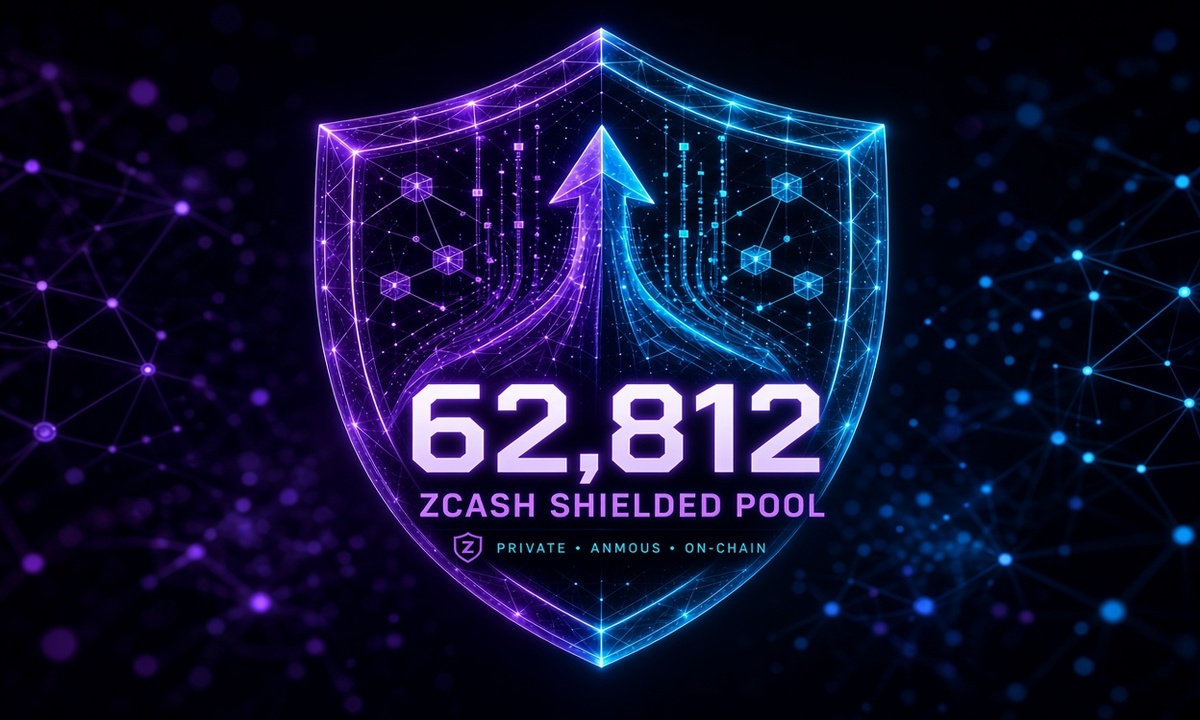
Last week, (September 14 to 20), the shielded pool processed 62,812 private transactions—the highest weekly total in more than four years and the fourth-highest figure ever logged.
Only three weeks during the summer-2022 market peak exceeded that mark, with 135,389 (in late June), 80,732 (in early July), and 64,795 (in early August) private transactions respectively.
This fresh data arrives while roughly 4.91 million ZEC, or about 29% of the circulating supply, sits inside the various shielded pools.
Ironwood, the newest pool activated in late July 2026, now holds the bulk of that value.
What Exactly Is the Zcash Shielded Pool?
Picture a sealed vault on the blockchain where amounts, senders, and recipients stay hidden from public view. That vault is the Zcash shielded pool.
Zero-knowledge (zK) proofs—specifically zk-SNARKs and their successors—let the network confirm that every transfer follows the rules without ever revealing the underlying details.
Users move coins into the pool through a shielding transaction, then send fully private payments inside it, and later withdraw them if needed.
The total balance of each pool remains publicly visible so the overall money supply stays auditable, yet everything that happens inside stays encrypted.
How Do Private Transactions Actually Work Inside the Pool?
A fully shielded transaction begins when a user creates encrypted notes that represent the value being spent and received.
The wallet generates a cryptographic proof that the notes are valid, that the sender owns them, and that no coins are created out of thin air.
Nodes verify the proof in a fraction of a second, then add the new commitments and nullifiers to the chain.
No one outside the transaction can see the addresses or the amounts. The only visible signals are the fact that a shielded action occurred and the net movement of value across the transparent boundary.
Modern wallets such as Zashi now default to shielding funds on receipt, which helps expand the anonymity set for everyone.
Why Did Private Transactions Suddenly Climb to a Multi-Year High?
Several forces converged at once. First and foremost, the successful migration into the Ironwood pool after the July 2026 network upgrade restored confidence that had temporarily dipped when the older Orchard Pool was sealed.
Holders moved large sums into the new circuit, and daily shielded activity rose sharply in the weeks that followed.
At the same time, improved wallet support and hardware integrations made private payments far easier.
Ledger devices now handle Ironwood addresses cleanly, and several exchanges accept deposits from shielded addresses.
Price action also played a role: ZEC climbed substantially through August and September, drawing renewed attention to the privacy features that differentiate the asset.
Messari’s on-chain report captured the weekly total of 62,812 private transactions during this period, confirming the four-year peak.

What Does the Recent Spike Mean for Everyday Users and the Broader Network?
Higher private-transaction volume expands the anonymity set. Every additional shielded payment makes it harder for outside observers to link any single transfer to a particular person.
The spike also signals genuine demand for on-chain privacy rather than mere speculation.
Network metrics from ZecStats show shielded transactions now accounting for more than 60% of daily activity on some days, a dramatic shift from earlier years when transparent transfers dominated.
Users who keep funds inside the pool enjoy stronger fungibility because their coins carry no public history that could later be used to discriminate against them.
How Has the Shielded Pool Evolved Across Successive Upgrades?
Zcash launched with the Sprout Pool in 2016. Sapling arrived in 2018 and made shielded transactions practical for ordinary hardware.
Orchard followed in 2022 with Halo 2 proofs that eliminated the need for a trusted setup.
Ironwood, activated at block 3,428,143 in July 2026, replaced Orchard after a circuit vulnerability was discovered and mitigated through a carefully designed turnstile mechanism.
Each generation improved performance, reduced proof sizes, and strengthened security assumptions.
Value gradually migrates forward through the turnstile, which is why older pools steadily decline while the newest one grows.
The current distribution—roughly 3.99 million ZEC in Ironwood, smaller residual balances in Orchard and Sapling, and a tiny remnant in Sprout—reflects this orderly progression.

Is the Surge in Zcash Shielded Pool Activity Likely to Continue?
Sustainability depends on continued wallet improvements, exchange support, and regulatory clarity.
If more services treat shielded addresses as first-class citizens, the anonymity set will keep expanding.
Project Tachyon and other research efforts aim to raise throughput without sacrificing ledger indistinguishability, which could further encourage private usage.
On the other hand, any sudden regulatory pressure on privacy coins could temporarily slow adoption.
For now, the trend line points upward: shielded supply has risen from roughly 8% in early 2024 to 29% today, and weekly private-transaction counts have returned to levels last seen during the 2022 bull market.
What Are the Practical Differences Between Shielded and Transparent Transactions?
Transparent transactions behave like Bitcoin: every address, amount, and link appears on the public ledger.
Shielded transactions hide all three.
A mixed transaction that moves coins from transparent to shielded reveals the amount leaving the transparent pool but conceals the destination.
The reverse reveals the amount arriving at a transparent address while hiding the source.
Only fully shielded transfers keep every detail private. Users who want maximum privacy, therefore keep funds inside the pool for as long as possible and avoid unnecessary deshielding.

Frequently Asked Questions About the Zcash Shielded Pool
How large is the current anonymity set?
The set grows with every new shielded note.
With nearly five million ZEC already inside the pools and tens of thousands of private transactions occurring each week, the practical anonymity set is larger than at any point since 2022.
Can anyone see how much ZEC sits in the shielded pools?
Yes, consensus rules enforce exact pool balances. Explorers such as ZecStats and CipherScan publish the figures daily.
What remains invisible is the distribution of those coins among individual users.
Does moving funds between pools reduce privacy?
The turnstile reveals the amount crossing from one pool to another, yet the internal ownership and subsequent movements stay hidden.
Migration is a necessary step when cryptography advances, and the design minimises the privacy cost.
Are shielded transactions slower or more expensive?
Proof generation has improved dramatically.
Modern circuits produce proofs quickly on consumer hardware, and fees remain competitive with transparent transactions once network congestion is factored in.
Will future upgrades further strengthen the shielded pool?
Work on Project Tachyon and additional zero-knowledge techniques continues.
The goal is higher throughput and even smaller proofs while preserving the strong privacy guarantees that define Zcash.
The latest weekly record of 62,812 private transactions shows that demand for genuine on-chain privacy remains alive and well.
As wallets continue to default to shielding and more infrastructure supports Ironwood addresses, the Zcash shielded pool looks poised to keep setting new activity benchmarks in the months ahead.
