

Messari has rolled out a new dashboard that puts stablecoin reserves data into one clean, comparable view.
Users can now examine current and historical backings for USDT, USDC, USD1 and several other major tokens side by side.
The tool lives inside the Blockworks analytics suite and standardises what used to sit scattered across separate attestations and issuer websites.
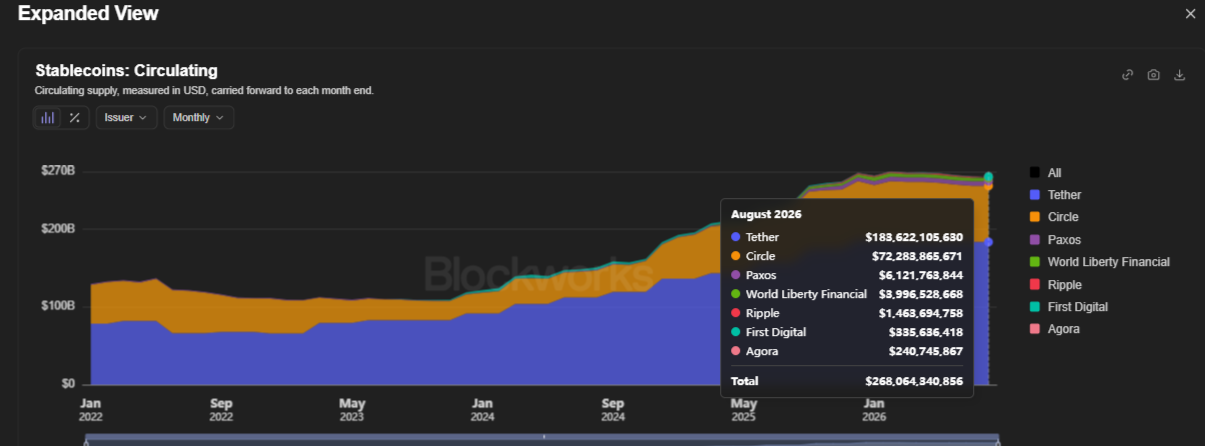
This launch arrives while the broader stablecoin market sits around the $315 billion mark as of this publication.
Tether’s USDT still commands roughly 60% of that supply and Circle’s USDC holds about a quarter.
Everyone who relies on these tokens for payments, trading or treasury management now gains an easier way to check the quality of the assets sitting behind them.

What Does the New Messari Dashboard Actually Show?
The page aggregates the latest reserve figures reported by each issuer and presents them in consistent columns.
Readers see circulating supply, total reserves, the resulting reserve ratio, the auditor, the report date and the attestation period.
Historical charts let users watch how the mix of cash, treasuries, gold or other assets has shifted over time.
In particular, the summary table currently lists USDT at roughly $184 billion circulating against $188 billion in reserves for a 102% ratio.
USDC appears near $72 billion circulating and $72 billion in reserves for a near-perfect 100% ratio.
Smaller tokens such as USD1, USDG, PYUSD and RLUSD sit in the same format so direct comparison becomes straightforward.
Why Standardised Stablecoin Reserves Tracking Matters Right Now
Different issuers publish on different schedules and use different asset categories.
One firm may emphasise short-term treasuries while another includes gold or secured loans.
Until now, an analyst had to open multiple PDFs, convert currencies and align dates by hand.
Messari’s standardised layout removes that friction.
At the same time, regulators on both sides of the Atlantic keep tightening disclosure rules.
The GENIUS Act framework in the United States and MiCA in Europe both demand clearer reserve reporting.
A single dashboard that already normalises the data helps compliance teams and risk officers move faster.
How Do Major Stablecoin Reserves Differ in Practice?
Tether continues to hold a broader mix that includes large treasury positions, some physical gold and a smaller book of secured loans.
Circle keeps almost everything inside cash, short-dated treasuries and overnight repo, much of it inside a BlackRock-managed government money-market fund.
Paxos products such as PYUSD and USDG stick closely to treasuries and cash.
Ripple’s RLUSD has shown reserve ratios above 100% in recent reports.
Looking across the full set of tokens the aggregate reserve ratio sits a bit above 101%.
That modest over-collateralisation provides a buffer, yet the composition of each buffer still varies widely.
Users who need the cleanest possible profile often lean toward tokens that disclose weekly or monthly and keep nearly all assets in cash and short treasuries.

What Risks Still Hide Inside Stablecoin Reserves?
Even well-attested reserves carry concentration risk. A large portion of USDC sits with a handful of systemically important banks and a single money-market fund.
Tether’s gold and bitcoin holdings introduce market-price swings that pure cash-and-treasuries portfolios avoid.
Custodian risk remains present for every issuer because the actual dollars or securities live at banks or clearing houses.
Beyond those structural points the timing of reports creates lag. Quarterly attestations can leave several weeks of activity unexamined.
Daily or weekly disclosures shrink that window, yet they still rely on the issuer’s own systems and the auditor’s procedures.
Frequently Asked Questions About Stablecoin Reserves and Messari’s New Tool
What exactly counts as a stablecoin reserve?
Reserves are the assets an issuer holds to back every token in circulation.
Typical holdings include bank deposits, short-term U.S. treasuries, overnight repurchase agreements and, in some cases, gold or other investments.
How often do the major issuers update their reserve numbers?
Circle publishes weekly holdings and receives monthly third-party assurance.
Tether reports quarterly through Binder Dijker Otte (BDO). Several newer tokens such as USD1 and RLUSD also follow monthly cycles.
Does a reserve ratio above 100 percent guarantee safety?
It shows the issuer holds more assets than tokens outstanding at the report date.
It does not eliminate liquidity risk, custodian risk or the possibility that certain assets could prove hard to sell quickly in a stress event.
Can ordinary users verify the numbers themselves?
Yes, most issuers post the full attestation PDFs on their websites.
Messari’s dashboard simply pulls the key figures into one place and adds historical context so users no longer need to hunt across multiple sources.
Why include smaller stablecoins such as USD1 or FDUSD?
Smaller tokens can grow quickly and sometimes adopt different reserve strategies.
Tracking them early helps the market spot emerging patterns or potential weak points before they become systemically important.
Will regulators start requiring this level of standardisation?
Both U.S. and European frameworks already push for clearer, more frequent disclosure.
Independent dashboards that normalise the data may eventually influence the exact templates issuers must follow.
The new Messari tool arrives at a moment when stablecoins sit at the centre of crypto liquidity and real-world payment experiments.
By placing reserve compositions for USDT, USDC and their peers into a single standardised format the platform gives analysts, treasurers and regulators a clearer window into the assets that keep the pegs intact.
Users who previously pieced together scattered reports can now compare quality, cadence and composition in a few clicks.
