

Zcash holders have backed a proposal to cut block times from 75 seconds to 25 seconds in a governance poll.
They also voted to keep the network’s existing halving schedule. Nearly 2.4 million ZEC took part in the Zcash Community Forum’s NU7 poll. The amount represented about 66% of the 3.6 million ZEC eligible in the Ironwood pool.
Poll organisers set one million ZEC as the minimum participation level for representative results. They closed the vote on September 14 at 19:00 UTC.
Organisers recorded eligible balances at mainnet block 3,459,350 on August 24. Only spendable shielded ZEC held in Ironwood qualified for the poll.
About 99.9% of participating ZEC supported the move to 25-second blocks. ZIP 218 contains the proposal for the shorter block time. The change would allow ZCash to produce blocks three times more often.
However, it would not increase the amount of new ZEC entering circulation each day.
ZIP 218 would reduce the reward for each block by three times after NU7 activates. The proposal sets the new block reward at 0.26041666 ZEC. This change would keep ZCash’s current issuance rate despite the shorter block time. Coinholders also rejected ZIP 234, which proposed a smoother way to issue new ZEC.
Holders representing 2,375,932.375 ZEC supported the current halving schedule. Only 22,384.875 ZEC supported the smoother issuance model. Another 4,147.625 ZEC favoured leaving issuance changes outside NU7. Holders representing 1,072.125 ZEC abstained from that vote.
Private Voting System Protects Balances During the NU7 Poll
Valar Group created a separate voting chain for the NU7 poll. The system used each participant’s ZEC holdings to calculate voting weight. However, the system did not reveal individual shielded balances alongside voting choices. At least 10 validators formed the election authority for the process.
Each validator held a separate part of the key needed to reveal the final tally. No single validator could recover voter identities using its own key share. At least two-thirds of the validators needed to combine their key shares to recover the final result. The system also used homomorphic encryption to protect individual votes.
Project Tachyon, Valar Group, the Zcash Foundation, Zodl, and Shielded Labs formed the coordinator group. Vizor and Zodl also supported the voting process through their wallets. Developers published the voting software and tally-auditing tools for public inspection. The poll used balances from Zcash’s Ironwood shielded pool.
Ironwood replaced the Orchard pool after developers disclosed a flaw that could have allowed counterfeit ZEC. The new pool added stronger controls around Zcash’s supply. The poll only measured coinholder sentiment and did not change Zcash’s consensus rules.

ZCash Holders Support 2031 NSM Recycling and a Faster NU7 Rollout
ZCash holders also backed February 2031 as the start date for recycling ZEC through the Network Sustainability Mechanism.
The option received 2,319,643.750 ZEC, which represented about 96.6% of participating ZEC. Holders representing 70,239.625 ZEC favoured starting the process sooner. Another 6,283 ZEC supported February 2027.
ZIP 235 proposes removing at least 60% of transaction fees from circulation through the NSM. The mechanism would later return those funds through future block rewards. It would do so without increasing Zcash’s maximum supply. Coinholders also supported removing unfinished features from NU7 instead of delaying the upgrade.
Meanwhile, ZEC is trading at $1,173, up 3.54% as of press time. The market cap of the coin stands at $19.79 billion, while the trading volume of the coin is up 14.43% to $1.24 billion.
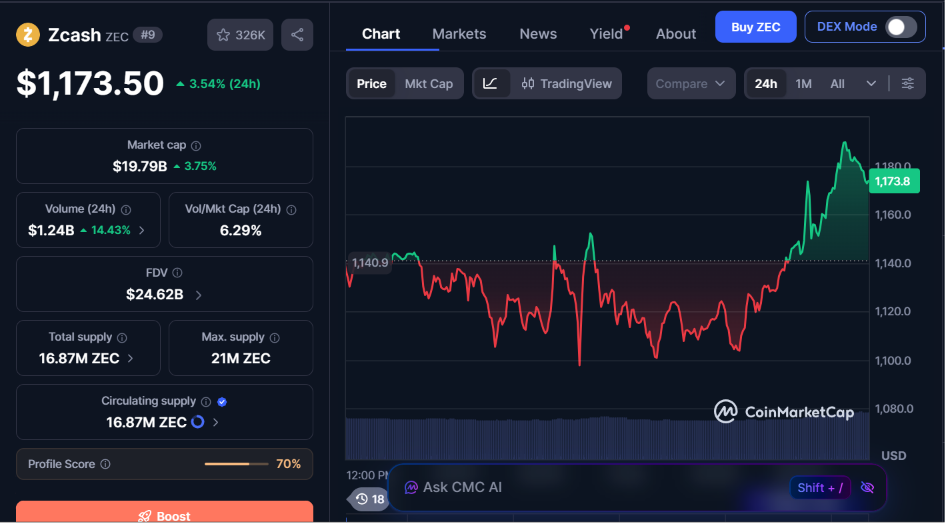
Zcash Price Chart: CoinMarketCap
